
Chapter 5
Mitigating Risk
Change Departure Time or Date
Advancing or delaying a departure may reduce risk likelihood. For example, on a day when a line of afternoon thunderstorms is forecast, a pilot could plan for an early morning departure or wait until the thunderstorms dissipate and depart late in the afternoon. For some meteorological hazards, such as an incoming low-pressure system, the pilot might choose to depart the day before originally planned.
Cancel the Flight
Canceling a flight is necessary if the pilot cannot mitigate risk sufficiently by other means. The cancellation option is easier if another means of transportation is available or if long-term rescheduling is an option.
Mitigating External Pressure Risks
External pressures can be either subtle or overt. Because it may involve passengers or others waiting for the arrival, it is best to inform them of the need for flexibility.
Local Versus Transportation Flights
A local pleasure flight can still be subject to external pressures, but it is easier to cancel than a scheduled flight related to transportation to an event. When planning a local flight with friends, for example, the pilot can reduce external pressures by telling them in advance that the flight could be canceled at the last minute due to weather or other reasons. For an IFR transportation flight, persons meeting the flight can use an application to know if the flight will arrive as planned. For a VFR flight anyone meeting the flight may wait at home and get notified after the flight arrives.
Personal Versus Business Flights
Pilots who fly business associates may feel significant external pressures. The pilot should manage passenger expectations and may plan for alternative travel options as a means to reduce risk.
Case Study
Risk Mitigation Analysis
Tricia diligently identified the hazards and assessed the risks of her proposed flight from Durango, CO to Santa Rosa, CA. She should now mitigate the high and serious risks that she identified during the assessment phase. She identified four high and five serious risks that she should attempt to mitigate by reducing risk likelihood, severity, or both.
Tricia starts by reconsidering the overall plan for this flight. She rules out making a non-stop flight because carrying the Smiths and their baggage would require a reduced fuel load, which in this case is a serious (yellow) risk. In addition, the direct route could lead to encounters with thunderstorms, icing conditions, areas of low ceilings, and high terrain. Furthermore, she realizes they should leave Monday morning, rather than Tuesday, because of the incoming front and low-pressure area. She also notes that there may be an issue with fog and low ceilings at Santa Rosa due to the coastal marine layer. This may dissipate by noon, but it is not yet possible to predict.
Tricia starts by calculating the allowable fuel load. With an empty weight of 1,903 pounds and a maximum allowable gross weight of 2,740 pounds, the useful load works out to 837 pounds. Tricia weighs 130 pounds, the Smiths together weigh 340 pounds. Together Tricia and the Smiths have 120 pounds of baggage. Tricia also has an electronic flight bag (EFB) and pilot gear totaling seven pounds. This leaves 240 pounds for fuel, which is 40 gallons. The airplane currently has 25 gallons on board.
There is a serious (yellow) hazard if making a gross weight takeoff from the Animas Air Park (00C). She decides to ask the Smiths to take a taxi to the Durango – La Plata County Airport (KDRO), which is about a ten-mile ride for them and a 7-nautical mile flight for her. It has a 9,200-foot runway. She can add 18 gallons of fuel before the short flight to Durango – La Plata County Airport, and can depart from there at gross weight, which includes 40 gallons of fuel. She plans to make one additional fuel stop.
After a thorough analysis and weather briefing, she elects to fly a southern route to avoid hazardous weather. She plans to refuel at the Barstow-Daggett, CA airport (KDAG). The 490 NM route from Durango – La Plata County Airport uses the Winslow, AZ (INW) VOR as a waypoint and should take 3 hours and 15 minutes. She will have 4 hours and 30 minutes endurance. From there, she will fly to Santa Rosa using the Palmdale, CA (PMD) VOR as a waypoint. This route is 390 NM and should take 2 hours 45 minutes with a 4 hour and 30 minute endurance. [Figure 5-1]
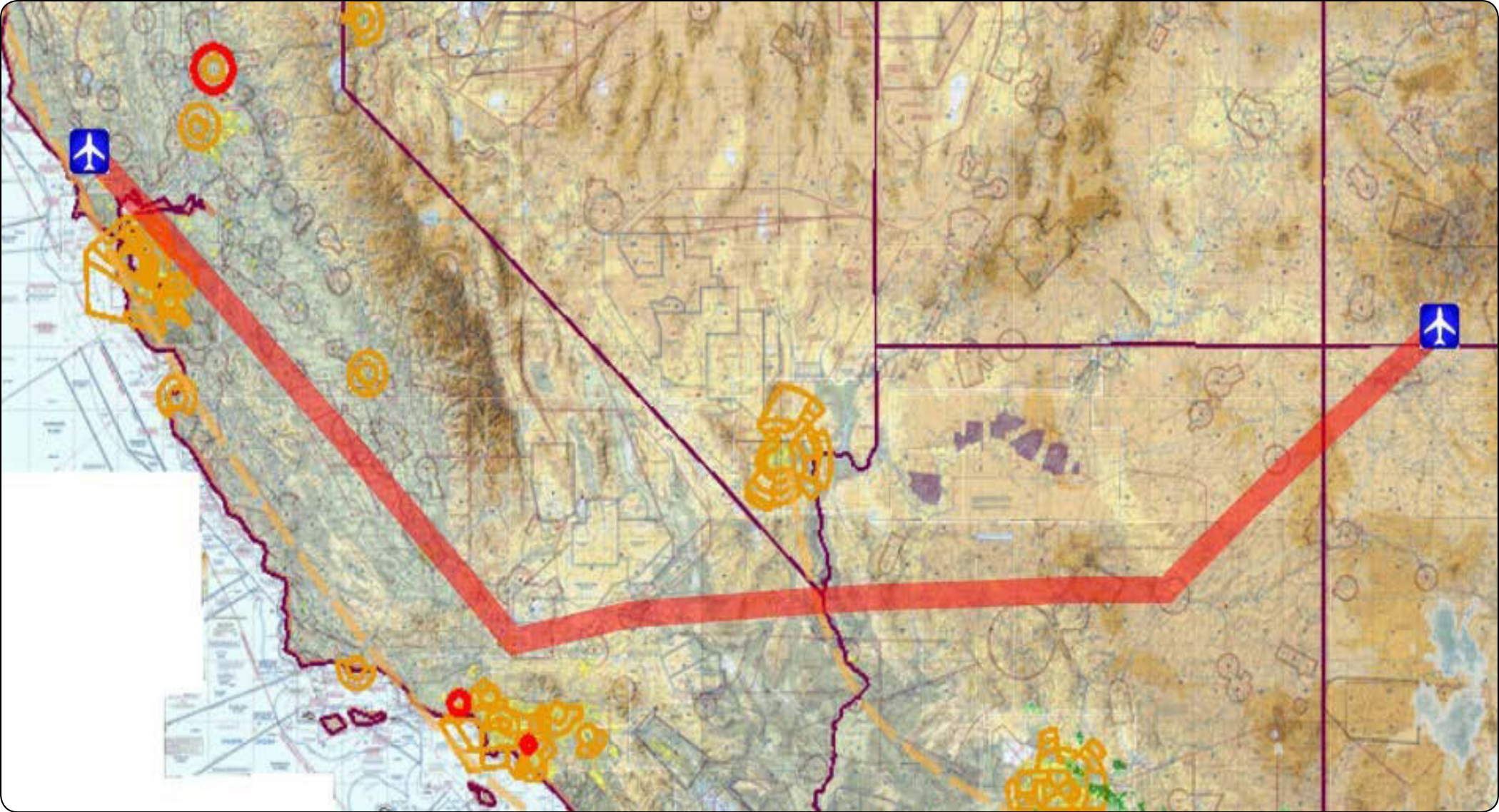
The total distance along this route is 880 NM, versus the straight-line distance of 711 NM. The additional 169 NM adds about 1 hour and 15 minutes to the total flight time.