
Chapter 5
Mitigating Risk
She mitigated the aircraft and environmental risks using this plan. She should also deal with the external pressure risks associated with leaving a day early, given the need for the Smiths to forgo the Monday festivities in Durango. An early departure also reduces the external pressures associated with making the Tuesday afternoon meetings on time. Tricia needs to explain the risk analysis to the Smiths and show them why a Monday departure is necessary.
She has concerns related to her instrument proficiency. To compensate, she decides to add 500 feet to her personal minimums for an instrument approach into Santa Rosa. This might require landing at a suitable alternate airport. With the predicted fuel load, she calculates that Sacramento Executive Airport (KSAC), 62 NM from KSTS and well inland, would be a good alternate.
She also considers pilot aeromedical risks. She will consume no alcohol, have an early dinner, and go to bed early. She also increases her intake of water. These actions should help avoid dehydration.
Having addressed all the previously identified risks, she completes the FRAT for the proposed trip, listing all of her mitigations. The completed FRAT in Figure 5-2 shows all the risks mitigated to medium or low levels. For illustrative purposes, the recalculated risk levels are shown on one sheet showing the before and after. When the conditions change significantly, such as for rescheduling or a change of aircraft, the pilot would normally redo the risk analysis using a fresh worksheet.
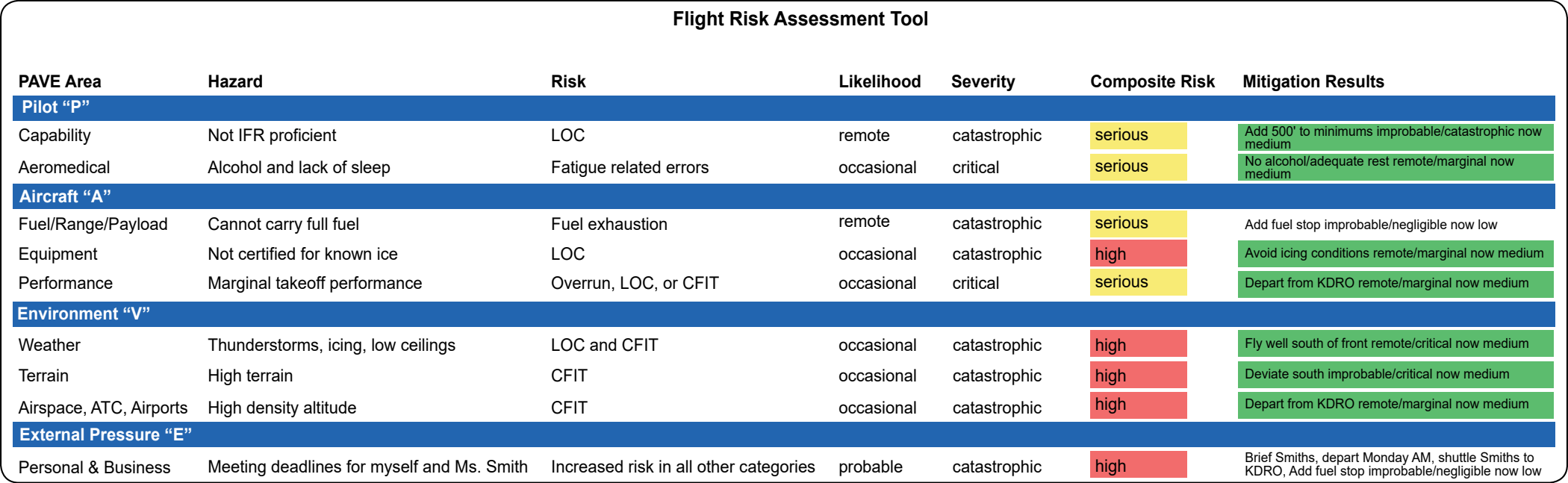
Of the nine risks assessed, she originally assessed four as high (red) and five as serious (yellow). According to her analysis and mitigations, the risk for the current plan has seven medium (green) and two low (white) risks.
Tricia meets with the Smiths. They agree with the early departure from Durango and the other mitigations. Matt Smith makes a few phone calls and returns with word that all of Monday’s festivities will go forward, but without the Smiths in attendance.
This risk mitigations used for the flight include the following:
- Adding a safety margin to personal minimums for instrument approaches;
- Abstaining from alcohol consumption, eating properly, and getting sufficient sleep;
- Reducing the departure fuel load and adding a fuel stop;
- Rescheduling to depart a day early;
- Departing with passengers from the Durango – La Plata County Airport, rather than from Animas Air Park; and
- Flying along a more southerly route to avoid weather hazards.
While on the ground in Daggett, CA for the planned fuel stop, Tricia checks the weather, which shows that the fog and low ceilings are persisting at Santa Rosa. She understands the potential consequences of slightly elevated risk if making an ILS approach with a 200- to 300-foot ceiling, and confirms her risk analysis remains valid by noting that her alternate, Sacramento Executive Airport, is reporting clear skies as forecast. She prepares her EFB for the possible diversion to Sacramento and reviews the airport information. This preparation alleviates the stress she may feel about diverting. She relieves external pressures by discussing a potential diversion with the Smiths, who indicate they will accept whatever decision she makes.
Within an hour after departure, the fog at Santa Rosa has lifted, and she executes a routine landing.
Several days later, Tricia receives a complementary note from the Smiths praising her consideration for safety.
Balanced Approach to Risk Management
The hypothetical case study used in Chapters 3 through 5 represents a moderately complex scenario covering the flight of a general aviation aircraft on a transportation flight.
It is appropriate to conduct a full risk management process for any flight, including the use of a FRAT. However, for less complex flights, such as a flight in the vicinity of the airport on a sunny day with no wind, the completion of a FRAT may not be necessary.
To enhance risk management accuracy and skill, consider the following steps:
- Take risk management and SRM courses.
- Obtain risk management training from a flight or ground instructor.
- Use a formal risk management process to reduce risk on all complex flights.
- If not using a FRAT, continue to use the PAVE checklist to identify hazards and assess and mitigate the associated risks.
Chapter Summary
Risk mitigation identifies hazards and reduces the likelihood or potential severity of associated risks. It may allow a pilot to undertake a flight that would otherwise generate unacceptable risk. In other cases, the risk mitigation process may identify high and serious risks that cannot be mitigated, which may require rescheduling, cancellation, or alternate transportation. A FRAT can enhance any risk mitigation analysis, but may not be required for simpler flights, provided the pilot has sufficient risk management skill. A brief FAA Safety Team (FAASTeam) video on risk-based decision-making summarizes many concepts ([source link](https://www.youtube.com/watch?v=pQiVosXauAk)) discussed in this chapter.