Chapter 1
Introduction to the Helicopter
Rigid Rotor System
The rigid rotor system is mechanically simple, but structurally complex because operating loads must be absorbed in bending rather than through hinges. In this system, the blades cannot flap or lead and lag, but they can be feathered.
Antitorque Systems
Tail Rotor
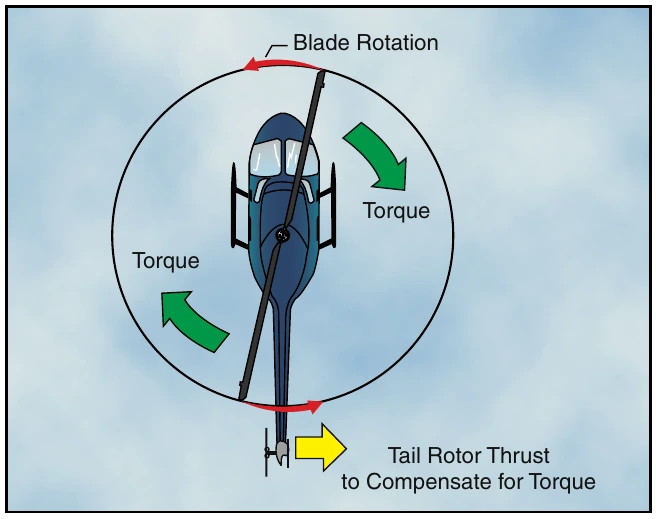
Most helicopters with a single, main rotor system require a separate rotor to overcome torque. This is accomplished through a variable pitch, antitorque rotor or tail rotor. [Figure 1-3]. You will need to vary the thrust of the antitorque system to maintain directional control whenever the main rotor torque changes, or to make heading changes while hovering.
Fenestron
Another form of antitorque rotor is the fenestron or “fan-in-tail” design. This system uses a series of rotating blades shrouded within a vertical tail. Because the blades are located within a circular duct, they are less likely to come into contact with people or objects. [Figure 1-4]
NOTAR®
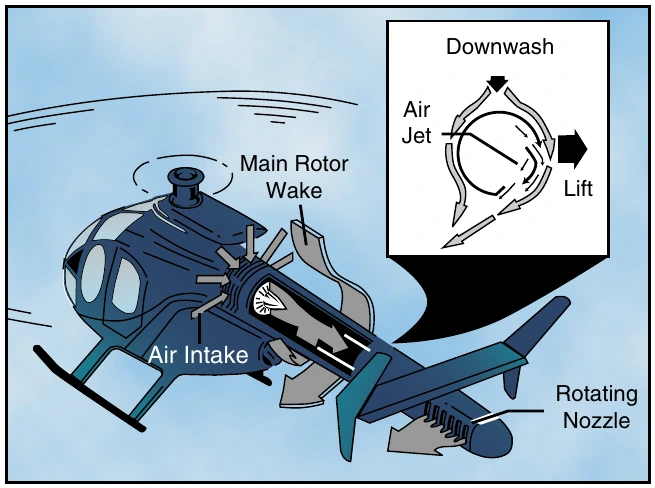
The NOTAR® system is an alternative to the antitorque rotor. The system uses low-pressure air that is forced into the tailboom by a fan mounted within the helicopter. The air is then fed through horizontal slots, located on the right side of the tailboom, and to a controllable rotating nozzle to provide antitorque and directional control. The low-pressure air coming from the horizontal slots, in conjunction with the downwash from the main rotor, creates a phenomenon called “Coanda Effect,” which produces a lifting force on the right side of the tailboom. [Figure 1-5]
Landing Gear
The most common landing gear is a skid type gear, which is suitable for landing on various types of surfaces. Some types of skid gear are equipped with dampers so touchdown shocks or jolts are not transmitted to the main rotor system. Other types absorb the shocks by the bending of the skid attachment arms.
Landing skids may be fitted with replaceable heavy-duty skid shoes to protect them from excessive wear and tear.
Helicopters can also be equipped with floats for water operations, or skis for landing on snow or soft terrain.
Wheels are another type of landing gear. They may be in a tricycle or four point configuration. Normally, the nose or tail gear is free to swivel as the helicopter is taxied on the ground.
Powerplant
A typical small helicopter has a reciprocating engine, which is mounted on the airframe. The engine can be mounted horizontally or vertically with the transmission supplying the power to the vertical main rotor shaft. [Figure 1-6]
Another engine type is the gas turbine. This engine is used in most medium to heavy lift helicopters due to its large horsepower output. The engine drives the main transmission, which then transfers power directly to the main rotor system, as well as the tail rotor.