
Chapter 10
Advanced Maneuvers
Always operate the helicopter as close to its normal capabilities as possible, taking into consideration the situation at hand. In all confined area operations, with the exception of the pinnacle operation, the angle of descent should be no steeper than necessary to clear any barrier in the approach path and still land on the selected spot. The angle of climb on takeoff should be normal, or not steeper than necessary to clear any barrier. Clearing a barrier by a few feet and maintaining normal operating r.p.m., with perhaps a reserve of power, is better than clearing a barrier by a wide margin but with a dangerously low r.p.m. and no power reserve.
Always make the landing to a specific point and not to some general area. This point should be located well forward, away from the approach end of the area. The more confined the area, the more essential it is that you land the helicopter precisely at a definite point. Keep this point in sight during the entire final approach.
When flying a helicopter near obstructions, always consider the tail rotor. A safe angle of descent over barriers must be established to ensure tail rotor clearance of all obstructions. After coming to a hover, take care to avoid turning the tail into obstructions.
Takeoff
A confined area takeoff is considered an altitude over airspeed maneuver. Before takeoff, make a ground reconnaissance to determine the type of takeoff to be performed, to determine the point from which the takeoff should be initiated to ensure the maximum amount of available area, and finally, how to best maneuver the helicopter from the landing point to the proposed takeoff position.
If wind conditions and available area permit, the helicopter should be brought to a hover, turned around, and hovered forward from the landing position to the takeoff position. Under certain conditions, sideward flight to the takeoff position may be necessary. If rearward flight is required to reach the takeoff position, place reference markers in front of the helicopter in such a way that a ground track can be safely followed to the takeoff position. In addition, the takeoff marker should be located so that it can be seen without hovering beyond it.
When planning the takeoff, consider the direction of the wind, obstructions, and forced landing areas. To help you fly up and over an obstacle, you should form an imaginary line from a point on the leading edge of the helicopter to the highest obstacle to be cleared. Fly this line of ascent with enough power to clear the obstacle by a safe distance. After clearing the obstacle, maintain the power setting and accelerate to the normal climb speed. Then, reduce power to the normal climb power setting.
Common Errors
- Failure to perform, or improper performance of, a high or low reconnaissance.
- Flying the approach angle at too steep or too shallow an approach for the existing conditions.
- Failing to maintain proper r.p.m.
- Failure to consider emergency landing areas.
- Failure to select a specific landing spot.
- Failure to consider how wind and turbulence could affect the approach.
- Improper takeoff and climb technique for existing conditions.
Pinnacle and Ridgeline Operations
A pinnacle is an area from which the surface drops away steeply on all sides. A ridgeline is a long area from which the surface drops away steeply on one or two sides, such as a bluff or precipice. The absence of obstacles does not necessarily lessen the difficulty of pinnacle or ridgeline operations. Updrafts, downdrafts, and turbulence, together with unsuitable terrain in which to make a forced landing, may still present extreme hazards.
Approach and Landing
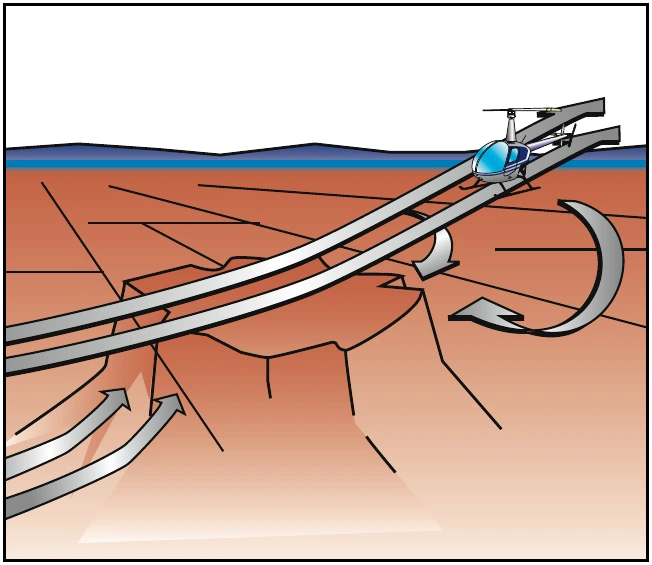
If you need to climb to a pinnacle or ridgeline, do it on the upwind side, when practicable, to take advantage of any updrafts. The approach flight path should be parallel to the ridgeline and into the wind as much as possible. [Figure 10-9]
Load, altitude, wind conditions, and terrain features determine the angle to use in the final part of an approach. As a general rule, the greater the winds, the steeper the approach needs to be to avoid turbulent air and downdrafts. Groundspeed during the approach is more difficult to judge because visual references are farther away than during approaches over trees or flat terrain. If a crosswind exists, remain clear of downdrafts on the leeward or downwind side of the ridgeline. If the wind velocity makes the crosswind landing hazardous, you may be able to make a low, coordinated turn into the wind just prior to terminating the approach. When making an approach to a pinnacle, avoid leeward turbulence and keep the helicopter within reach of a forced landing area as long as possible.
Altitude over Airspeed— In this type of maneuver, it is more important to gain altitude than airspeed. However, unless operational considerations dictate otherwise, the crosshatched or shaded areas of the height/velocity diagram should be avoided.
On landing, take advantage of the long axis of the area when wind conditions permit. Touchdown should be made in the forward portion of the area. Always perform a stability check, prior to reducing r.p.m., to ensure the landing gear is on firm terrain that can safely support the weight of the helicopter.
Takeoff
A pinnacle takeoff is an airspeed over altitude maneuver made from the ground or from a hover. Since pinnacles and ridgelines are generally higher than the immediate surrounding terrain, gaining airspeed on the takeoff is more important than gaining altitude. The higher the airspeed, the more rapid the departure from slopes of the pinnacle. In addition to covering unfavorable terrain rapidly, a higher airspeed affords a more favorable glide angle and thus contributes to the chances of reaching a safe area in the event of a forced landing. If a suitable forced landing area is not available, a higher airspeed also permits a more effective flare prior to making an autorotative landing.
On takeoff, as the helicopter moves out of ground effect, maintain altitude and accelerate to normal climb airspeed. When normal climb speed is attained, establish a normal climb attitude. Never dive the helicopter down the slope after clearing the pinnacle.