
Chapter 10
Advanced Maneuvers
After the downslope skid is on the surface, reduce the collective to full down, and neutralize the cyclic and pedals (frame 4). Normal operating r.p.m. should be maintained until the full weight of the helicopter is on the landing gear. This ensures adequate r.p.m. for immediate takeoff in case the helicopter starts sliding down the slope. Use antitorque pedals as necessary throughout the landing for heading control. Before reducing the r.p.m., move the cyclic control as necessary to check that the helicopter is firmly on the ground.
Common Errors
- Failure to consider wind effects during the approach and landing.
- Failure to maintain proper r.p.m. throughout the entire maneuver.
- Turning the tail of the helicopter into the slope.
- Lowering the downslope skid or wheel too rapidly.
- Applying excessive cyclic control into the slope, causing mast bumping.
Slope Takeoff
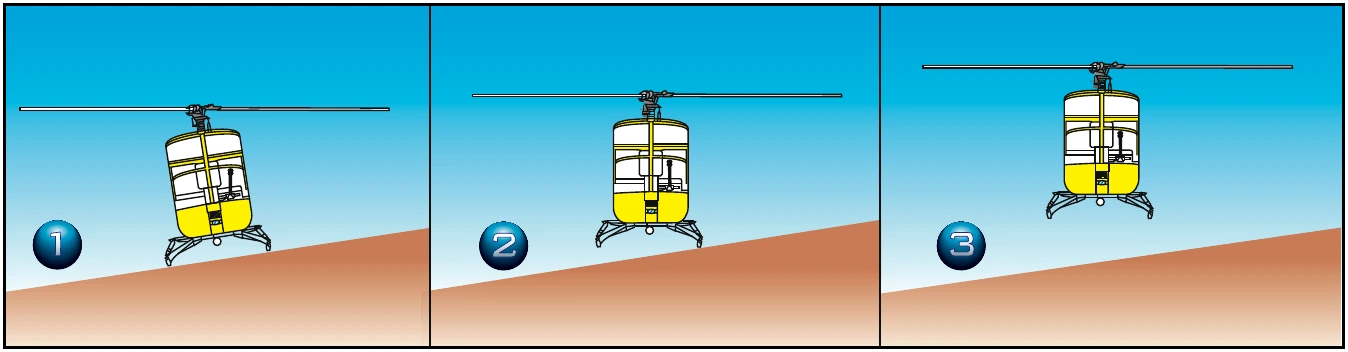
A slope takeoff is basically the reverse of a slope landing. [Figure 10-7] Conditions that may be associated with the slope, such as turbulence and obstacles, must be considered during the takeoff. Planning should include suitable forced landing areas.
Technique
Begin the takeoff by increasing r.p.m. to the normal range with the collective full down. Then, move the cyclic toward the slope (frame 1). Holding cyclic toward the slope causes the downslope skid to rise as you slowly raise the collective (frame 2). As the skid comes up, move the cyclic toward the neutral position.
If properly coordinated, the helicopter should attain a level attitude as the cyclic reaches the neutral position.
At the same time, use antitorque pedal pressure to maintain heading and throttle to maintain r.p.m. With the helicopter level and the cyclic centered, pause momentarily to verify everything is correct, and then gradually raise the collective to complete the liftoff (frame 3).
After reaching a hover, take care to avoid hitting the ground with the tail rotor. If an upslope wind exists, execute a crosswind takeoff and then make a turn into the wind after clearing the ground with the tail rotor.
Common Errors
- Failure to adjust cyclic control to keep the helicopter from sliding downslope.
- Failure to maintain proper r.p.m.
- Holding excessive cyclic into the slope as the downslope skid is raised.
- Turning the tail of the helicopter into the slope during takeoff.
Confined Area Operations
A confined area is an area where the flight of the helicopter is limited in some direction by terrain or the presence of obstructions, natural or manmade. For example, a clearing in the woods, a city street, a road, a building roof, etc., can each be regarded as a confined area. Generally, takeoffs and landings should be made into the wind to obtain maximum airspeed with minimum groundspeed.
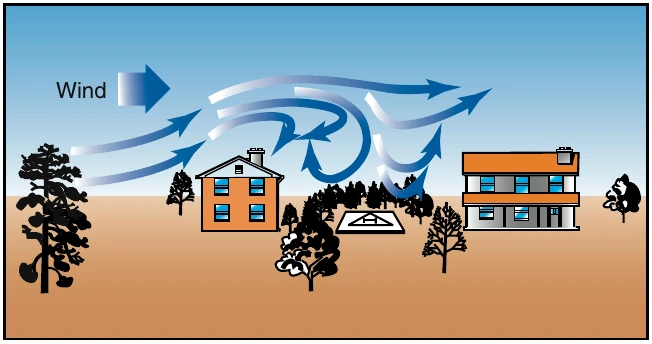
There are several things to consider when operating in confined areas. One of the most important is maintaining a clearance between the rotors and obstacles forming the confined area. The tail rotor deserves special consideration because, in some helicopters, you cannot always see it from the cabin. This not only applies while making the approach, but while hovering as well. Another consideration is that wires are especially difficult to see; however, their supporting devices, such as poles or towers, serve as an indication of their presence and approximate height. If any wind is present, you should also expect some turbulence. [Figure 10-8]
Something else for you to consider is the availability of forced landing areas during the planned approach. You should think about the possibility of flying from one alternate landing area to another throughout the approach, while avoiding unfavorable areas. Always leave yourself a way out in case the landing cannot be completed or a go-around is necessary.
Approach
A high reconnaissance should be completed before initiating the confined area approach. Start the approach phase using the wind and speed to the best possible advantage. Keep in mind areas suitable for forced landing. It may be necessary to choose between an approach that is crosswind, but over an open area, and one directly into the wind, but over heavily wooded or extremely rough terrain where a safe forced landing would be impossible. If these conditions exist, consider the possibility of making the initial phase of the approach crosswind over the open area and then turning into the wind for the final portion of the approach.