Chapter 13
Night Operations
Images that move are perceived more easily by the rod areas than by the cones in the fovea. If you have ever seen something move out of the corner of your eye, it was most likely detected by your rod receptors.
Since the cones do not function well in the dark, you may not be able to see an object if you look directly at it. The concentration of cones in the fovea can make a night blindspot at the center of your vision. To see an object clearly, you must expose the rods to the image.
This is accomplished by looking 5° to 10° off center of the object you want to see. You can try out this effect on a dim light in a darkened room. When you look directly at the light, it dims or disappears altogether. If you look slightly off center, it becomes clearer and brighter. [Figure 13-4]
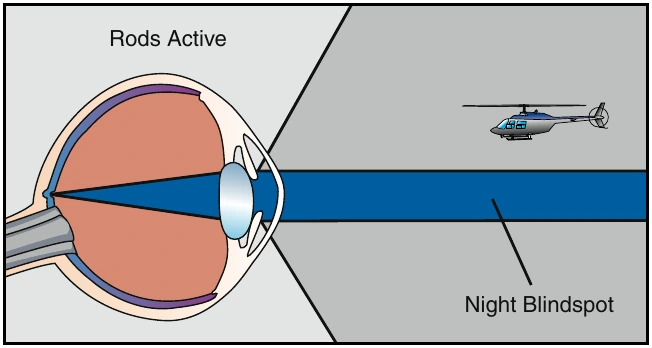
How well you see at night is determined by the rods in your eyes, as well as the amount of light allowed into your eyes. The wider the pupil is open at night, the better your night vision becomes.
Night Vision
The cones in your eyes adapt quite rapidly to changes in light intensities, but the rods do not. If you have ever walked from bright sunlight into a dark movie theater, you have experienced this dark adaptation period. The rods can take approximately 30 minutes to fully adapt to the dark. A bright light, however, can completely destroy your night adaptation and severely restrict your visual acuity.
There are several things you can do to keep your eyes adapted to the dark. The first is obvious; avoid bright lights before and during the flight. For 30 minutes before a night flight, avoid any bright light sources, such as headlights, landing lights, strobe lights, or flashlights. If you encounter a bright light, close one eye to keep it light sensitive. This allows you to see again once the light is gone. Light sensitivity also can be gained by using sunglasses if you will be flying from daylight into an area of increasing darkness.
Red cockpit lighting also helps preserve your night vision, but red light severely distorts some colors, and completely washes out the color red. This makes reading an aeronautical chart difficult. A dim white light or carefully directed flashlight can enhance your night reading ability. While flying at night, keep the instrument panel and interior lights turned up no higher than necessary. This helps you see outside visual references more easily. If your eyes become blurry, blinking more frequently often helps.
Your diet and general physical health have an impact on how well you can see in the dark. Deficiencies in vitamins A and C have been shown to reduce night acuity. Other factors, such as carbon monoxide poisoning, smoking, alcohol, certain drugs, and a lack of oxygen also can greatly decrease your night vision.
Night Scanning
Good night visual acuity is needed for collision avoidance. Night scanning, like day scanning, uses a series of short, regularly spaced eye movements in 10° sectors. Unlike day scanning, however, off-center viewing is used to focus objects on the rods rather than the fovea blindspot. When you look at an object, avoid staring at it too long. If you stare at an object without moving your eyes, the retina becomes accustomed to the light intensity and the image begins to fade. To keep it clearly visible, new areas in the retina must be exposed to the image. Small, circular eye movements help eliminate the fading. You also need to move your eyes more slowly from sector to sector than during the day to prevent blurring.
Aircraft Lighting
In order to see other aircraft more clearly, regulations require that all aircraft operating during the night hours have special lights and equipment. The requirements for operating at night are found in Title 14 of the Code of Federal Regulations (14 CFR) part 91. In addition to aircraft lighting, the regulations also provide a definition of nighttime, currency requirements, fuel reserves, and necessary electrical systems.
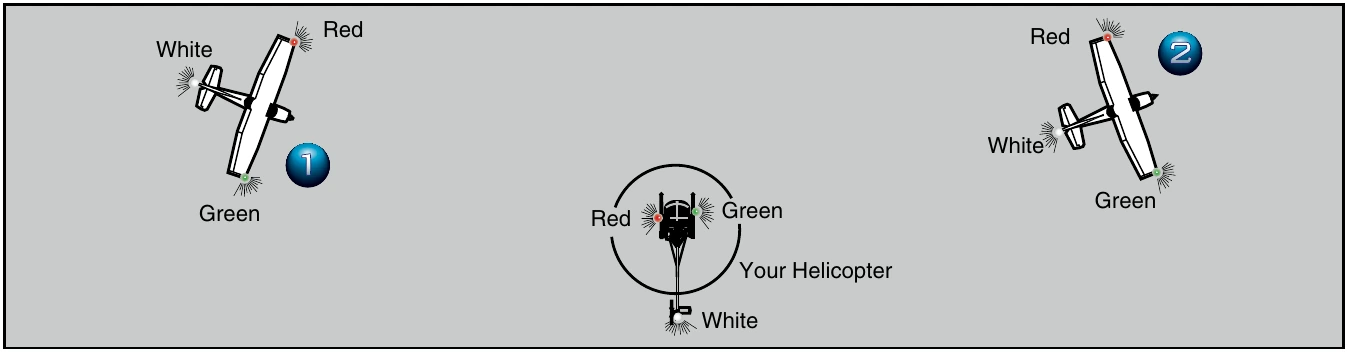
Position lights enable you to locate another aircraft, as well as help you determine its direction of flight. The approved aircraft lights for night operations are a green light on the right cabin side or wingtip, a red light on the left cabin side or wingtip, and a white position light on the tail. In addition, flashing aviation red or white anticollision lights are required for night flights. These flashing lights can be in a number of locations, but are most commonly found on the top and bottom of the cabin. [Figure 13-5]
Visual Illusions
There are many different types of visual illusions that you can experience at any time, day or night. The next few paragraphs cover some of the illusions that commonly occur at night.