
Chapter 13
Night Operations
Autokinesis is caused by staring at a single point of light against a dark background, such as a ground light or bright star, for more than a few seconds. After a few moments, the light appears to move on its own. To prevent this illusion, you should focus your eyes on objects at varying distances and not fixate on one target, as well as maintain a normal scan pattern.
Night Myopia
Another problem associated with night flying is night myopia, or night-induced nearsightedness. With nothing to focus on, your eyes automatically focus on a point just slightly ahead of your aircraft. Searching out and focusing on distant light sources, no matter how dim, helps prevent the onset of night myopia.
False Horizon
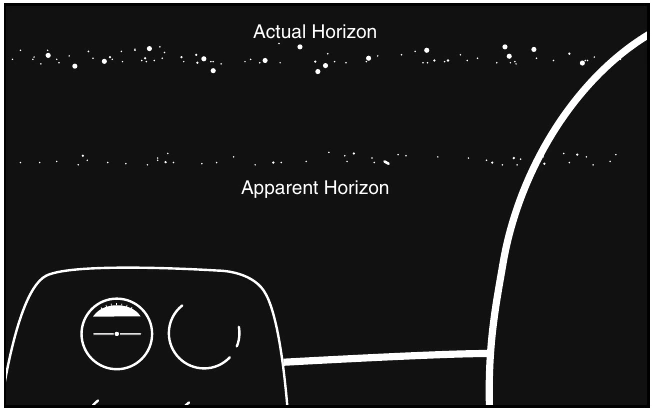
A false horizon can occur when the natural horizon is obscured or not readily apparent. It can be generated by confusing bright stars and city lights. [Figure 13-6] It can also occur while you are flying toward the shore of an ocean or a large lake. Because of the relative darkness of the water, the lights along the shoreline can be mistaken for the stars in the sky. [Figure 13-7]
Landing Illusions
Landing illusions occur in many forms. Above featureless terrain at night, there is a natural tendency to fly a lower-than-normal approach. Elements that cause any type of visual obscuration, such as rain, haze, or a dark runway environment also can cause low approaches.
Bright lights, steep surrounding terrain, and a wide runway can produce the illusion of being too low, with a tendency to fly a higher-than-normal approach.
Night Flight
The night flying environment and the techniques you use when flying at night, depend on outside conditions.
Flying on a bright, clear, moonlit evening when the visibility is good and the wind is calm, is not much different from flying during the day. However, if you are flying on an overcast night over a sparsely populated area, with little or no outside lights from the ground, the situation is quite different. Visibility is restricted so you have to be more alert in steering clear of obstructions and low clouds. Your options are also limited in the event of an emergency, as it is more difficult to find a place to land and determine wind direction and speed. At night, you have to rely more heavily on the aircraft systems, such as lights, flight instruments, and navigation equipment. As a precaution, if the visibility is limited or outside references are inadequate, you should strongly consider delaying the flight until conditions improve, unless you have received training in instrument flight and your helicopter has the appropriate instrumentation and equipment.
Preflight
The preflight inspection is performed in the usual manner, except it should be done in a well lit area or with a flashlight. Careful attention must be paid to the aircraft electrical system. In helicopters equipped with fuses, a spare set is required by regulation, and common sense, so make sure they are onboard. If the helicopter is equipped with circuit breakers, check to see that they are not tripped. A tripped circuit breaker may be an indication of an equipment malfunction. Reset it and check the associated equipment for proper operation.
Check all the interior lights, especially the instrument and panel lights. The panel lighting can usually be controlled with a rheostat or dimmer switch, allowing you to adjust the intensity. If the lights are too bright, a glare may reflect off the windshield creating a distraction.
Always carry a flashlight with fresh batteries to provide an alternate source of light if the interior lights malfunction.
All aircraft operating between sunset and sunrise are required to have operable navigation lights. Turn these lights on during the preflight to inspect them visually for proper operation. Between sunset and sunrise, theses lights must be on any time the engine is running.
All recently manufactured aircraft certified for night flight, must have an anticollision light that makes the aircraft more visible to other pilots. This light is either a red or white flashing light and may be in the form of a rotating beacon or a strobe. While anticollision lights are required for night VFR flights, they may be turned off any time they create a distraction for the pilot.
One of the first steps in preparation for night flight is becoming thoroughly familiar with the helicopter’s cockpit, instrumentation and control layout. It is recommended that you practice locating each instrument, control, and switch, both with and without cabin lights.
Since the markings on some switches and circuit breaker panels may be hard to read at night, you should assure yourself that you are able to locate and use these devices, and read the markings in poor light conditions.