
Chapter 16
Aerodynamics of the Gyroplane
Rotor Force
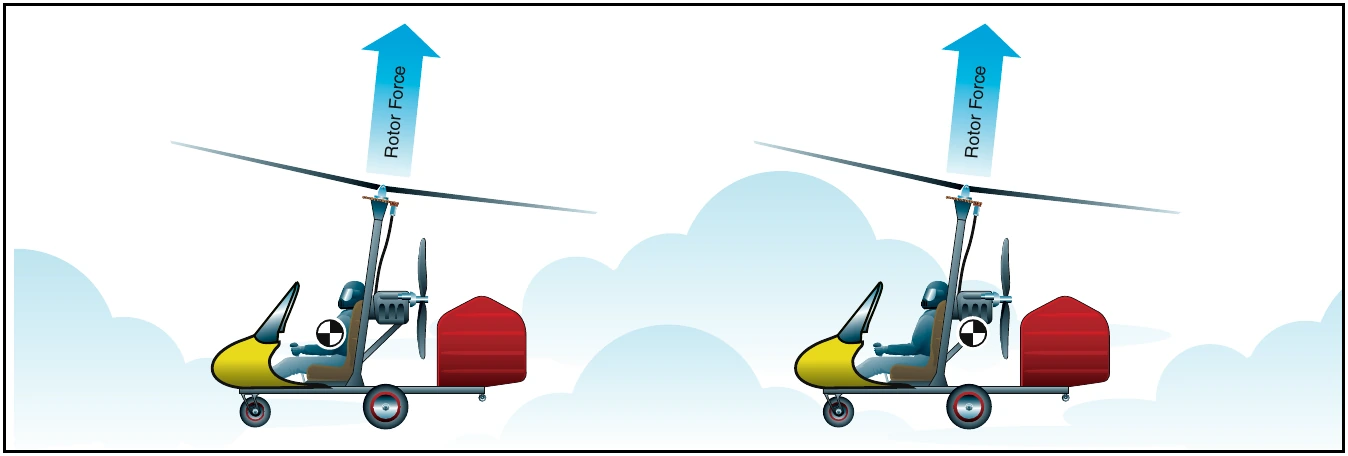
Because some gyroplanes do not have horizontal stabilizers, and the propeller thrust lines are different, gyroplane manufacturers can achieve the desired stability by placing the center of gravity in front of or behind the rotor force line. [Figure 16-10]
Suppose the CG is located behind the rotor force line in forward flight. If a gust of wind increases the angle of attack, rotor force increases. There is also an increase in the difference between the lift produced on the advancing and retreating blades. This increases the flapping angle and causes the rotor to pitch up. This pitching action increases the moment around the center of gravity, which leads to a greater increase in the angle of attack. The result is an unstable condition.
If the CG is in front of the rotor force line, a gust of wind, which increases the angle of attack, causes the rotor disc to react the same way, but now the increase in rotor force and blade flapping decreases the moment. This tends to decrease the angle of attack, and creates a stable condition.
Trimmed Condition
As was stated earlier, manufacturers use a combination of the various stability factors to achieve a trimmed gyroplane. For example, if you have a gyroplane where the CG is below the propeller thrust line, the propeller thrust gives your aircraft a nose down pitching moment when power is applied. To compensate for this pitching moment, the CG, on this type of gyroplane, is usually located behind the rotor force line. This location produces a nose up pitching moment.
Conversely, if the CG is above the propeller thrust line, the CG is usually located ahead of the rotor force line.
Of course, the location of fuselage drag, the pitch inertia, and the addition of a horizontal stabilizer can alter where the center of gravity is placed.
Blade Flapping— The upward or downward movement of the rotor blades during rotation.