
Chapter 19
Rotorcraft Flight Manual (Gyroplane)
As with most certificated aircraft manufactured after March 1979, FAA-certificated gyroplanes are required to have an approved flight manual. The flight manual describes procedures and limitations that must be adhered to when operating the aircraft. Specification for Pilot’s Operating Handbook, published by the General Aviation Manufacturers Association (GAMA), provides a recommended format that more recent gyroplane flight manuals follow. [Figure 19-1]
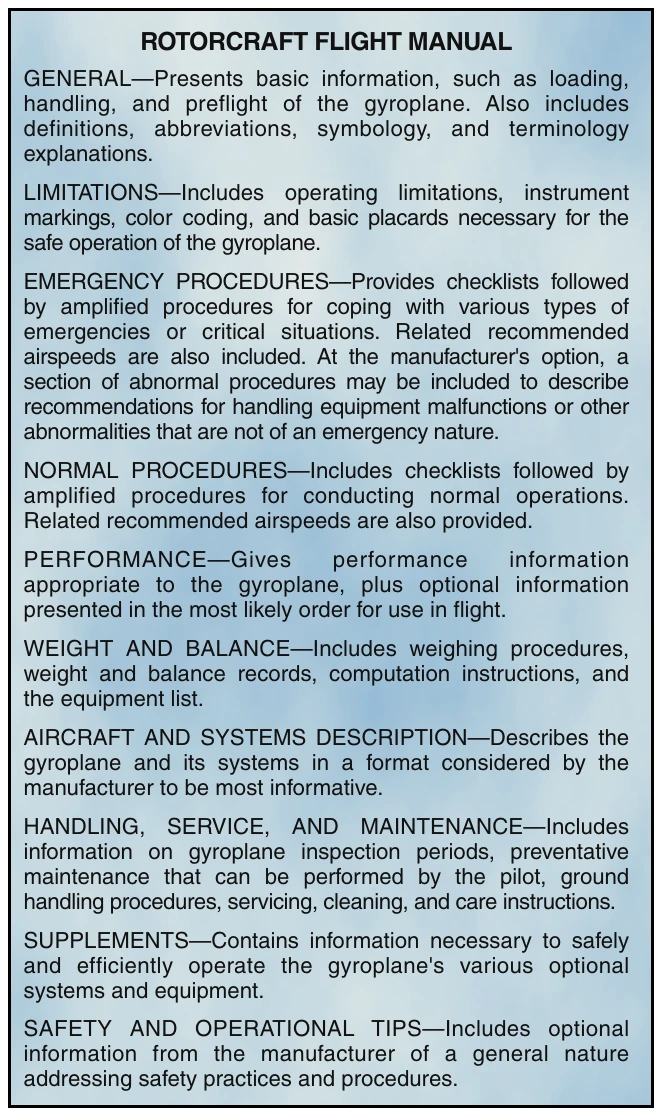
This format is the same as that used by helicopters, which is explained in depth in Chapter 6—Rotorcraft Flight Manual (Helicopter).
Amateur-built gyroplanes may have operating limitations but are not normally required to have an approved flight manual. One exception is an exemption granted by the FAA that allows the commercial use of two-place, amateur-built gyroplanes for instructional purposes. One of the conditions of this exemption is to have an approved flight manual for the aircraft. This manual is to be used for training purposes, and must be carried in the gyroplane at all times.
Using the Flight Manual
The flight manual is required to be on board the aircraft to guarantee that the information contained therein is readily available. For the information to be of value, you must be thoroughly familiar with the manual and be able to read and properly interpret the various charts and tables.
Weight and Balance Section
The weight and balance section of the flight manual contains information essential to the safe operation of the gyroplane. Careful consideration must be given to the weight of the passengers, baggage, and fuel prior to each flight. In conducting weight and balance computations, many of the terms and procedures are similar to those used in helicopters. These are further explained in Chapter 7—Weight and Balance. In any aircraft, failure to adhere to the weight and balance limitations prescribed by the manufacturer can be extremely hazardous.
Sample Problem
As an example of a weight and balance computation, assume a sightseeing flight in a two-seat, tandem-configured gyroplane with two people aboard. The pilot, seated in the front, weighs 175 pounds while the rear seat passenger weighs 160 pounds. For the purposes of this example, there will be no baggage carried. The basic empty weight of the aircraft is 1,315 pounds with a moment, divided by 1,000, of 153.9 pound-inches.
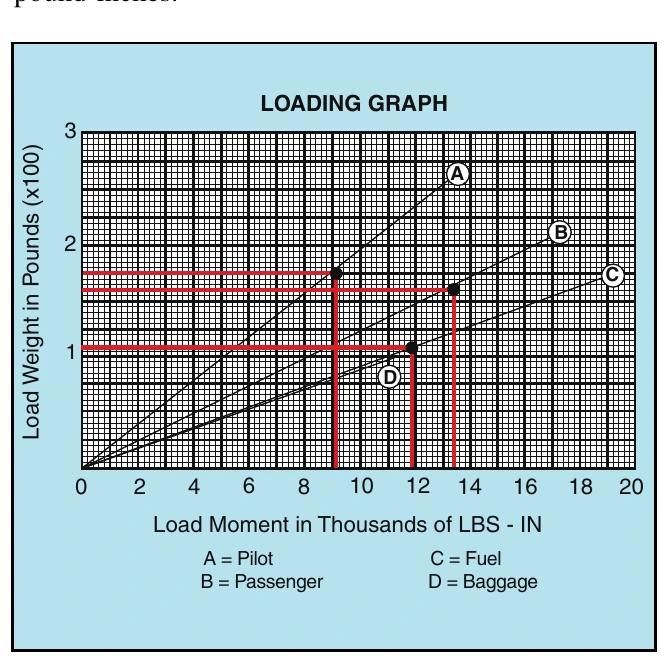
Using the loading graph [Figure 19-2], the moment/1000 of the pilot is found to be 9.1 pound-inches, and the passenger has a moment/1000 of 13.4 pound-inches.
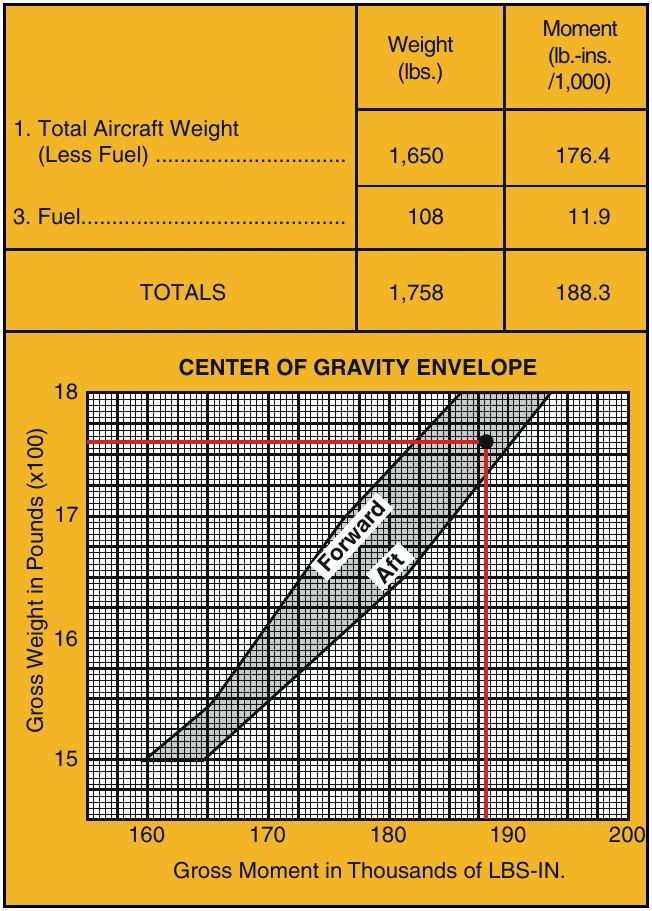
Adding these figures, the total weight of the aircraft for this flight (without fuel) is determined to be 1,650 pounds with a moment/1000 of 176.4 pound-inches. [Figure 19-3]
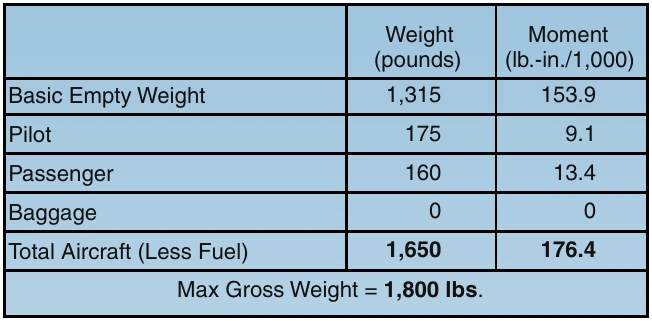
The maximum gross weight for the sample aircraft is 1,800 pounds, which allows up to 150 pounds to be carried in fuel. For this flight, 18 gallons of fuel is deemed sufficient. Allowing six pounds per gallon of fuel, the fuel weight on the aircraft totals 108 pounds. Referring again to the loading graph [Figure 19-2], 108 pounds of fuel would have a moment/1000 of 11.9 pound-inches.
This is added to the previous totals to obtain the total aircraft weight of 1,758 pounds and a moment/1000 of 188.3. Locating this point on the center of gravity envelope chart [Figure 19-4], shows that the loading is within the prescribed weight and balance limits.
Performance Section
The performance section of the flight manual contains data derived from actual flight testing of the aircraft.
Because the actual performance may differ, it is prudent to maintain a margin of safety when planning operations using this data.