
Chapter 2
General Aerodynamics
Parasite drag is present any time the helicopter is moving through the air. This type of drag increases with airspeed.
Nonlifting components of the helicopter, such as the cabin, rotor mast, tail, and landing gear, contribute to parasite drag. Any loss of momentum by the airstream, due to such things as openings for engine cooling, creates additional parasite drag. Because of its rapid increase with increasing airspeed, parasite drag is the major cause of drag at higher airspeeds. Parasite drag varies with the square of the velocity. Doubling the airspeed increases the parasite drag four times.
Total Drag
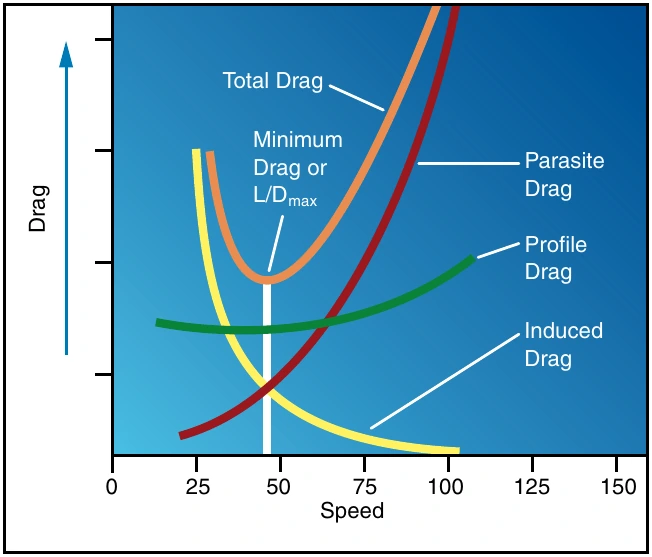
Total drag for a helicopter is the sum of all three drag forces. [Figure 2-14] As airspeed increases, parasite drag increases, while induced drag decreases. Profile drag remains relatively constant throughout the speed range with some increase at higher airspeeds.
Combining all drag forces results in a total drag curve.
The low point on the total drag curve shows the airspeed at which drag is minimized. This is the point where the lift-to-drag ratio is greatest and is referred to as L/D_MAX. At this speed, the total lift capacity of the helicopter, when compared to the total drag of the helicopter, is most favorable. This is important in helicopter performance.
L/D_MAX— The maximum ratio between total lift (L) and the total drag (D). This point provides the best glide speed. Any deviation from best glide speed increases drag and reduces the distance you can glide.