
Chapter 21
Gyroplane Emergencies
Gyroplanes are quite reliable, however emergencies do occur, whether a result of mechanical failure or pilot error. By having a thorough knowledge of the gyroplane and its systems, you will be able to more readily handle the situation. In addition, by knowing the conditions which can lead to an emergency, many potential accidents can be avoided.
Aborted Takeoff
Prior to every takeoff, consideration must be given to a course of action should the takeoff become undesirable or unsafe. Mechanical failures, obstructions on the takeoff surface, and changing weather conditions are all factors that could compromise the safety of a takeoff and constitute a reason to abort. The decision to abort a takeoff should be definitive and made as soon as an unsafe condition is recognized. By initiating the abort procedures early, more time and distance will be available to bring the gyroplane to a stop. A late decision to abort, or waiting to see if it will be necessary to abort, can result in a dangerous situation with little time to respond and very few options available.
When initiating the abort sequence prior to the gyroplane leaving the surface, the procedure is quite simple. Reduce the throttle to idle and allow the gyroplane to decelerate, while slowly applying aft cyclic for aerodynamic braking. This technique provides the most effective braking and slows the aircraft very quickly. If the gyroplane has left the surface when the decision to abort is made, reduce the throttle until an appropriate descent rate is achieved. Once contact with the surface is made, reduce the throttle to idle and apply aerodynamic braking as before. The wheel brakes, if the gyroplane is so equipped, may be applied, as necessary, to assist in slowing the aircraft.
Accelerate/Stop Distance
An accelerate/stop distance is the length of ground roll an aircraft would require to accelerate to takeoff speed and, assuming a decision to abort the takeoff is made, bring the aircraft safely to a stop. This value changes for a given aircraft based on atmospheric conditions, the takeoff surface, aircraft weight, and other factors affecting performance. Knowing the accelerate/stop value for your gyroplane can be helpful in planning a safe takeoff, but having this distance available does not necessarily guarantee a safe aborted takeoff is possible for every situation. If the decision to abort is made after liftoff, for example, the gyroplane will require considerably more distance to stop than the accelerate/stop figure, which only considers the ground roll requirement. Planning a course of action for an abort decision at various stages of the takeoff is the best way to ensure the gyroplane can be brought safely to a stop should the need arise.
For a gyroplane without a flight manual or other published performance data, the accelerate/stop distance can be reasonably estimated once you are familiar with the performance and takeoff characteristics of the aircraft. For a more accurate figure, you can accelerate the gyroplane to takeoff speed, then slow to a stop, and note the distance used. Doing this several times gives you an average accelerate/stop distance. When performance charts for the aircraft are available, as in the flight manual of a certificated gyroplane, accurate accelerate/stop distances under various conditions can be determined by referring to the ground roll information contained in the charts.
Lift-off at Low Airspeed and High Angle of Attack
Because of ground effect, your gyroplane might be able to become airborne at an airspeed less than minimum level flight speed. In this situation, the gyroplane is flying well behind the power curve and at such a high angle of attack that unless a correction is made, there will be little or no acceleration toward best climb speed. This condition is often encountered in gyroplanes capable of jump takeoffs. Jumping without sufficient rotor inertia to allow enough time to accelerate through minimum level flight speed, usually results in your gyroplane touching down after liftoff. If you do touch down after performing a jump takeoff, you should abort the takeoff.
During a rolling takeoff, if the gyroplane is forced into the air too early, you could get into the same situation.
It is important to recognize this situation and take immediate corrective action. You can either abort the takeoff, if enough runway exists, or lower the nose and accelerate to the best climb speed. If you choose to continue the takeoff, verify that full power is applied, then, slowly lower the nose, making sure the gyroplane does not contact the surface. While in ground effect, accelerate to the best climb speed. Then, adjust the nose pitch attitude to maintain that airspeed.
Common Errors
The following errors might occur when practicing a lift-off at a low airspeed.
- Failure to check rotor for proper operation, track, and r.p.m. prior to initiating takeoff.
- Use of a power setting that does not simulate a “behind the power curve” situation.
- Poor directional control.
- Rotation at a speed that is inappropriate for the maneuver.
- Poor judgement in determining whether to abort or continue takeoff.
- Failure to establish and maintain proper climb attitude and airspeed, if takeoff is continued.
- Not maintaining the desired ground track during the climb.
Pilot-Induced Oscillation (PIO)
Pilot-induced oscillation, sometimes referred to as porpoising, is an unintentional up-and-down oscillation of the gyroplane accompanied with alternating climbs and descents of the aircraft. PIO is often the result of an inexperienced pilot overcontrolling the gyroplane, but this condition can also be induced by gusty wind conditions. While this condition is usually thought of as a longitudinal problem, it can also happen laterally.
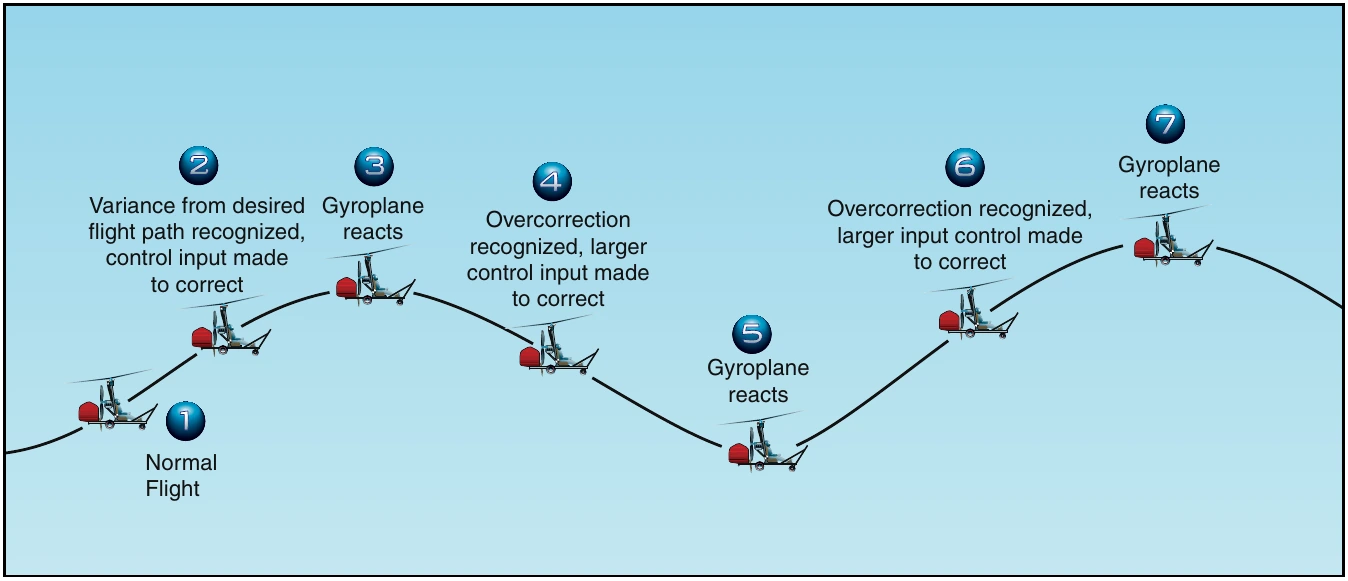
As with most other rotor-wing aircraft, gyroplanes experience a slight delay between control input and the reaction of the aircraft. This delay may cause an inexperienced pilot to apply more control input than required, causing a greater aircraft response than was desired. Once the error has been recognized, opposite control input is applied to correct the flight attitude.
Because of the nature of the delay in aircraft response, it is possible for the corrections to be out of synchronization with the movements of the aircraft and aggravate the undesired changes in attitude. The result is PIO, or unintentional oscillations that can grow rapidly in magnitude. [Figure 21-1]
In gyroplanes with an open cockpit and limited flight instruments, it can be difficult for an inexperienced pilot to recognize a level flight attitude due to the lack of visual references. As a result, PIO can develop as the pilot chases a level flight attitude and introduces climbing and descending oscillations. PIO can also develop if a wind gust displaces the aircraft, and the control inputs made to correct the attitude are out of phase with the aircraft movements. Because the rotor disc angle decreases at higher speeds and cyclic control becomes more sensitive, PIO is more likely to occur and can be more pronounced at high airspeeds. To minimize the possibility of PIO, avoid high-speed flight in gusty conditions, and make only small control inputs. After making a control input, wait briefly and observe the reaction of the aircraft before making another input. If PIO is encountered, reduce power and place the cyclic in the position for a normal climb. Once the oscillations have stopped, slowly return the throttle and cyclic to their normal positions. The likelihood of encountering PIO decreases greatly as experience is gained, and the ability to subconsciously anticipate the reactions of the gyroplane to control inputs is developed.