
Chapter 9
Basic Flight Maneuvers
This training maneuver requires you to fly constant radius turns around a preselected point on the ground using a bank of approximately 30°, while maintaining a constant altitude. [Figure 9-17] Your objective, as in other ground reference maneuvers, is to develop the ability to subconsciously control the helicopter while dividing attention between the flight path and ground references, while still watching for other air traffic in the vicinity.
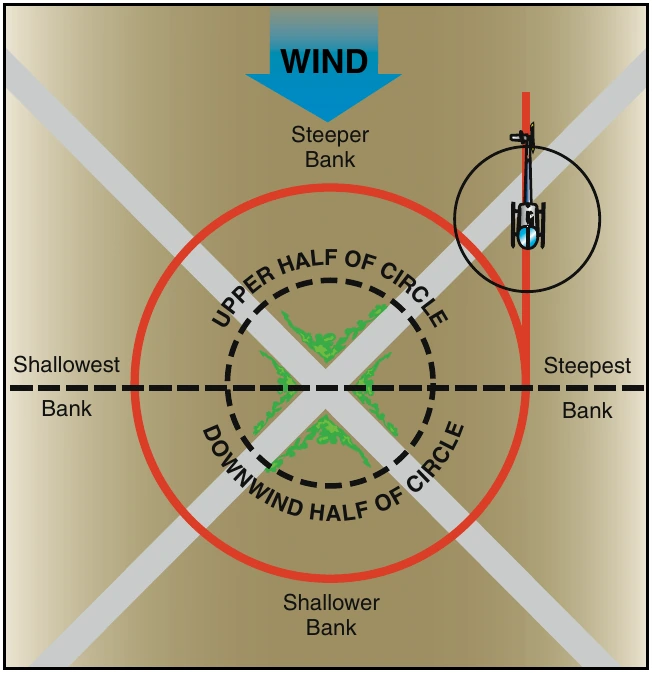
The factors and principles of drift correction that are involved in S-turns are also applicable in this maneuver. As in other ground track maneuvers, a constant radius around a point will, if any wind exists, require a constantly changing angle of bank and angles of wind correction. The closer the helicopter is to a direct downwind heading where the groundspeed is greatest, the steeper the bank, and the faster the rate of turn required to establish the proper wind correction angle. The more nearly it is to a direct upwind heading where the groundspeed is least, the shallower the bank, and the slower the rate of turn required to establish the proper wind correction angle. It follows, then, that throughout the maneuver, the bank and rate of turn must be gradually varied in proportion to the groundspeed.
The point selected for turns around a point should be prominent and easily distinguishable, yet small enough to present a precise reference. Isolated trees, crossroads, or other similar small landmarks are usually suitable.
The point should be in an area away from communities, livestock, or groups of people on the ground to prevent possible annoyance or hazard to others. Since the maneuver is performed between 600 and 1,000 feet AGL, the area selected should also afford an opportunity for a safe emergency autorotation in the event it becomes necessary.
To enter turns around a point, fly the helicopter on a downwind heading to one side of the selected point at a distance equal to the desired radius of turn. When any significant wind exists, it is necessary to roll into the initial bank at a rapid rate so that the steepest bank is attained abeam the point when the helicopter is headed directly downwind. By entering the maneuver while heading directly downwind, the steepest bank can be attained immediately. Thus, if a bank of 30° is desired, the initial bank is 30° if the helicopter is at the correct distance from the point. Thereafter, the bank is gradually shallowed until the point is reached where the helicopter is headed directly upwind. At this point, the bank is gradually steepened until the steepest bank is again attained when heading downwind at the initial point of entry.
Just as S-turns require that the helicopter be turned into the wind in addition to varying the bank, so do turns around a point. During the downwind half of the circle, the helicopter’s nose must be progressively turned toward the inside of the circle; during the upwind half, the nose must be progressively turned toward the outside. The downwind half of the turn around the point may be compared to the downwind side of the S-turn, while the upwind half of the turn around a point may be compared to the upwind side of the S-turn.
As you become experienced in performing turns around a point and have a good understanding of the effects of wind drift and varying of the bank angle and wind correction angle as required, entry into the maneuver may be from any point. When entering this maneuver at any point, the radius of the turn must be carefully selected, taking into account the wind velocity and groundspeed so that an excessive bank is not required later on to maintain the proper ground track.
Common Errors During Ground Reference Maneuvers
- Faulty entry technique.
- Poor planning, orientation, or division of attention.
- Uncoordinated flight control application.
- Improper correction for wind drift.
- An unsymmetrical ground track during S-Turns Across a Road.
- Failure to maintain selected altitude or airspeed.
- Selection of a ground reference where there is no suitable emergency landing area within gliding distance.
Traffic Patterns
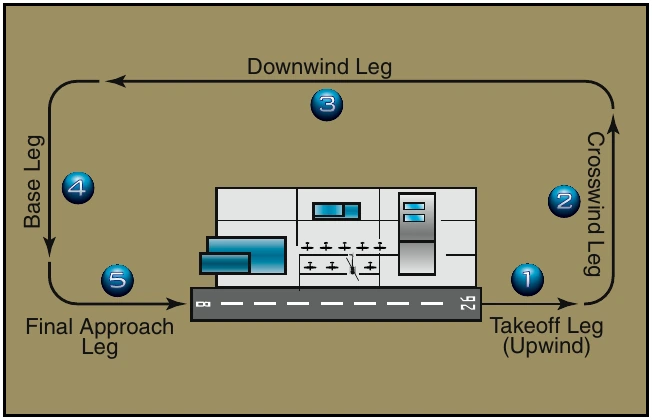
A traffic pattern is useful to control the flow of traffic, particularly at airports without operating control towers. It affords a measure of safety, separation, protection, and administrative control over arriving, departing, and circling aircraft. Due to specialized operating characteristics, airplanes and helicopters do not mix well in the same traffic environment. At multiple-use airports, you routinely must avoid the flow of fixed-wing traffic. To do this, you need to be familiar with the patterns typically flown by airplanes. In addition, you should learn how to fly these patterns in case air traffic control (ATC) requests that you fly a fixed-wing traffic pattern.
A normal traffic pattern is rectangular, has five named legs, and a designated altitude, usually 600 to 1,000 feet AGL. A pattern in which all turns are to the left is called a standard pattern. [Figure 9-18] The takeoff leg (item 1) normally consists of the aircraft’s flight path after takeoff. This leg is also called the upwind leg. You should turn to the crosswind leg (item 2), after passing the departure end of the runway when you are at a safe altitude. Fly the downwind leg (item 3) parallel to the runway at the designated traffic pattern altitude and distance from the runway. Begin the base leg (item 4) at a point selected according to other traffic and wind conditions. If the wind is very strong, begin the turn sooner than normal. If the wind is light, delay the turn to base. The final approach (item 5) is the path the aircraft flies immediately prior to touchdown.
You may find variations at different localities and at airports with operating control towers. For example, a right-hand pattern may be designated to expedite the flow of traffic when obstacles or highly populated areas make the use of a left-hand pattern undesirable.
When approaching an airport with an operating control tower in a helicopter, it is possible to expedite traffic by stating your intentions, for example:
- (Call sign of helicopter) Robinson 8340J.
- (Position) 10 miles west.
- (Request) for landing and hover to...
In order to avoid the flow of fixed-wing traffic, the tower will often clear you direct to an approach point or to a particular runway intersection nearest your destination point. At uncontrolled airports, if at all possible, you should adhere to standard practices and patterns.
Traffic pattern entry procedures at airports with an operating control tower are specified by the controller.
At uncontrolled airports, traffic pattern altitudes and entry procedures may vary according to established local procedures. The general procedure is for you to enter the pattern at a 45° angle to the downwind leg abeam the midpoint of the runway. For information concerning traffic pattern and landing direction, you should utilize airport advisory service or UNICOM, when available.