
Chapter 9
Basic Flight Maneuvers
The standard departure procedure when using the fixed-wing traffic pattern is usually straight-out, downwind, or a right-hand departure. When a control tower is in operation, you can request the type of departure you desire. In most cases, helicopter departures are made into the wind unless obstacles or traffic dictate otherwise. At airports without an operating control tower, you must comply with the departure procedures established for that airport.
Approaches
An approach is the transition from traffic pattern altitude to either a hover or to the surface. The approach should terminate at the hover altitude with the rate of descent and groundspeed reaching zero at the same time. Approaches are categorized according to the angle of descent as normal, steep, or shallow. In this chapter we will concentrate on the normal approach. Steep and shallow approaches are discussed in the next chapter.
You should use the type of approach best suited to the existing conditions. These conditions may include obstacles, size and surface of the landing area, density altitude, wind direction and speed, and weight.
Regardless of the type of approach, it should always be made to a specific, predetermined landing spot.
Normal Approach to a Hover
A normal approach uses a descent profile of between 8° and 12° starting at approximately 300 feet AGL.
Technique
On final approach, at the recommended approach airspeed and at approximately 300 feet AGL, align the helicopter with the point of intended touchdown.
[Figure 9-19] After intercepting an approach angle of 8° to 12°, begin the approach by lowering the collective sufficiently to get the helicopter decelerating and descending down the approach angle. With the decrease in the collective, the nose tends to pitch down, requiring aft cyclic to maintain the recommended approach airspeed attitude. Adjust antitorque pedals, as necessary, to maintain longitudinal trim. You can determine the proper approach angle by relating the point of intended touchdown to a point on the helicopter windshield. The collective controls the angle of approach. If the touchdown point seems to be moving up on the windshield, the angle is becoming shallower, necessitating a slight increase in collective. If the touchdown point moves down on the windshield, the approach angle is becoming steeper, requiring a slight decrease in collective. Use the cyclic to control the rate of closure or how fast your are moving toward the touchdown point. Maintain entry airspeed until the apparent groundspeed and rate of closure appear to be increasing. At this point, slowly begin decelerating with slight aft cyclic, and smoothly lower the collective to maintain approach angle. Use the cyclic to maintain a rate of closure equivalent to a brisk walk.
At approximately 25 to 40 feet AGL, depending on wind, the helicopter begins to lose effective translational lift. To compensate for loss of effective translational lift, you must increase the collective to maintain the approach angle, while maintaining the proper r.p.m. The increase of collective pitch tends to make the nose rise, requiring forward cyclic to maintain the proper rate of closure.
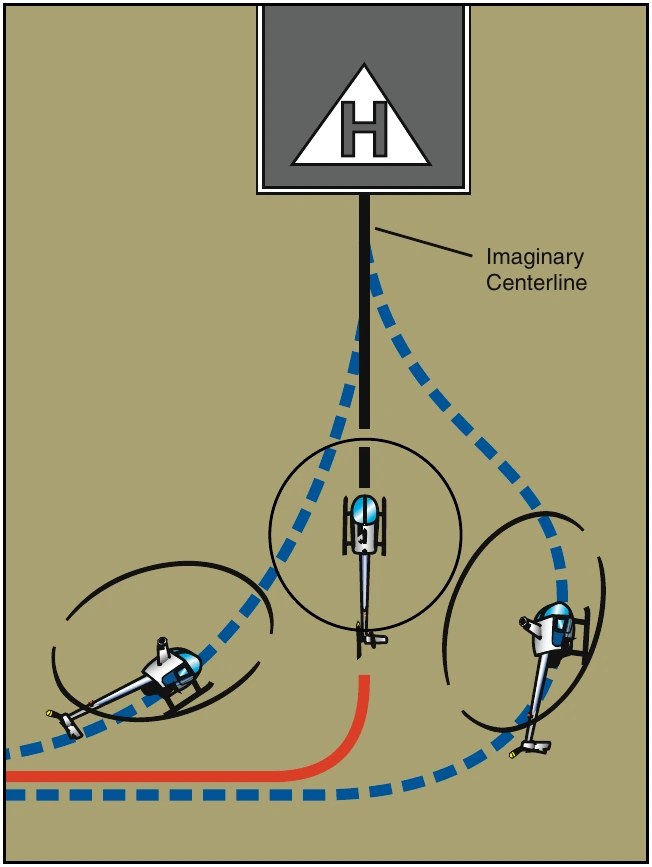
As the helicopter approaches the recommended hover altitude, you need to increase the collective sufficiently to maintain the hover. At the same time you need to apply aft cyclic to stop any forward movement, while controlling the heading with antitorque pedals.
Common Errors
- Failing to maintain proper r.p.m. during the entire approach.
- Improper use of the collective in controlling the angle of descent.
- Failing to make antitorque pedal corrections to compensate for collective changes during the approach.
- Failing to simultaneously arrive at hovering altitude and attitude with zero groundspeed.
- Low r.p.m. in transition to the hover at the end of the approach.
- Using too much aft cyclic close to the surface, which may result in tail rotor strikes.
Normal Approach to the Surface
A normal approach to the surface or a no-hover landing is used if loose snow or dusty surface conditions exist.
These situations could cause severely restricted visibility, or the engine could possibly ingest debris when the helicopter comes to a hover. The approach is the same as the normal approach to a hover; however, instead of terminating at a hover, continue the approach to touchdown.
Touchdown should occur with the skids level, zero groundspeed, and a rate of descent approaching zero.