
Chapter 9
Basic Flight Maneuvers
As the turn begins, use the cyclic as necessary (usually into the wind) to keep the helicopter over the desired spot. To continue the turn, you need to add more and more pedal pressure as the helicopter turns to the crosswind position. This is because the wind is striking the tail surface and tail rotor area, making it more difficult for the tail to turn into the wind. As pedal pressures increase due to crosswind forces, you must increase the cyclic pressure into the wind to maintain position. Use the collective with the throttle to maintain a constant altitude and r.p.m. [Figure 9-2]
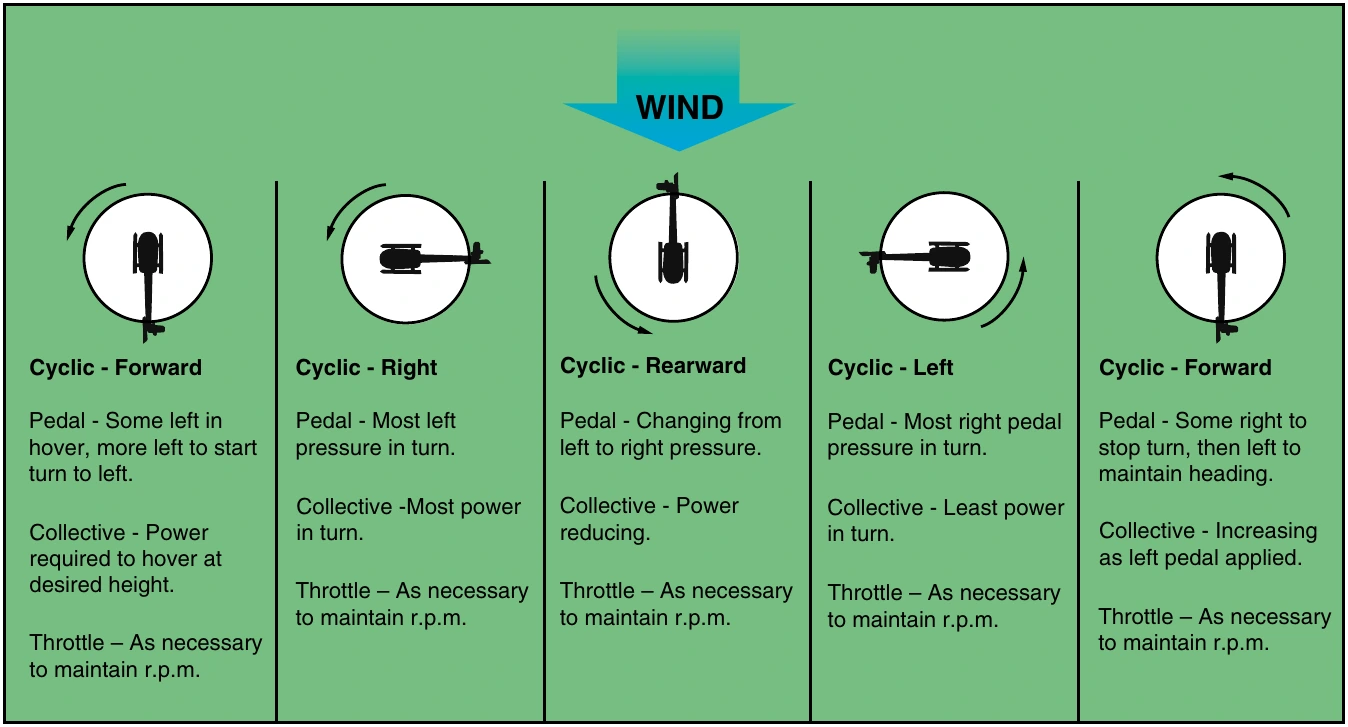
After the 90° portion of the turn, you need to decrease pedal pressure slightly to maintain the same rate of turn. Approaching the 180°, or downwind, portion, you need to anticipate opposite pedal pressure due to the tail moving from an upwind position to a downwind position. At this point, the rate of turn has a tendency to increase at a rapid rate due to the weathervaning tendency of the tail surfaces. Because of the tailwind condition, you need to hold rearward cyclic pressure to keep the helicopter over the same spot.
Because of the helicopter’s tendency to weathervane, maintaining the same rate of turn from the 180° position actually requires some pedal pressure opposite the direction of turn. If you do not apply opposite pedal pressure, the helicopter tends to turn at a faster rate.
The amount of pedal pressure and cyclic deflection throughout the turn depends on the wind velocity. As you finish the turn on the upwind heading, apply opposite pedal pressure to stop the turn. Gradually apply forward cyclic pressure to keep the helicopter from drifting.
Control pressures and direction of application change continuously throughout the turn. The most dramatic change is the pedal pressure (and corresponding power requirement) necessary to control the rate of turn as the helicopter moves through the downwind portion of the maneuver.
Turns can be made in either direction; however, in a high wind condition, the tail rotor may not be able to produce enough thrust, which means you will not be able to control a turn to the right in a counterclockwise rotor system. Therefore, if control is ever questionable, you should first attempt to make a 90° turn to the left. If sufficient tail rotor thrust exists to turn the helicopter crosswind in a left turn, a right turn can be successfully controlled. The opposite applies to helicopters with clockwise rotor systems. In this case, you should start your turn to the right.
Hovering turns should be avoided in winds strong enough to preclude sufficient aft cyclic control to maintain the helicopter on the selected surface reference point when headed downwind. Check the flight manual for the manufacturer ’s recommendations for this limitation.
Common Errors
- Failing to maintain a slow, constant rate of turn.
- Failing to maintain position over the reference point.
- Failing to maintain r.p.m. within normal range.
- Failing to maintain constant altitude.
- Failing to use the antitorque pedals properly.
Hovering—Forward Flight
You normally use forward hovering flight to move a helicopter to a specific location, and it is usually begun from a stationary hover. During the maneuver, constant groundspeed, altitude, and heading should be maintained.
Technique
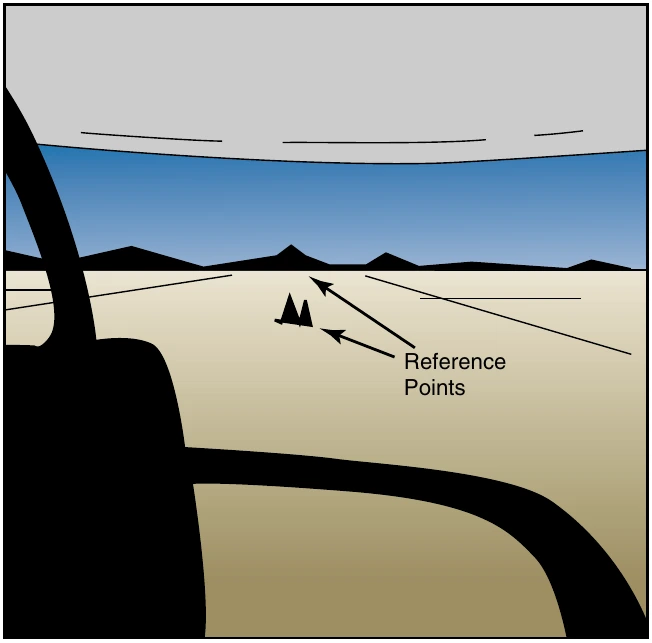
Before starting, pick out two references directly in front and in line with the helicopter. These reference points should be kept in line throughout the maneuver. [Figure 9-3]
Begin the maneuver from a normal hovering altitude by applying forward pressure on the cyclic. As movement begins, return the cyclic toward the neutral position to keep the groundspeed at a slow rate—no faster than a brisk walk. Throughout the maneuver, maintain a constant groundspeed and path over the ground with the cyclic, a constant heading with the antitorque pedals, altitude with the collective, and the proper r.p.m. with the throttle.
To stop the forward movement, apply reward cyclic pressure until the helicopter stops. As forward motion stops, return the cyclic to the neutral position to prevent rearward movement. Forward movement can also be stopped by simply applying rearward pressure to level the helicopter and let it drift to a stop.
Common Errors
- Exaggerated movement of the cyclic, resulting in erratic movement over the surface.
- Failure to use the antitorque pedals properly, resulting is excessive heading changes.
- Failure to maintain desired hovering altitude.
- Failure to maintain proper r.p.m.