
Chapter 9
Basic Flight Maneuvers
Taxiing refers to operations on, or near the surface of taxiways or other prescribed routes. In helicopters, there are three different types of taxiing.
Hover Taxi
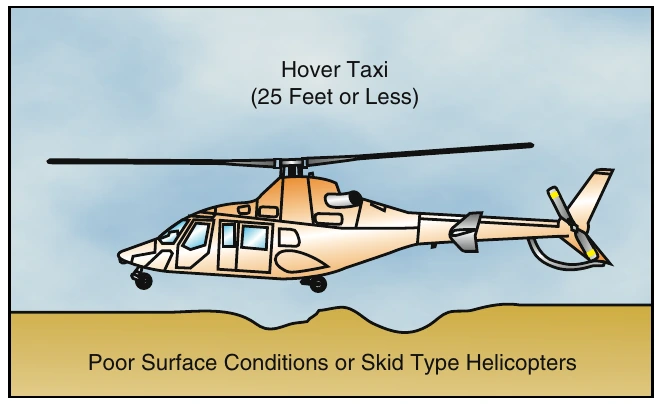
A "hover taxi" is used when operating below 25 feet AGL. [Figure 9-5] Since hover taxi is just like forward, sideward, or rearward hovering flight, the technique to perform it will not be presented here.
Air Taxi
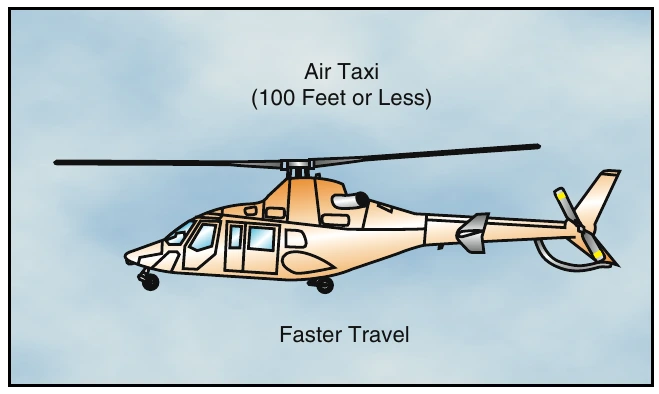
An "air taxi" is preferred when movements require greater distances within an airport or heliport boundary. [Figure 9-6] In this case, you basically fly to your new location; however, you are expected to remain below 100 feet AGL, and to avoid overflight of other aircraft, vehicles, and personnel.
Technique
Before starting, determine the appropriate airspeed and altitude combination to remain out of the cross-hatched or shaded areas of the height-velocity diagram.
Additionally, be aware of crosswind conditions that could lead to loss of tail rotor effectiveness. Pick out two references directly in front of the helicopter for the ground path desired. These reference points should be kept in line throughout the maneuver.
Begin the maneuver from a normal hovering altitude by applying forward pressure on the cyclic. As movement begins, attain the desired airspeed with the cyclic.
Control the desired altitude with the collective, and r.p.m. with the throttle. Throughout the maneuver, maintain a desired groundspeed and ground track with the cyclic, a constant heading with antitorque pedals, the desired altitude with the collective, and proper operating r.p.m. with the throttle.
To stop the forward movement, apply aft cyclic pressure to reduce forward speed. Simultaneously lower the collective to initiate a descent to hover altitude. As forward motion stops, return the cyclic to the neutral position to prevent rearward movement. When at the proper hover altitude, increase the collective as necessary.
Common Errors
- Erratic movement of the cyclic, resulting in improper airspeed control and erratic movement over the surface.
- Failure to use antitorque pedals properly, resulting in excessive heading changes.
- Failure to maintain desired altitude.
- Failure to maintain proper r.p.m.
- Overflying parked aircraft causing possible damage from rotor downwash.
- Flying in the cross-hatched or shaded area of the height-velocity diagram.
- Flying in a crosswind that could lead to loss of tail rotor effectiveness.
Surface Taxi
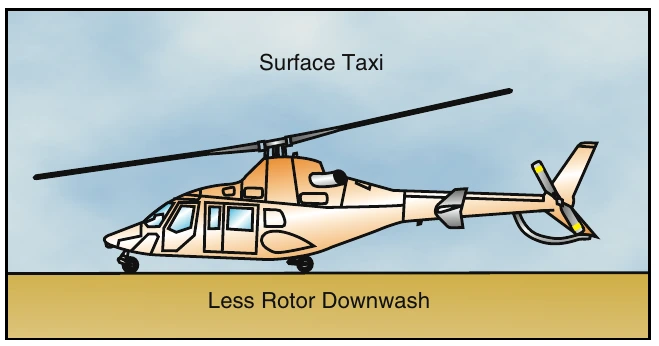
A "surface taxi," for those helicopters with wheels, is used whenever you wish to minimize the effects of rotor downwash. [Figure 9-7]
Technique
The helicopter should be in a stationary position on the surface with the collective full down and the r.p.m. the same as that used for a hover. This r.p.m. should be maintained throughout the maneuver. Then, move the cyclic slightly forward and apply gradual upward pressure on the collective to move the helicopter forward along the surface. Use the antitorque pedals to maintain heading and the cyclic to maintain ground track. The collective controls starting, stopping, and speed while taxiing. The higher the collective pitch, the faster the taxi speed; however, you should not taxi faster than a brisk walk. If your helicopter is equipped with brakes, use them to help you slow down. Do not use the cyclic to control groundspeed.