
Chapter 1
Weight and Balance Control
Weight Changes
The maximum allowable weight for an aircraft is determined by design considerations. However, the maximum operational weight may be less than the maximum allowable weight due to such considerations as high density altitude or high-drag field conditions caused by wet grass or water on the runway. The maximum operational weight may also be limited by the departure or arrival airport’s runway length.
One important preflight consideration is the distribution of the load in the aircraft. Loading the aircraft so the gross weight is less than the maximum allowable is not enough. This weight must be distributed to keep the CG within the limits specified in the POH or AFM.
If the CG is too far forward, a heavy passenger can be moved to one of the rear seats or baggage may be shifted from a forward baggage compartment to a rear compartment. If the CG is too far aft, passenger weight or baggage can be shifted forward. The fuel load should be balanced laterally. The pilot should pay special attention to the POH or AFM regarding the operation of the fuel system in order to keep the aircraft balanced in flight.
Weight and balance of a helicopter is far more critical than for an airplane. Some helicopters may be properly loaded for takeoff, but near the end of a long flight when the fuel tanks are almost empty, the CG may have shifted enough for the helicopter to be out of balance laterally or longitudinally. Before making any long flight, the CG with the fuel available for landing must be checked to ensure it is within the allowable range.
Airplanes with tandem seating normally have a limitation requiring solo flight to be made from the front seat in some airplanes or the rear seat in others. Some of the smaller helicopters also require solo flight be made from a specific seat, either the right, left, or center. These seating limitations are noted by a placard, usually on the instrument panel, and they should be strictly followed.
As an aircraft ages, its weight usually increases due to debris and dirt collecting in hard-to-reach locations and moisture absorbed in the cabin insulation. This increase in weight is normally small, but it can be determined only by accurately weighing the aircraft.
Changes of fixed equipment may have a major effect upon the weight of the aircraft. Many aircraft are overloaded by the installation of extra radios or instruments. Fortunately, the replacement of older, heavy electronic equipment with newer, lighter types results in a weight reduction. This weight change, however helpful, can cause the CG to shift, which must be computed and annotated in the weight and balance record.
Repairs and alterations are the major sources of weight changes. It is the responsibility of the FAA-certificated mechanic or repairman making any repair or alteration to know the weight and location of a change, to compute the CG, record the new empty weight and EWCG in the aircraft weight and balance record, and update the equipment lists.
If the newly calculated EWCG should happen to fall outside the EWCG range, it is necessary to perform an adverse-loading check. This requires a forward and rearward adverse-loading check and a maximum weight check. These weight and balance extreme conditions represent the maximum forward and rearward CG position for the aircraft. An adverse-loading check is a deliberate attempt to load an aircraft in a manner that creates the most critical balance condition and still remains within the design CG limits of the aircraft. If any of the checks fall outside the loaded CG range, the aircraft must be reconfigured or placarded to prevent the pilot from loading the aircraft improperly. It is sometimes possible to install a fixed ballast in order for the aircraft to operate again within the normal CG range.
The FAA-certificated mechanic or repairman conducting an annual or condition inspection must ensure the weight and balance data in the aircraft records is current and accurate. It is the responsibility of the PIC to use the most current weight and balance data when operating the aircraft.
Stability and Balance Control
Balance control refers to the location of the CG of an aircraft. This is of primary importance to aircraft stability, which is a factor in flight safety. The CG is the point at which the total weight of the aircraft is assumed to be concentrated, and the CG must be located within specific limits for safe flight. Both lateral and longitudinal balance are important, but the prime concern is longitudinal balance; that is, the location of the CG along the longitudinal or lengthwise axis.
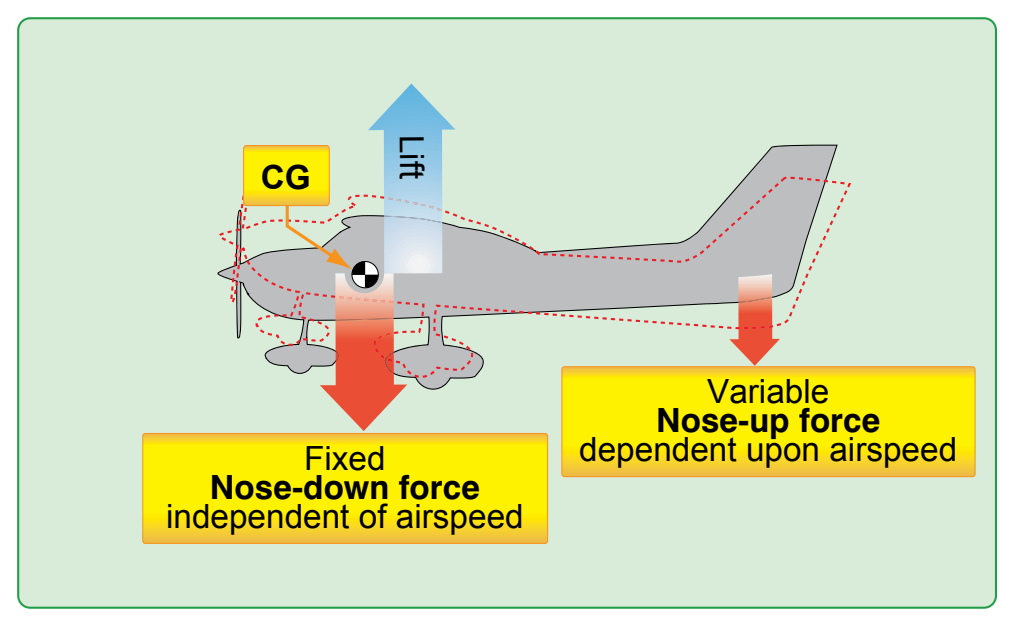
An airplane is designed to have stability that allows it to be trimmed to maintain straight-and-level flight with hands off the controls. Longitudinal stability is maintained by ensuring the CG is slightly ahead of the center of lift. This produces a fixed nose-down force independent of the airspeed. This is balanced by a variable nose-up force, which is produced by a downward aerodynamic force on the horizontal tail surfaces that varies directly with the airspeed. [Figure 1-1] If a rising air current should cause the nose to pitch up, the airplane slows and the downward force on the tail decreases. The weight concentrated at the CG pulls the nose back down. If the nose should drop in flight, the airspeed increases and the increased downward tail load brings the nose back up to level flight.
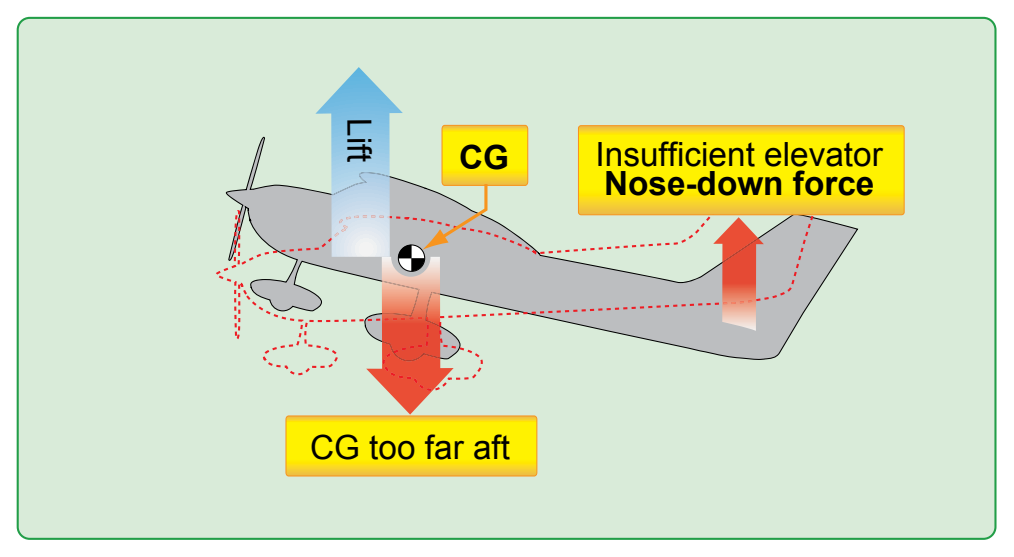
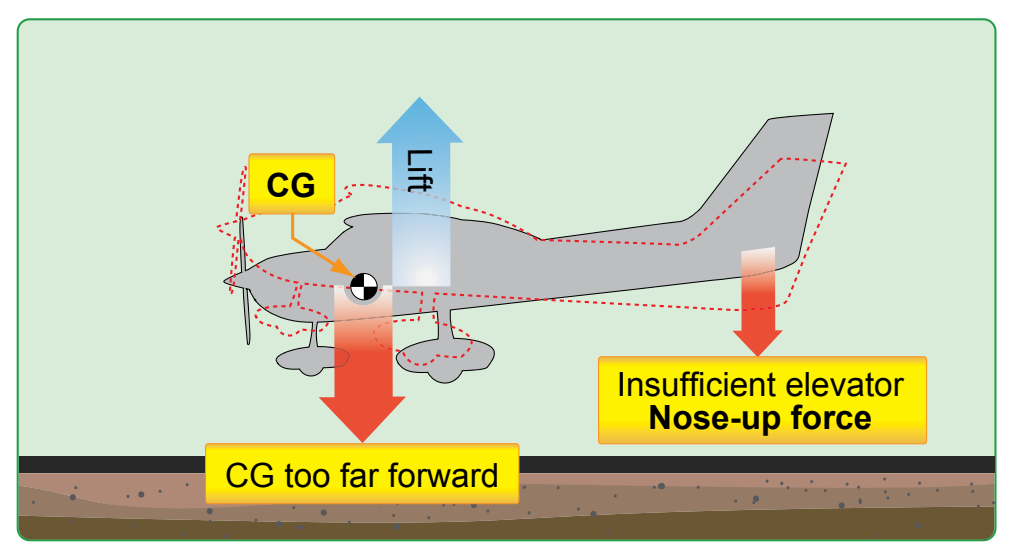
As long as the CG is maintained within the allowable limits for its weight, the airplane has adequate longitudinal stability and control. If the CG is too far aft, it is too near the center of lift; the airplane is unstable and difficult to recover from a stall. [Figure 1-2] If the unstable airplane should enter a spin, the spin could become flat making recovery difficult or impossible. If the CG is too far forward, the downward tail load needs to be increased to maintain level flight. This increased tail load has the same effect as carrying additional weight; the aircraft must fly at a higher angle of attack and drag increases.
A more serious problem caused by the CG being too far forward is the lack of sufficient elevator authority. At low takeoff speeds, the elevator might not produce enough nose-up force to rotate; on landing there may not be enough elevator force to flare the airplane. [Figure 1-3] Both takeoff and landing runs are lengthened if the CG is too far forward. The basic aircraft design is such that lateral symmetry is assumed to exist. For each item of weight added to the left of the center line of the aircraft (also known as buttock line zero or BL-0), there is generally an equal weight at a corresponding location on the right.
The lateral balance can be upset by uneven fuel loading or burnoff. The position of the lateral CG is not normally computed for an airplane, but the pilot must be aware of the adverse effects that result from a laterally unbalanced condition. [Figure 1-4] This is corrected by using the aileron trim tab until enough fuel has been used from the tank on the heavy side to balance the airplane. The deflected trim tab deflects the aileron to produce additional lift on the heavy side, but it also produces additional drag, and the airplane flies inefficiently.