
Chapter 1
Weight and Balance Control
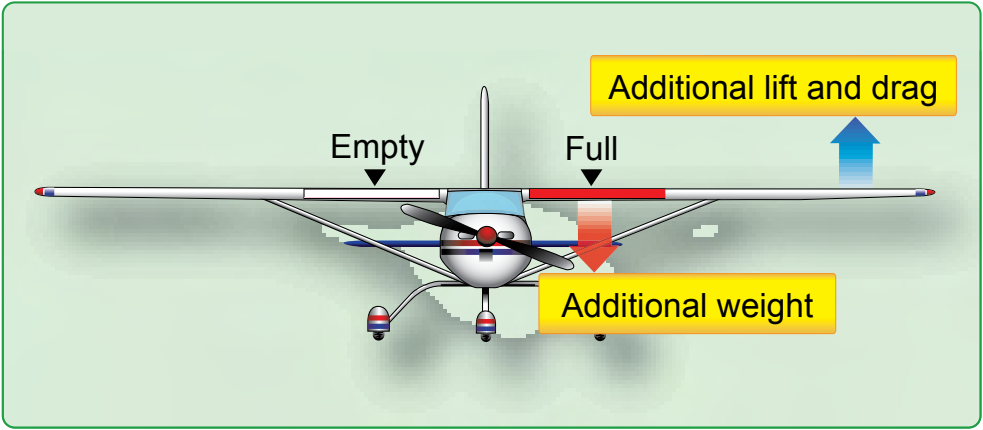
Helicopters are more often affected by lateral imbalance than airplanes. If a helicopter is loaded with heavy occupants and fuel on the same side, it could be out of balance enough to make it unsafe to fly. It is also possible that if external loads are carried in such a position that requires large lateral displacement of the cyclic control to maintain level flight, the fore-and-aft cyclic control effectiveness is limited.
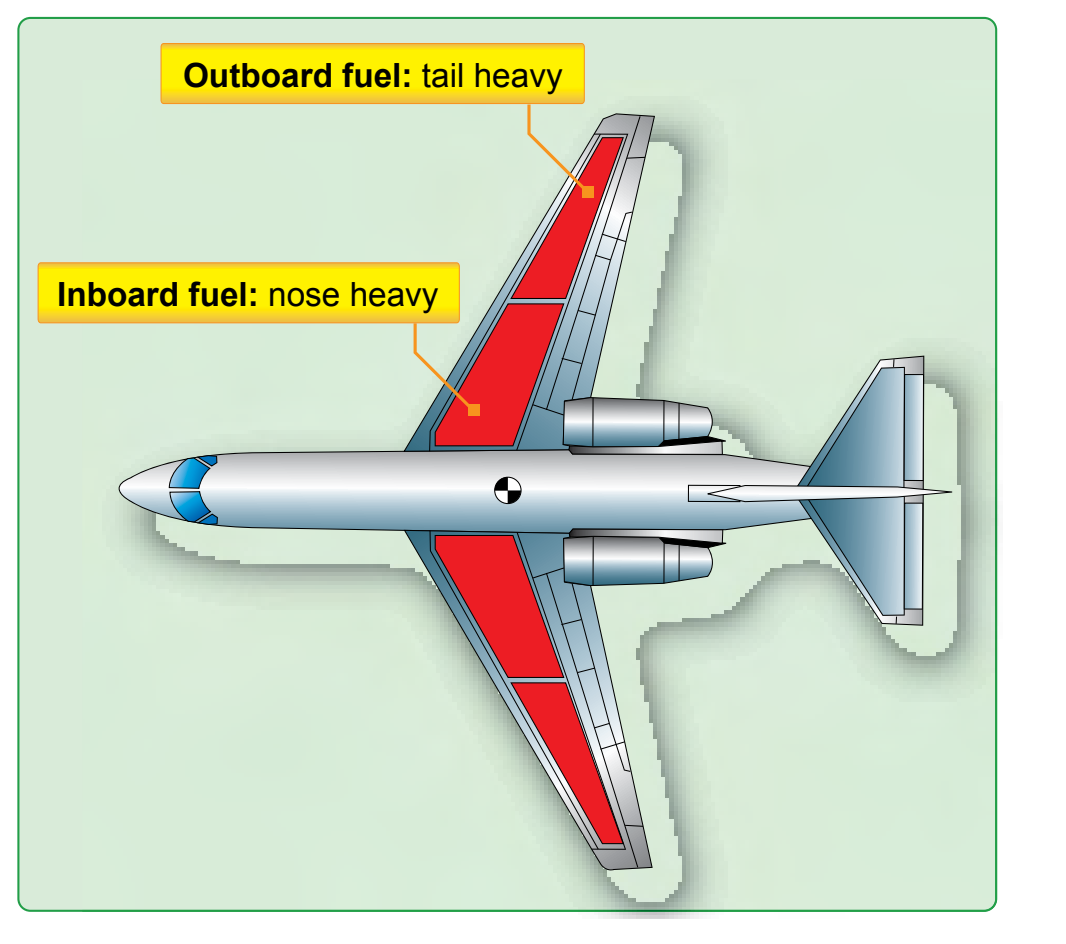
Swept-wing airplanes are more critical due to fuel imbalance because as the fuel is used from the outboard tanks, the CG shifts forward. As fuel is used from the inboard tanks, the CG shifts aft. [Figure 1-5] For this reason, fuel-use scheduling in swept-wing airplane operations is critical.
Weight Control for Aircraft Other Than Fixed and Rotor-wing
Some light aircraft utilize different methods of determining weight and balance from the traditional fixed and rotor-wing aircraft. These aircraft achieve flight control by methods different from the fixed-wing airplane or helicopter. Most notable of these are weight-shift control (WSC) aircraft (also known as trikes), powered parachutes, and balloons. These aircraft typically do not specify either an EWCG or a CG range. They require only a certified or approved maximum weight. To understand why this is so, a look at how flight control is achieved is helpful.
Airplanes and WSC aircraft control flight under the influence of the same four forces (lift, gravity, thrust, and drag), and around the same three axes (pitch, yaw, and roll). However, each aircraft accomplishes this control in a very different manner. This difference helps explain why the fixed-wing airplane requires an established weight and a known CG, whereas the WSC aircraft only requires the known weight.
The fixed-wing airplane has movable controls that alter lift on various airfoil surfaces to vary pitch, roll, and yaw. In turn, these changes in lift affect the characteristics of the flight parameters. Weight normally decreases in flight due to fuel consumption, and the airplane CG changes with this weight reduction. An airplane utilizes its variable flight controls to compensate and maintain controllability through the various flight modes and as the CG changes. An airplane has a CG range or envelope within which it must remain if the flight controls are to remain effective and the airplane safely operated.
Weight-Shift Control Aircraft
The WSC aircraft has a relatively set platform wing without a tail. The pilot achieves control by shifting weight. In the design of this aircraft, the weight of the airframe and its payload is attached to the wing at a single point in a pendulous arrangement. The pilot, through the flight controls, controls the arm of this pendulum and thereby controls the aircraft. When a change in flight parameter is desired, the pilot displaces the aircraft’s weight by the appropriate distance and direction. This change momentarily disrupts the equilibrium between the four forces acting on the aircraft. The wing, due to its inherent stability, then moves appropriately to reestablish the desired relationship between these forces; the wing flexes and alters its shape. As the shape is changed, lift is varied at different points on the wing to achieve the desired flight parameters. The flight controls primarily affect the pitch-and-roll axes. Since there is no vertical tail plane, there is minimal or no yaw control. Unlike in an airplane, the CG experienced by the WSC aircraft wing remains constant. Since the weight of the airframe acts through a single point (the wing attach point), the range over which the weight may act is fixed at the pendulum arm or length. Even though weight decreases as fuel is consumed, weight remains focused at the wing attach point. Because the range is fixed, there is no need to establish a calculated range. The pilot should consult the POH or Aircraft Operating Instructions (AOI) for maximum takeoff weight and minimum and maximum seat weight limits prior to each flight.
Powered Parachutes
The powered parachute is also a pendulum-style aircraft. Its airframe CG is fixed at the pendulum attach point. It is more limited in controllability than the WSC aircraft because it lacks an aerodynamic pitch control. Pitch (and lift) control is primarily a function of the power control. Increased power results in increased lift; cruise power amounts to level flight; decreased power causes a descent. Due to this characteristic, the aircraft is basically a one-airspeed aircraft. Once again, because the CG is fixed at the attach point to the wing, there is no CG range. As with WSC, the pilot should consult the POH or AOI for maximum takeoff weight and minimum and maximum seat weight limits prior to each flight.
Roll control on a powered parachute is achieved by changing the shape of the wing. The change is achieved by varying the length of steering lines attached to the outboard trailing edges of the wing. The trailing edge of the parachute is pulled down slightly on one side or the other to create increased drag along that side. This change in drag creates roll and yaw, permitting the aircraft to be steered.
Balloons
The balloon is controlled by the pilot only in the vertical dimension; this is in contrast to all other aircraft. He or she achieves this control through the use of lift and weight. Wind provides all other movement. The CG of the gondola remains constant beneath the balloon envelope. As in WSC and powered-parachute aircraft, there is no CG limitation.
Underestimating the Importance of Weight and Balance
Many pilots, from sport pilot to commercial pilot, tend to underestimate the importance of proper weight and balance of their aircraft. Load sheets are taken for granted and hasty calculations are made of the aircraft’s CG. Unfortunately, each year there are a number of accidents related to weight and balance issues. Many of these occurrences could have been avoided had more attention been given to weight and balance.
Every student pilot is taught how to work a weight and balance problem and that it is important to make sure every flight is loaded “within the envelope” (no more than maximum gross weight) for both takeoff and landing. But does he or she really understand just why this is so and the disastrous effect of being out of the envelope? Two examples of documented cases are provided below in an effort to indicate the serious nature of maintaining the proper weight and balance. In case studies when weight and balance was listed as the major factor of the accident, many were fatal.
For instance, a small aircraft was loaded with hunters, gear, and dogs (none of the dogs were secured inside the aircraft). During takeoff, all the dogs went to the aft of the airplane. This shifted the CG well aft of its allowable limit. The airplane stalled and crashed. The airplane was destroyed with casualties.
Another accident occurred when a group of skydivers were sitting on the floor toward the aft portion of the airplane (they were unsecured). During takeoff, the CG was again well beyond its aft limit. The airplane stalled and crashed. The airplane was destroyed with casualties.