
Chapter 10
Use of Computer for Weight and Balance Computations
Introduction
Almost all weight and balance problems involve only simple math. This allows slide rules and hand-held electronic calculators to relieve much of the tedium involved with these problems. This chapter compares the methods of determining the center of gravity (CG) of an airplane while it is being weighed. First, it shows how to determine the CG using a simple electronic calculator, then solves the same problem using an E6-B flight computer. Finally, it shows how to solve it using a dedicated electronic flight computer.
Examples of typical weight and balance problems (solved with an electronic calculator) that pilots and airframe and powerplant (A&P) maintenance technicians encounter throughout their aviation endeavors are shown later in this chapter.
Electronic Calculator
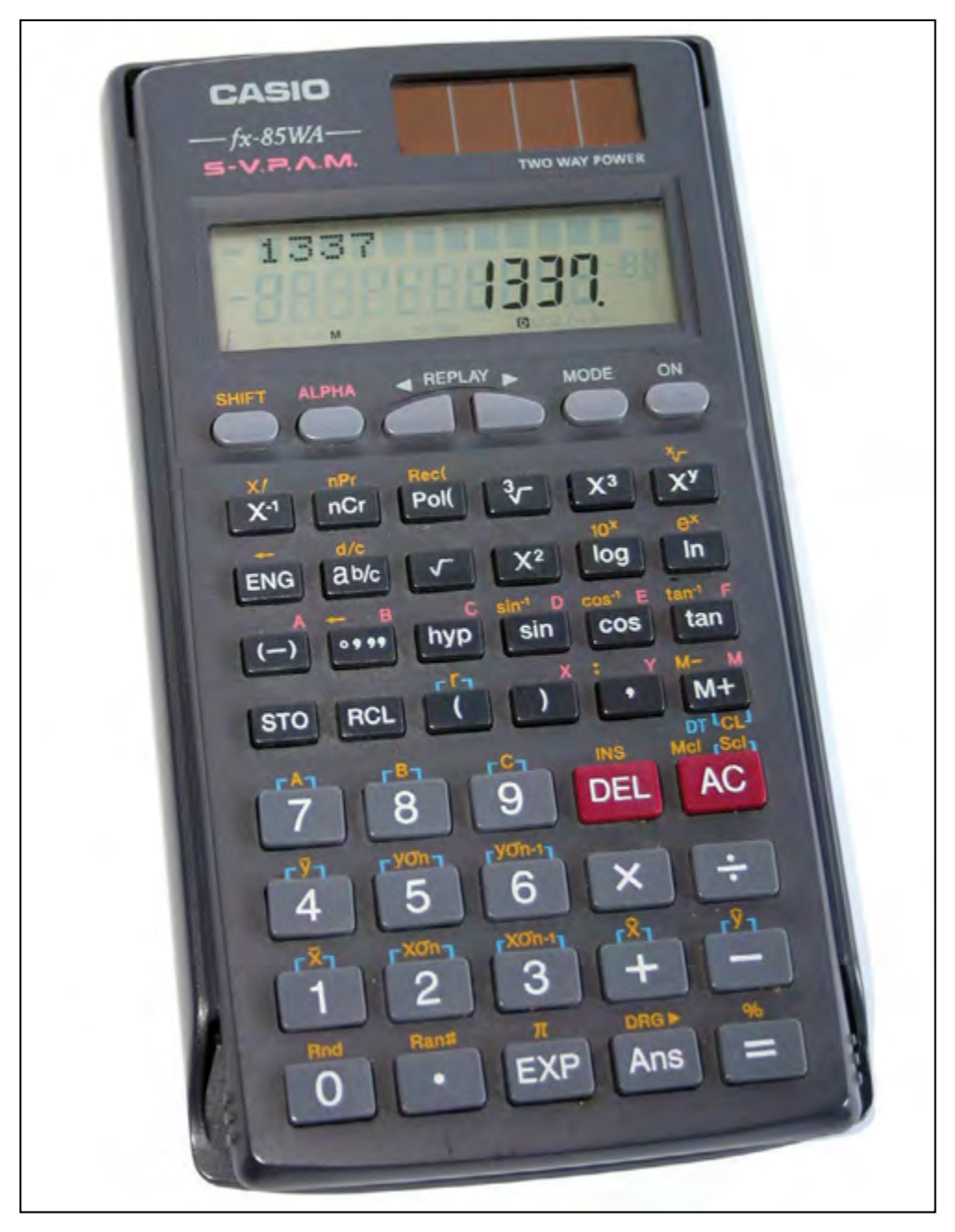
Determining the CG of an airplane in inches for the main-wheel weighing points can be done with any simple electronic calculator that has addition (+), subtraction (–), multiplication (×), and division (÷) functions. [Figure 10-1] Scientific calculators with such additional functions as memory (M), parentheses (( )), plus or minus (+/–), exponential (yx), reciprocal (1/x), and percentage (%) functions allow more complex problems to be solved or simple problems to be solved using fewer steps.
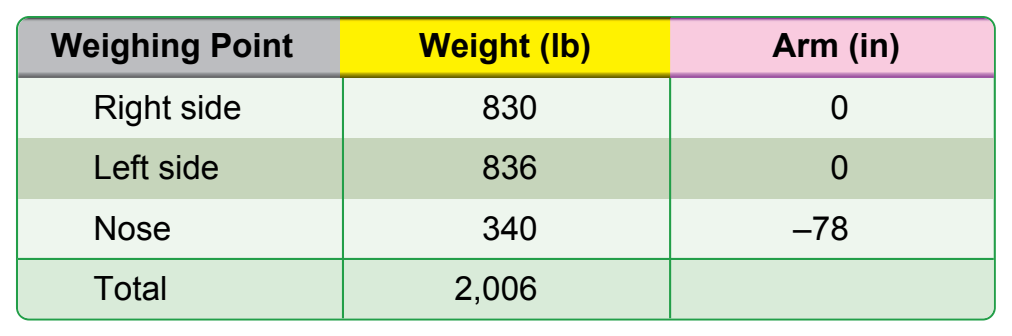
According to Figure 10-2, the weight of the nosewheel (F) is 340 pounds, the distance between main wheels and nosewheel (L) is –78 inches, and the total weight (W) of the airplane is 2,006 pounds. L is negative because the nosewheel is ahead of the main wheels.
To determine the CG, use this formula:
CG = (F × L) / W
= (340 × –78) / 2,006
Key the data into the calculator and press the equal (=) key. The answer should read as follows:
(340)(×)(78)(+/–)(÷)(2006)(=) –13.2
The arm of the nosewheel is negative, so the CG is –13.2 or 13.2 inches ahead of the main wheel weighing points.
E6-B Flight Computer
The E6-B uses a special kind of slide rule. Instead of its scales going from 1 to 10, as on a normal slide rule, both scales go from 10 to 100. The E6-B cannot be used for addition or subtraction, but it is useful for making calculations involving multiplication and division. Its accuracy is limited, but it is sufficiently accurate for most weight and balance problems.
The same problem that was just solved with the electronic calculator can be solved on an E6-B by following these steps:
CG = (F × L) / W
= (340 × –78) / 2,006