
Chapter 10
Use of Computer for Weight and Balance Computations
First, multiply 340 by 78 (disregard the minus sign) [Figure 10-3]:
- Place 10 on the inner scale (this is the index opposite 34 on the outer scale that represents 340).
- Opposite 78 on the inner scale, read 26.5 on the outer scale. Determine the value of these digits by estimating: 300 × 80 = 24,000, so 340 × 78 = 26,500. Then, divide 26,500 by 2,006 [Figure 10-4]:
- On the inner scale, place 20, which represents 2,006 opposite 26.5 on the outer scale (26.5 represents 26,500).
- Opposite the index, 10, on the inner scale read 13.2 on the outer scale. Determine the value of 13.2 by estimating: 20,000 ÷ 2000 = 10, so 26,500 ÷ 2,006 = 13.2. The arm (–78) is negative, so the CG is also negative.
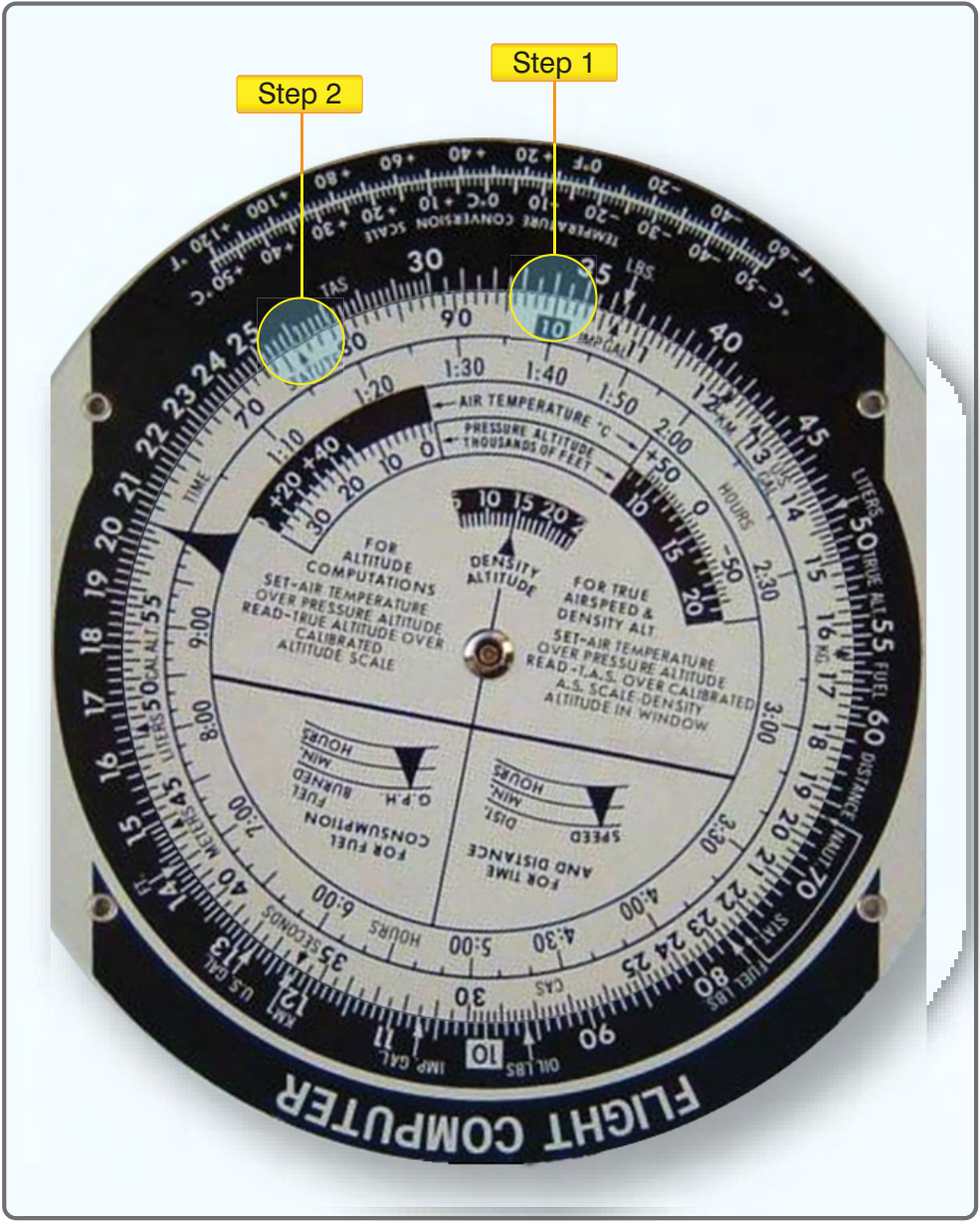
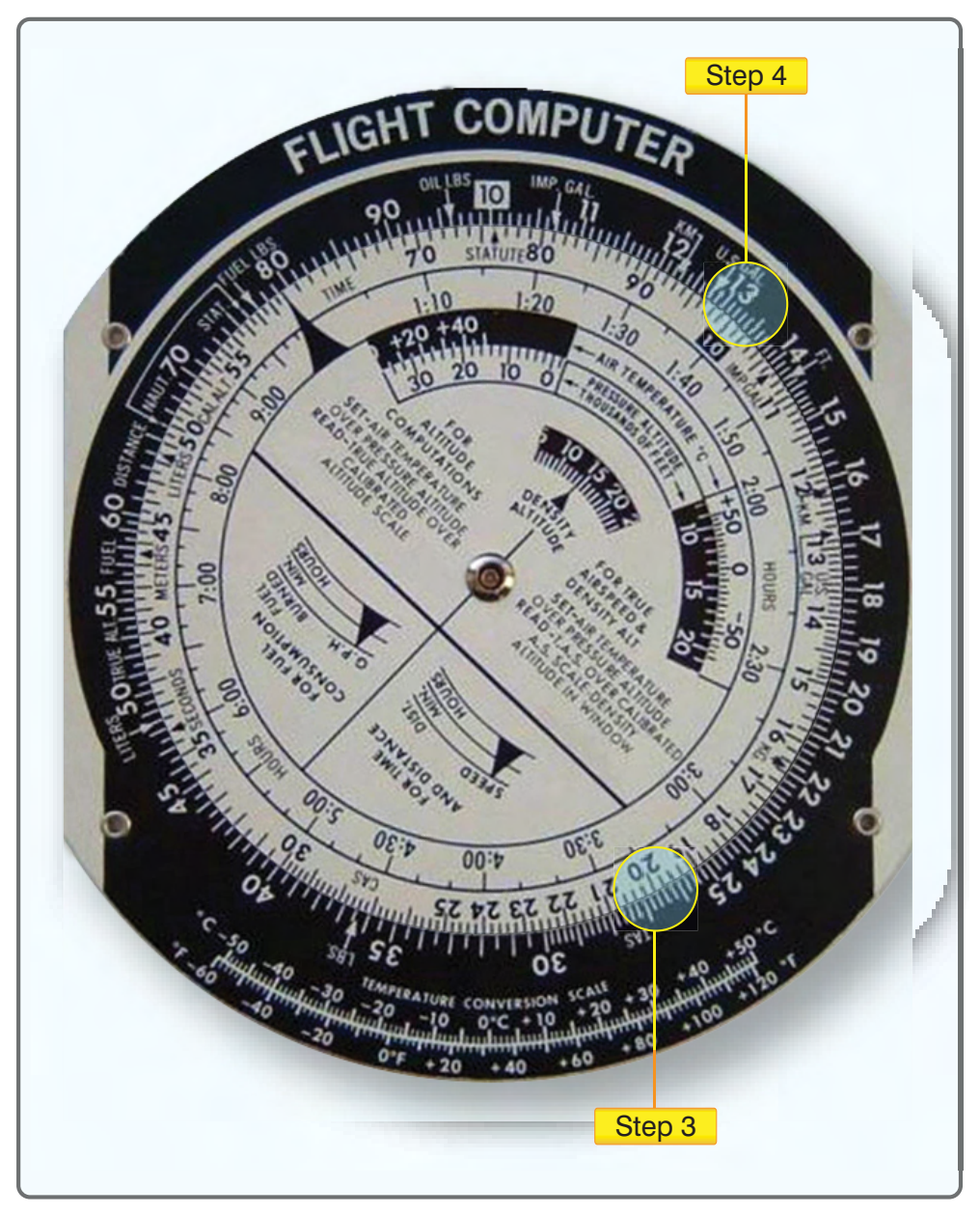
The CG is –13.2 inches or 13.2 inches ahead of the datum.
Dedicated Electronic Flight Computer
Dedicated electronic flight computers, like the one in Figure 10-5, are programmed to solve many flight problems such as wind correction, heading and ground speed, endurance, and true airspeed (TAS), as well as weight and balance problems.
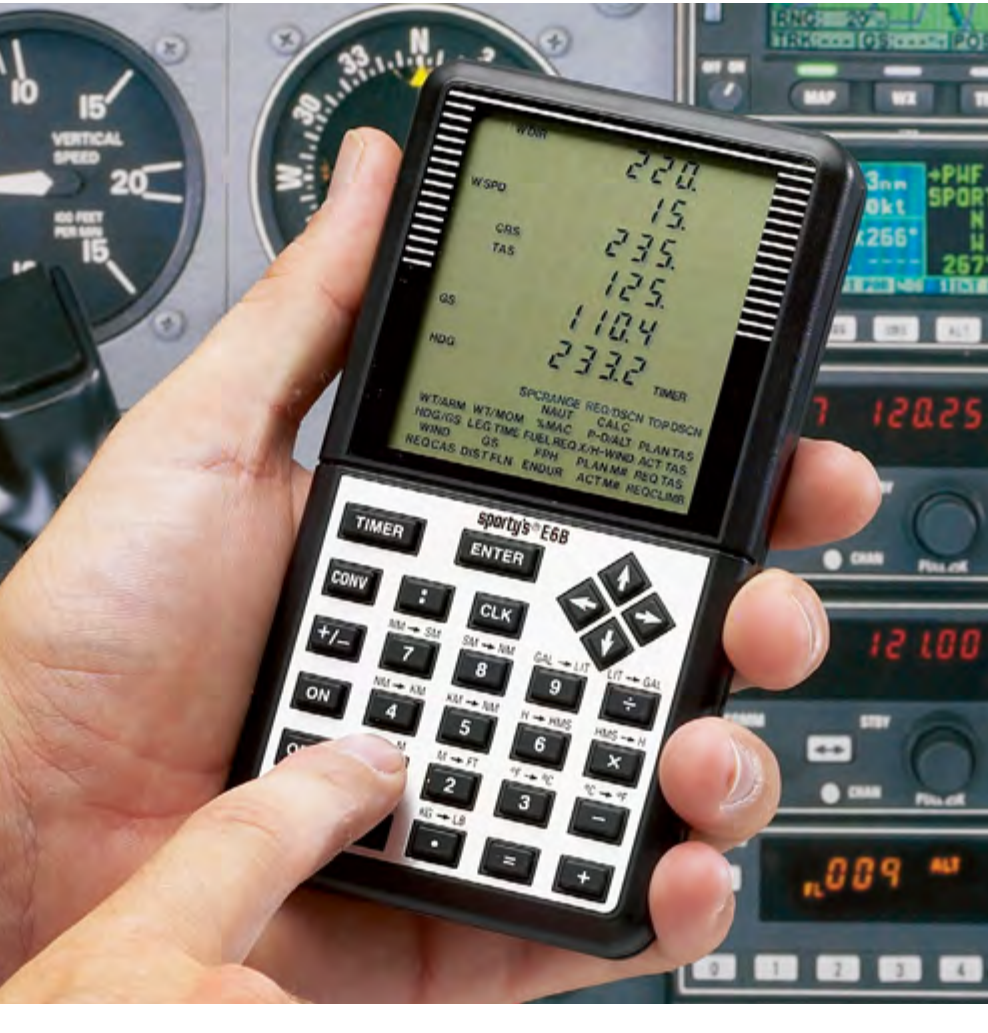
The problem just solved with an electronic calculator and an E6-B can also be solved with a dedicated flight computer using the information shown in Figure 10-2. Each flight computer handles the problems in a slightly different way, but all are programmed with prompts that solicit the required data to be inputted so there is no need to memorize any formulas. Weight and arms are inputted as called for, and a running total of the weight, moment, and CG are displayed.
Typical Weight and Balance Problems
A hand-held electronic calculator like the one in Figure 10-5 is a valuable tool for solving weight and balance problems. It can be used for a variety of problems and has a high degree of accuracy. The examples given here are solved with a calculator using only the (×),(÷),(+),( – ), and (+/–) functions. If other functions are available on your calculator, some of the steps may be simplified.
Determining CG in Inches From the Datum
This type of problem is solved by first determining the location of the CG in inches from the main wheel weighing points, then measuring this location in inches from the datum. There are four types of problems involving the location of the CG relative to the datum.
Nosewheel Airplane With Datum Ahead of the Main Wheels
The datum (D) is 128 inches ahead of the main wheel weighing points; the weight of the nosewheel (F) is 340 pounds, and the distance between main wheels and nosewheel (L) is 78 inches. The total weight (W) of the airplane is 2,006 pounds. Refer to Figure 3-5 on page 3-5.
Use this formula:
CG = D – (F × L) / W
- Determine the CG in inches from the main wheel: (340)(×)(78)(÷)(2006)(=) 13.2
- Determine the CG in inches from the datum: (128)(–)(13.2)(=) 114.8 The CG is 114.8 inches behind the datum.
Nosewheel Airplane With Datum Behind the Main Wheels
The datum (D) is 75 inches behind the main wheel weighing points, the weight of the nosewheel (F) is 340 pounds, and the distance between main wheels and nosewheel (L) is 78 inches. The total weight (W) of the airplane is 2,006 pounds. Refer to Figure 3-6 on page 3-5.