
Chapter 10
Use of Computer for Weight and Balance Computations
Determining CG, Given Weights, and Moment Indexes
Other weight and balance problems involve weights and moment indexes, such as moment/100 or moment/1,000. To determine the CG, add all the weights and all the moment indexes. Then, divide the total moment index by the total weight and multiply the answer by the reduction factor. Figure 10-7 contains the specifications for determining the CG using weights and moments indexes. Determine the CG by using the data in Figure 10-7 and following these steps:
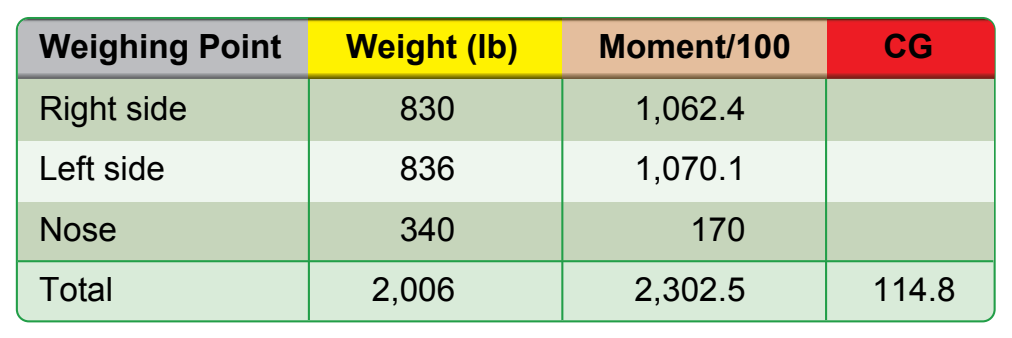
- Determine the total weight and record this number: (830)(+)(836)(+)(340)(=) 2,006
- Determine the total moment index, divide this by the total weight, and multiply it by the reduction factor of 100: (1062.4)(+)(1070.1)(+)(170)(=)(2302.5)(÷)(2006)(=) (1.148)(×)(100)(=) 114.8
This airplane weighs 2,006 pounds and its CG is 114.8 inches from the datum.
Determining CG in Percent Mean Aerodynamic Chord (MAC)
- The loaded CG is 42.47 inches aft of the datum.
- MAC is 61.6 inches long.
- LEMAC is at station 20.1.
- Determine the distance between the CG and LEMAC: (42.47)(–)(20.1)(=) 22.37
- Then, use this formula: (22.37)(×)(100)(÷)(61.6)(=) 36.3
The CG of this airplane is located at 36.3 percent MAC.
Determining Lateral CG of a Helicopter
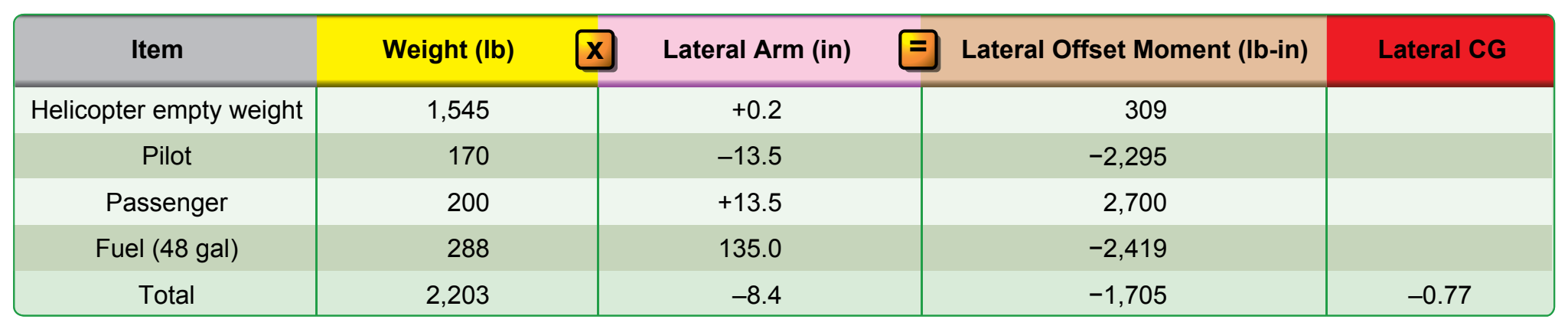
For a helicopter, it is often necessary to determine not only the longitudinal CG, but the lateral CG as well. Lateral CG is measured from butt line zero (BL 0). All items and moments to the left of BL 0 are negative, and all those to the right of BL 0 are positive. Figure 10-8 contains the specifications for determining the lateral CG of a typical helicopter.
Determine the lateral CG by using the data in Figure 10-8 and following these steps:
- Add all of the weights: (1545)(+)(170)(+)(200)(+)(288)(=) 2,203
- Multiply the lateral arm (the distance between butt line zero and the CG of each item) by its weight to get the lateral offset moment of each item. Moments to the right of BL 0 are positive and those to the left are negative. (1,545)(×)(.2)(=) 309 (170)(×)(13.5)(+/–)(=) –2,295 (200)(×)(13.5)(=) 2,700 (288)(×)(8.4)(+/–)(=) –2,419
- Determine the algebraic sum of the lateral offset moments. (309)(+)(2295)(+/–)(+)(2700)(+)(2419)(+/–)(=) –1,705
- Divide the sum of the moments by the total weight to determine the lateral CG. (1705)(+/–)(÷)(2203)(=) –0.77
The lateral CG is 0.77 inch to the left of BL 0.
Determining ΔCG Caused by Shifting Weights
Fifty pounds of baggage is shifted from the aft baggage compartment at station 246 to the forward compartment at station 118. The total airplane weight is 4,709 pounds. How much does the CG shift?
- Determine the number of inches the baggage is shifted: (246)(–)(118)(=) 128
- Use this formula:
ΔCG = (Weight shifted × Distance weight is shifted) / Total weight
(50)(×)(128)(÷)(4709)(=) 1.36