
Chapter 9
Weight and Balance Control—Commuter Category and Large Aircraft
Introduction
This chapter discusses general guidelines and procedures for weighing large fixed-wing aircraft exceeding a takeoff weight of 12,500 pounds. Several examples of center of gravity (CG) determination for various operational aspects of these aircraft are also included. Persons seeking approval for a weight and balance control program for aircraft operated under Title 14 of the Code of Federal Regulations (14 CFR) part 91, subpart K, 121, 125, or 135 should consult with the Flight Standards District Office (FSDO) or Certificate Management Office (CMO) that has jurisdiction in their area. Additional information on weight and balance for large aircraft can be found in Federal Aviation Administration (FAA) Advisory Circular (AC) 120-27, Aircraft Weight and Balance Control, FAA Type Certificate Data Sheets (TCDS), and the aircraft flight and maintenance manuals for specific aircraft.
Establishing the Initial Weight of an Aircraft
Prior to being placed into service, each aircraft is weighed and the empty weight and CG location established. New aircraft are normally weighed at the factory and are eligible to be placed into operation without reweighing if the weight and balance records were adjusted for alterations and modifications to the aircraft, such as interior reconfigurations.
An aircraft transferred from one operator that has an approved weight and balance program to another operator with an approved program does not need to be weighed prior to use by the receiving operator unless more than 36 calendar months have elapsed since the last individual or fleet weighing, or unless some other modification to the aircraft warrants that the aircraft be weighed. Aircraft transferred, purchased, or leased from an operator without an approved weight and balance program, and that have not been modified or have been minimally modified, can be placed into service without being reweighed if the last weighing was accomplished by an acceptable method (for example, manufacturer’s instructions or AC 43.13-2, Acceptable Methods, Techniques, and Practices—Aircraft Alterations) within the last 12 calendar months and a weight and balance change record was maintained by the operator. It is potentially unsafe to fail to reweigh an aircraft after it has been modified.
When weighing large aircraft, compliance with the relevant manuals, operations specifications, or management specification is required to ensure that weight and balance requirements specified in the Aircraft Flight Manual (AFM) are met in accordance with approved limits. This provides information to the flight crew that allows the maximum payload to be carried safely.
The aircraft should be weighed in still air or an enclosed building after the aircraft has been cleaned. Ensure that the aircraft is in a configuration for weighing with regard to flight controls, unusable fuel, ballast, oil and other operating fluids, and equipment as required by the controlling weight and balance procedure.
Large aircraft are not usually raised off the floor on jacks for weighing; they are weighed on ramp-type scales. The scales must be properly calibrated, zeroed, and used in accordance with the manufacturer’s instructions. Each scale should be periodically checked for accuracy as recommended in the manufacturer’s calibration schedule, either by the manufacturer or by a recognized facility, such as a civil department of weights and measures. If no manufacturer’s schedule is available, the period between calibrations should not exceed 12 months.
Determining the Empty Weight and Empty Weight CG (EWCG)
When the aircraft is properly prepared for weighing, roll it onto the scales, and level it. The weights are measured at three weighing points: the two main wheel points and the nosewheel point. The empty weight and empty weight CG (EWCG) are determined by using the following steps with the results recorded in the weight and balance record for use in all future weight and balance computations.
- Determine the moment index of each of the main-wheel points by multiplying the net weight (scale reading minus tare weight), in pounds, at these points by the distance from the datum, in inches. Divide these numbers by the appropriate reduction factor.
- Determine the moment index of the nosewheel weighing point by multiplying its net weight, in pounds, by its distance from the datum, in inches. Divide this by the reduction factor.
- Determine the total weight by adding the net weight of the three weighing points and the total moment index by adding the moment indexes of each point.
- Divide the total moment index by the total weight and multiply the result by the reduction factor. This gives the CG in inches from the datum.
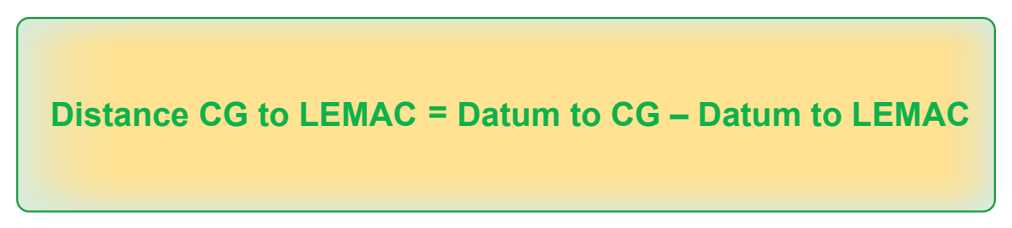
- Determine the distance of the CG behind the leading edge of the mean aerodynamic chord (LEMAC) by subtracting the distance between the datum and LEMAC from the distance between the datum and the CG. [Figure 9-1]
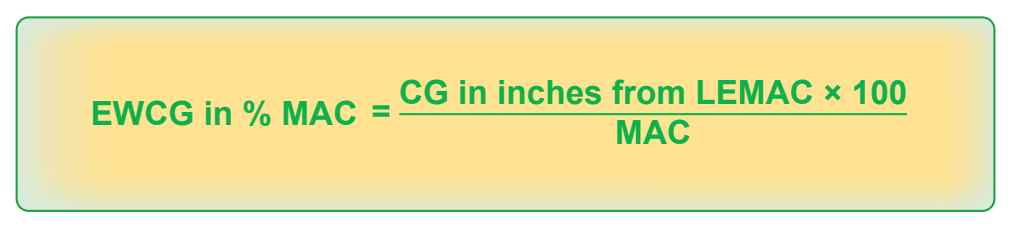
- Determine the EWCG in percentage of MAC (percent MAC) by using the formula in Figure 9-2.

Documenting Changes to an Aircraft’s Weight and Balance
The weight and balance system should include methods by which a complete, current, and continuous record of the weight and CG of each aircraft is maintained, such as a log, ledger, or other equivalent electronic means. Alterations and changes affecting the weight and/or balance of the aircraft should be recorded in this log. Changes in the weight or location of weight in or on the aircraft should be recorded whenever the weight change is at or exceeds the weights listed in Figure 9-3.
Determining the Loaded CG of the Airplane in Percent MAC
A loading schedule is used to document compliance with the certificated weight and balance limitations contained in the manufacturer’s AFM and weight and balance manual. The basic operating weight (BOW) and the operating index are entered into a loading schedule like the one in Figure 9-4, and the variables for a specific flight are entered as appropriate to determine the loaded weight and CG.
Use the data in this example: