
Chapter 9
Weight and Balance Control—Commuter Category and Large Aircraft

Determining the CG Shift When Cargo Is Added or Removed
To calculate the CG when cargo is added or removed, add or subtract the weight and moment index of the affected cargo to the original loading chart. Determine the new CG by dividing the new moment index by the new total weight, and multiply this by the reduction factor. [Figure 9-54]

Determining Which Limits Are Exceeded
When preparing an aircraft for flight, consider all parameters and check to determine that no limits have been exceeded. Consider the parameters below, and determine which limit, if any, has been exceeded.
- The aircraft in this example has a basic empty weight of 9,005 pounds and a moment index of 25,934 pound inches/100.
- The crew weight is 340 pounds and its moment/100 is 439.
- The passengers and baggage have a weight of 3,950 pounds and a moment/100 of 13,221.
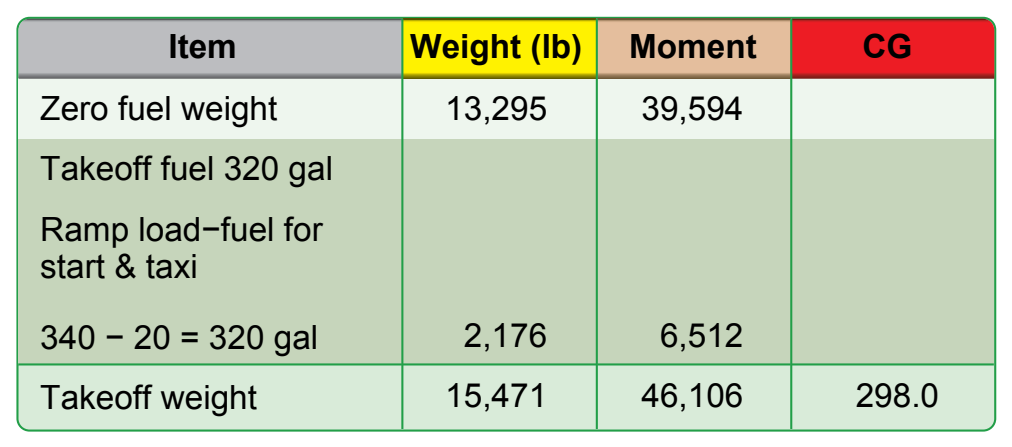
- The fuel is computed at 6.8 lb/gal. The ramp load is 340 gallons or 2,312 pounds. Fuel used for start and taxi is 20 gallons, or 136 pounds. Fuel remaining at landing is 100 gallons, or 680 pounds.
- Maximum takeoff weight is 16,600 pounds.
- Maximum zero fuel weight is 14,000 pounds.
- Maximum landing weight is 16,000 pounds.
Take these steps to determine which limit, if any, is exceeded:
- Determine the zero fuel weight, which is the weight of the aircraft with all of the useful load except the fuel onboard. [Figure 9-55]
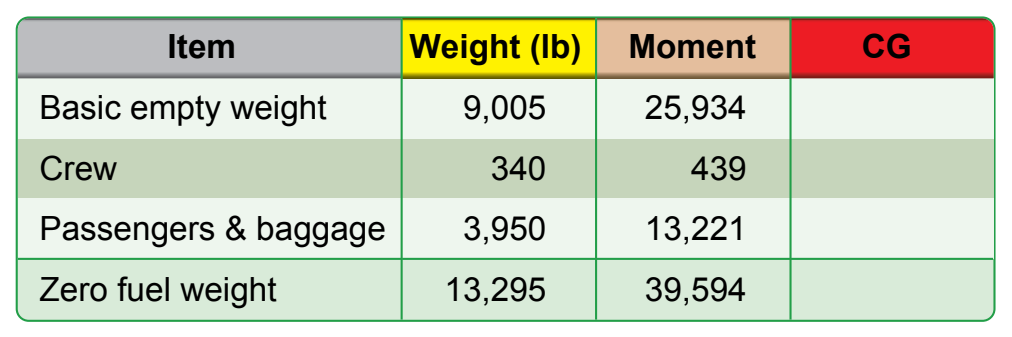
The zero fuel weight of 13,295 pounds is less than the maximum of 14,000 pounds, so this parameter is acceptable.
- Determine the takeoff weight and CG. The takeoff weight is the zero fuel weight plus the weight of the ramp load of fuel, minus the weight of the fuel used for start and taxi. The takeoff CG is the moment/100 divided by the weight, and then the result multiplied by 100. The takeoff weight of 15,471 pounds is below the maximum takeoff weight of 16,600 pounds, and a check of the weight and balance diagram shows that the CG at station 298.0 is also within limits. [Figure 9-56]
- Determine the landing weight and CG. This is the zero fuel weight plus the weight of fuel at landing. [Figure 9-57]
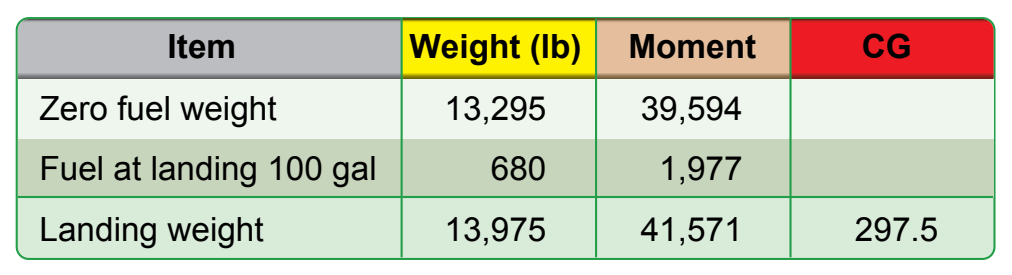
The landing weight of 13,975 pounds is less than the maximum landing weight of 16,000 pounds. According to the weight and balance diagram, the landing CG at station 297.5 is also within limits.