
Chapter 9
Weight and Balance Control—Commuter Category and Large Aircraft
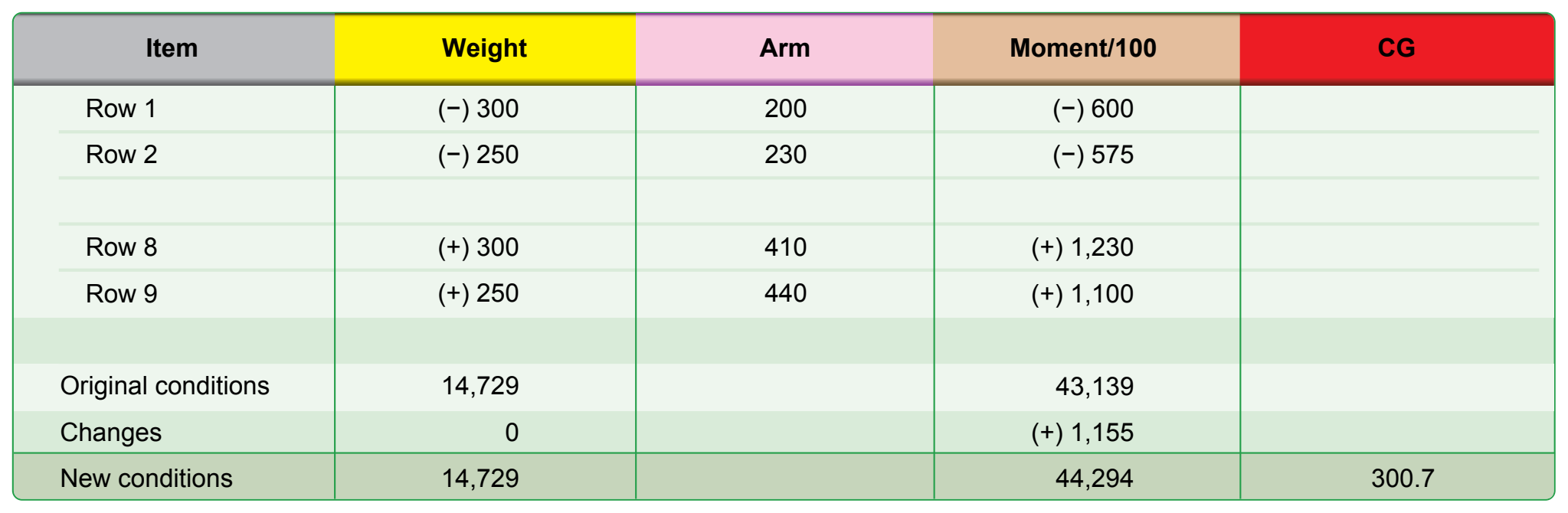
Using the loaded weight and CG of the Beech 1900, calculate the change in CG when the passengers in rows 1 and 2 are moved to rows 8 and 9. [Figure 9-47] Note that there is no weight change, but the moment index has been increased by 1,155 pound-inches/100 to 44,294. The new CG is at fuselage station 300.7. [Figure 9-48]
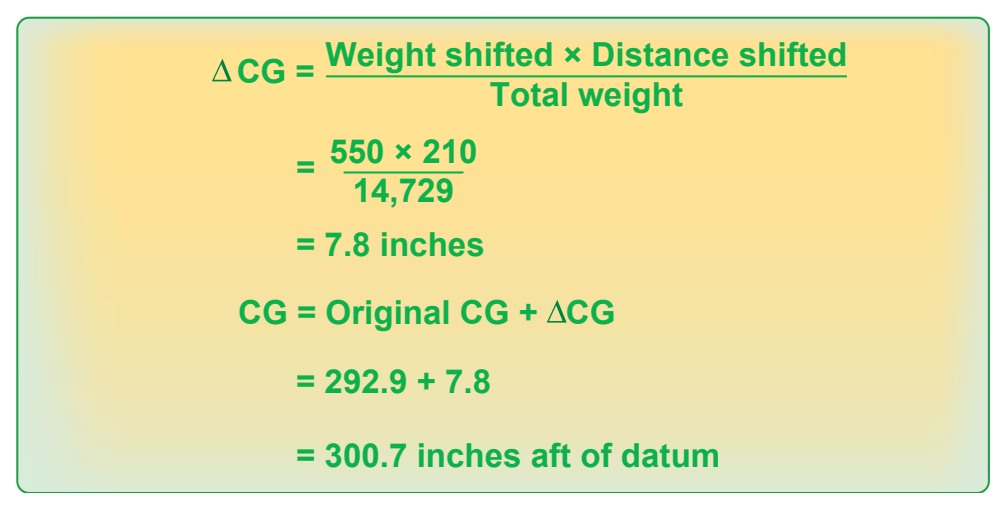
This type of problem is usually solved by using the following two formulas. The total amount of weight shifted is 550 pounds (300 + 250) and both rows of passengers have moved aft by 210 inches (410 – 200 and 440 – 230). The CG has been shifted aft by 7.8 inches, and the new CG is at station 300.7. [Figure 9-49]

In a large cabin aircraft with high-density seating such as the B737-800, the operator must account for the seating of passengers in the cabin [Figure 9-50]. If assigned seating is used to determine passenger location, the operator must implement procedures to ensure the assignment of passenger seating is incorporated into the loading procedure.
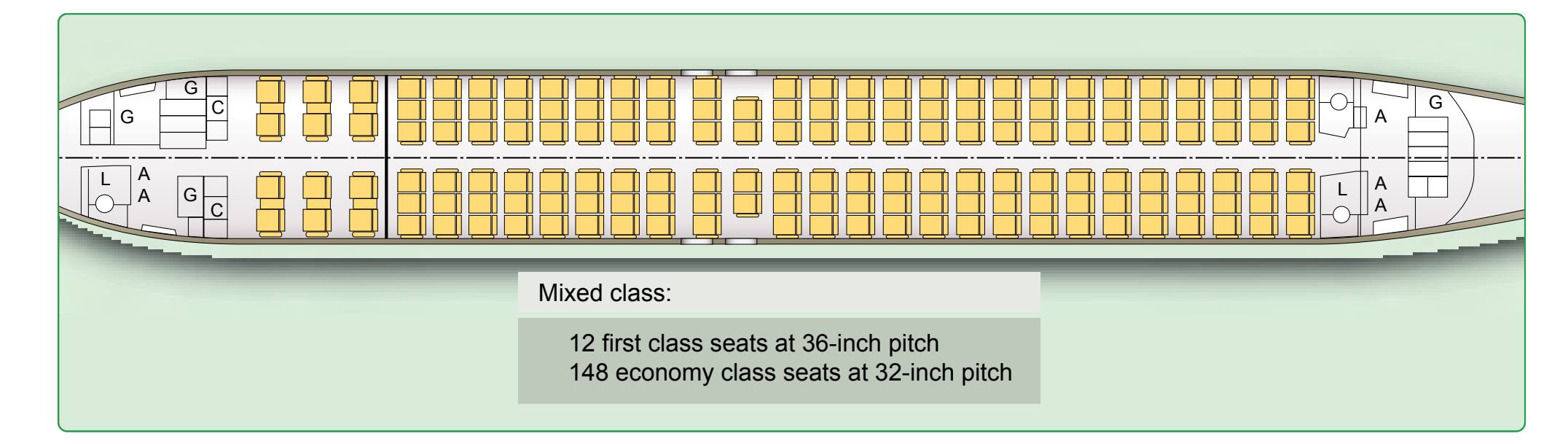
It is recommended that the operator take into account the possibility that some passengers may not sit in their assigned seats.
If the actual seating location of each passenger is not known, the operator may assume that all passengers are seated uniformly throughout the cabin or a specified subsection of the cabin. Reasonable assumptions can be made about the manner in which people distribute themselves throughout the cabin. For example, window seats are occupied first followed by aisle seats, followed by the remaining seats (window-aisle-remaining seating). Both forward and rear loading conditions should be considered. The passengers may fill up the window, aisle, and remaining seats from the front of the aircraft to the back, or the back to the front.
If necessary, the operator may divide the passenger cabin into subsections or zones and manage the loading of each zone individually. It can be assumed that passengers will be sitting uniformly throughout each zone.
Another consideration is the in-flight movement of passengers, crew, and equipment. It is assumed that all passengers, crew, and equipment are secured when the aircraft is in the takeoff or landing configuration. Standard operating procedures should be taken into account. Examples of items that can move during flight are:
- Flight deck crew members moving to the lavatory.
- Flight attendants moving throughout the cabin.
- Service carts moving throughout the cabin.
- Passengers moving throughout the cabin.
- Passengers moving to the lavatory.
Determining Changes in Weight and CG When the Aircraft Is Operated in Its Cargo Configuration
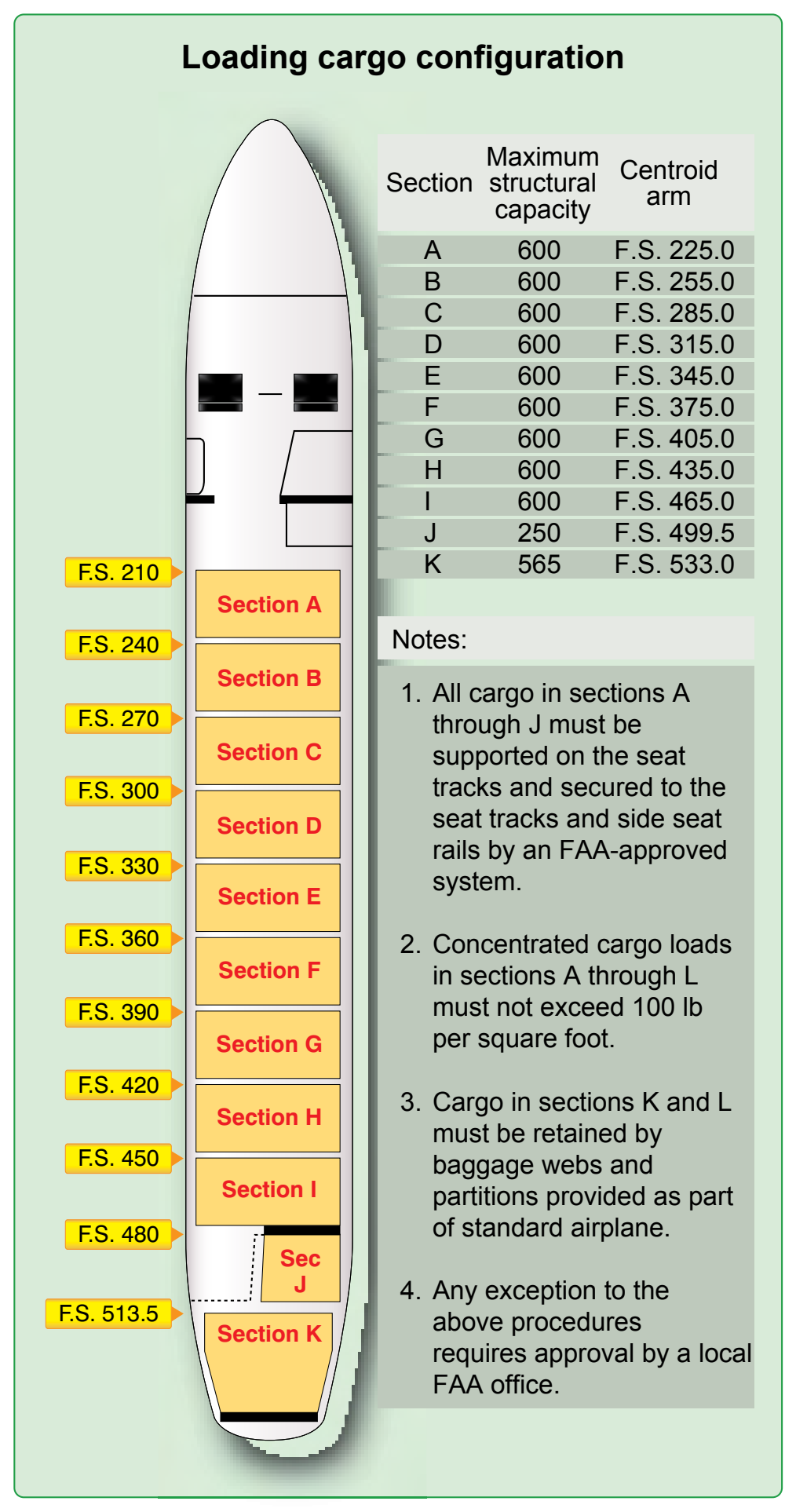
To determine changes in weight and CG when the aircraft is operated in its cargo configuration, the Beech 1900 is used as an example. Figure 9-51 illustrates the airplane configuration. Notice that the arm of each cargo section is the centroid of that section.
The flight manifest of the Beech 1900 in the cargo configuration is illustrated in Figure 9-52. The BOW includes the pilots and their baggage and there is no separate item for them.
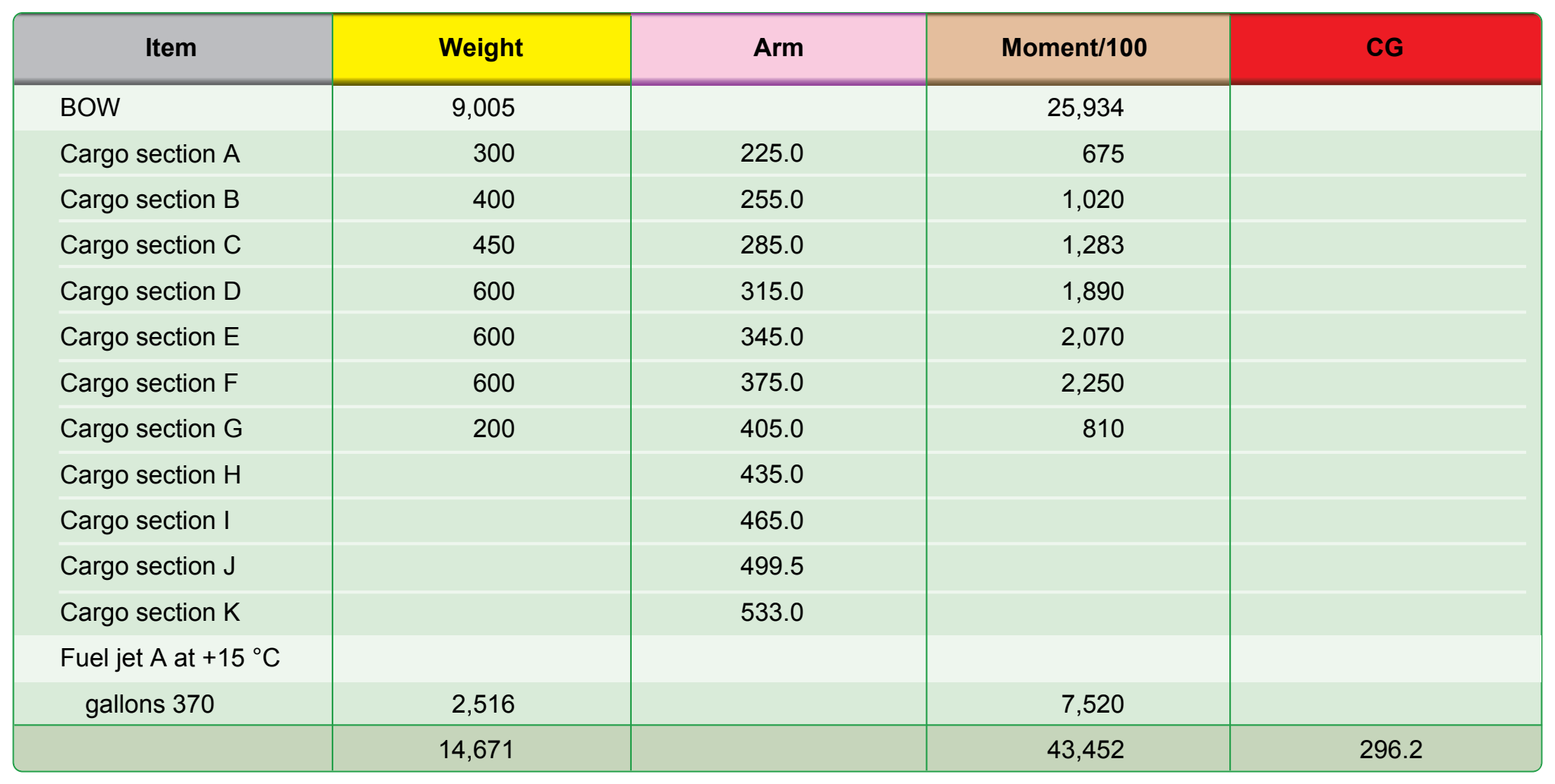
At the standard temperature of 15 °C, the fuel weighs 6.8 pounds per gallon. Refer to Figure 9-45 to determine the weight and moment index of 370 gallons of Jet A fuel. The CG under these loading conditions is located at station 296.2.
Determining the CG Shift When Cargo Is Moved From One Section to Another
To calculate the CG when cargo is shifted from one section to another, use the formula found in Figure 9-53. If the cargo is moved forward, the CG is subtracted from the original CG. If the cargo is shifted aft, add the CG to the original.