
Chapter 12
Transition to Complex Airplanes
Introduction
A high-performance airplane is defined as an airplane with an engine capable of developing more than 200 horsepower (see 14 CFR part 61, section 61.31(f)(1)). A complex airplane (see 14 CFR part 61, section 61.1) means an airplane that has a retractable landing gear, flaps, and a controllable pitch propeller, including airplanes equipped with an engine control system consisting of a digital computer and associated accessories for controlling the engine and propeller, such as a full authority digital engine control; or, in the case of a seaplane, flaps and a controllable pitch propeller, including seaplanes equipped with an engine control system consisting of a digital computer and associated accessories for controlling the engine and propeller, such as a full authority digital engine control.
Transition to a complex airplane, or a high-performance airplane, can be demanding for many pilots. Both increased performance and complexity require additional planning, judgment, and piloting skills. Transition to these types of airplanes, therefore, should be accomplished in a systematic manner through a structured course of training administered by a qualified flight instructor.
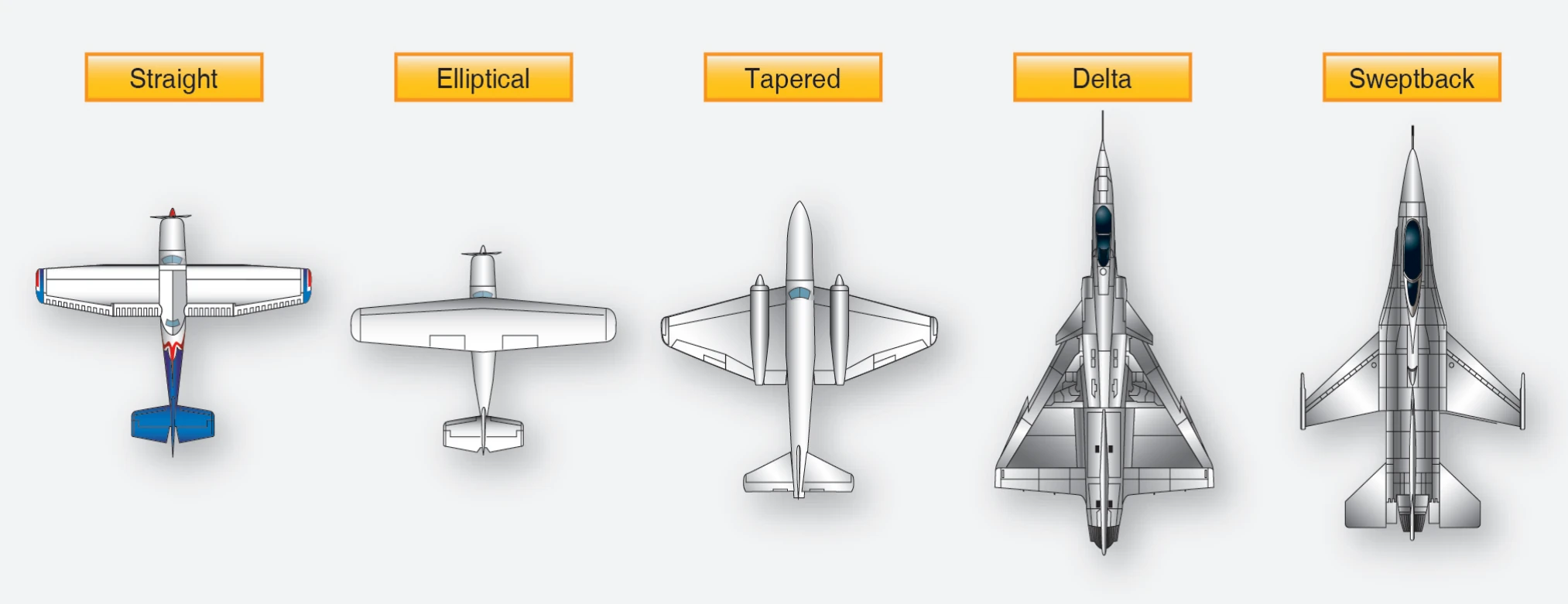
Airplanes can be designed to fly through a wide range of airspeeds. High speed flight requires smaller wing areas and moderately cambered airfoils whereas low speed flight is obtained with airfoils with a greater camber and larger wing area. [Figure 12-1] Many compromises are often made by designers to provide for higher speed cruise flight and low speeds for landing. Flaps are a common design effort to increase an airfoil’s camber and surface area for lower-speed flight. [Figure 12-2]
Since an airfoil cannot have two different cambers at the same time, designers and engineers deliver the desired performance characteristics using two different methods. Either the airfoil can be a compromise, or a cruise airfoil can be combined with a device for increasing the camber of the airfoil for low-speed flight. Camber is the asymmetry between the top and the bottom surfaces of an airfoil. One method for varying an airfoil’s camber is the addition of trailing-edge flaps. Engineers call these devices a high-lift system.
Function of Flaps
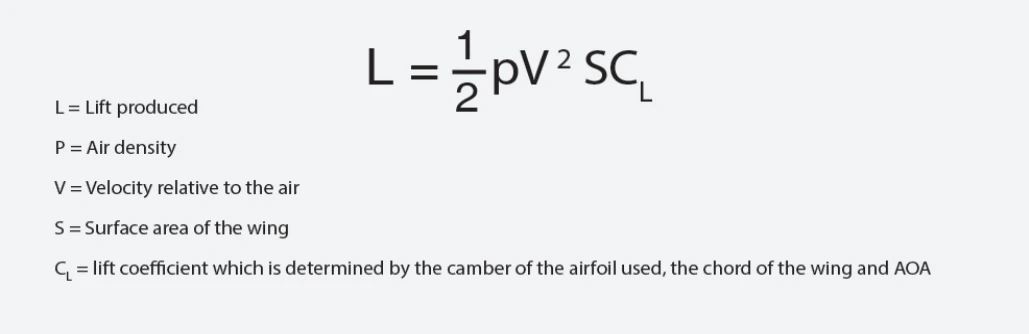
Flaps work primarily by changing the camber of the airfoil, which increases the wing’s lift coefficient. With some flap designs, the surface area of the wing is also increased. Flap deflection does not increase the critical (stall) angle of attack (AOA). In some cases, flap deflection actually decreases the critical AOA. Deflection of a wing’s control surfaces, such as ailerons and flaps, alters both lift and drag. With aileron deflection, there is asymmetrical lift which imparts a rolling moment about the airplane’s longitudinal axis. Wing flaps act symmetrically about the longitudinal axis producing no rolling moment; however, both lift and drag increase as well as a pitching moment about the lateral axis. Lift is a function of several variables including air density, velocity, surface area, and lift coefficient. Since flaps increase an airfoil’s lift coefficient, lift is increased. [Figure 12-3]
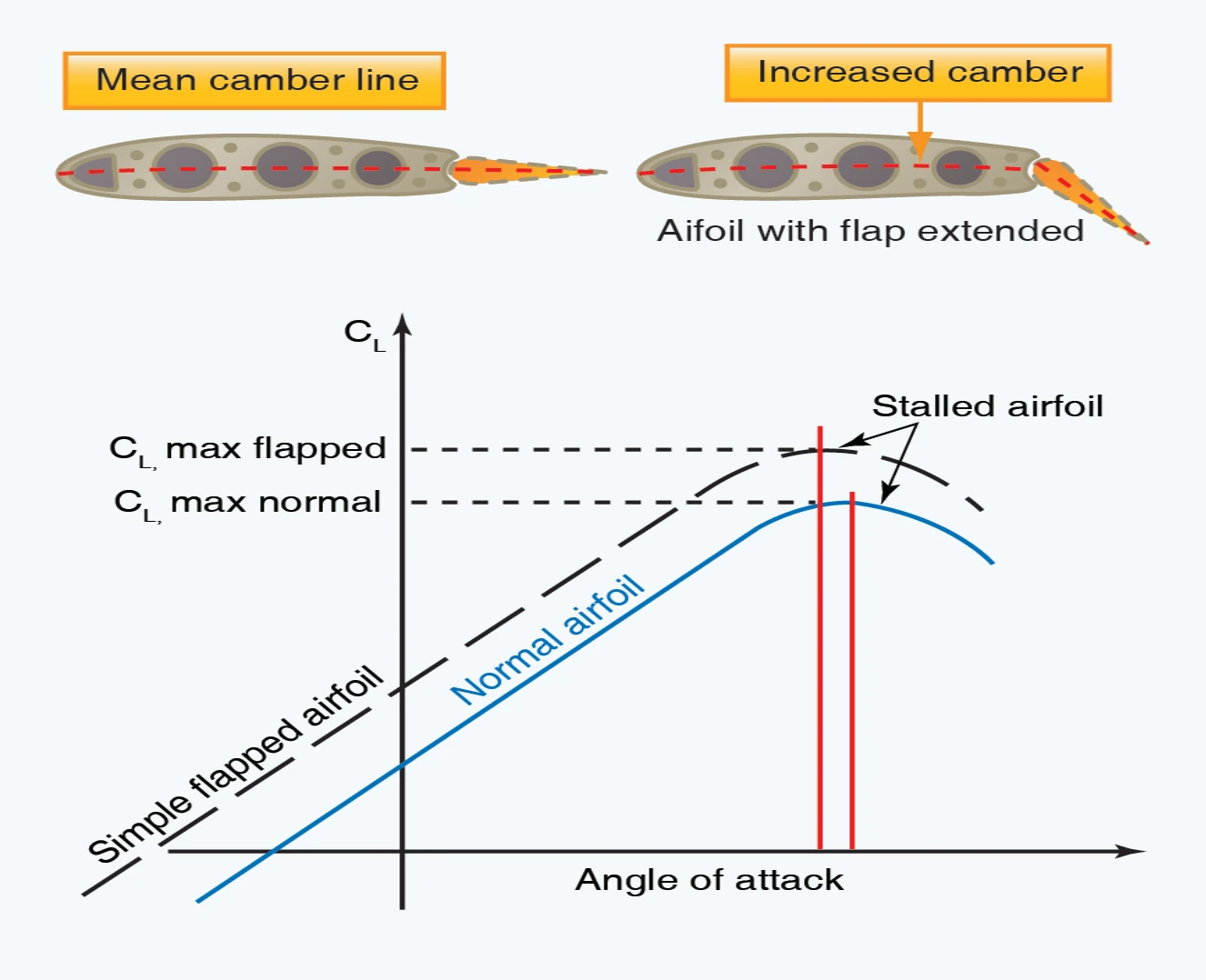
As flaps are deflected, the aircraft may pitch nose-up, nose-down, or have minimal changes in pitch attitude. Pitching moment is caused by the rearward movement of the wing’s center of pressure; however, that pitching behavior depends on several variables including flap type, wing position, downwash behavior, and horizontal tail location. Consequently, pitch behavior depends on the design features of the particular airplane.
Flap deflection of up to 15° primarily produces lift with minimal increases in drag. Deflection beyond 15° produces a large increase in drag. Drag from flap deflection is parasite drag and, as such, is proportional to the square of the speed. Also, deflection beyond 15° produces a significant nose-up pitching moment in most high-wing airplanes because the resulting downwash changes the airflow over the horizontal tail.
Flap Effectiveness
Flap effectiveness depends on a number of factors, but the most noticeable are size and type. For the purpose of this chapter, trailing edge flaps are classified as four basic types: plain (hinge), split, slotted, and Fowler. [Figure 12-4]
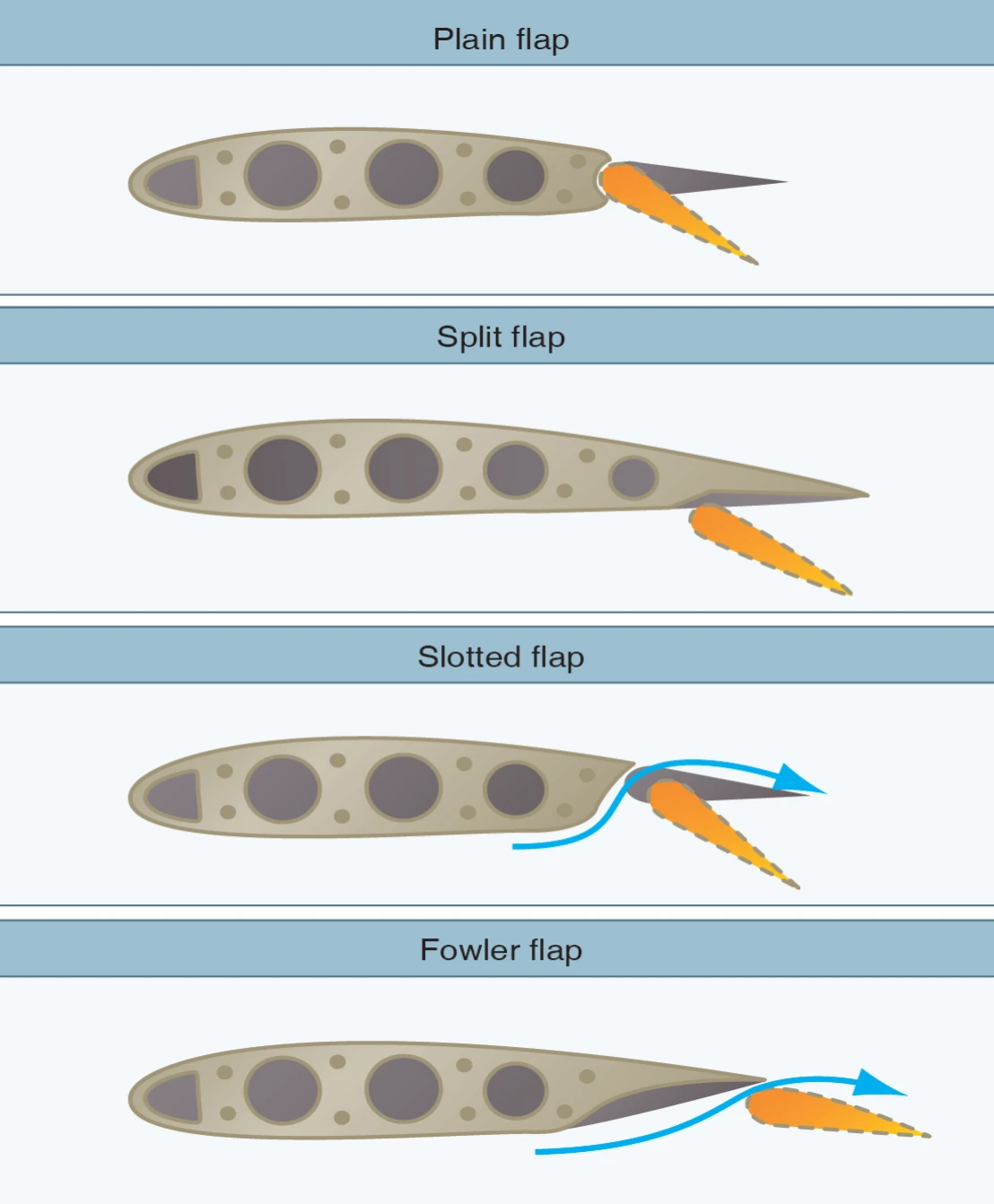
The plain or hinge flap is a hinged section of the wing. The structure and function are comparable to the other control surfaces— ailerons, rudder, and elevator. The split flap is more complex. It is the lower or underside portion of the wing; deflection of the flap leaves the upper trailing edge of the wing undisturbed. It is, however, more effective than the hinge flap because of greater lift and less pitching moment, but there is more drag. Split flaps are more useful for landing, but the partially deflected hinge flaps have the advantage in takeoff. The split flap has significant drag at small deflections, whereas the hinge flap does not because airflow remains “attached” to the flap.
The slotted flap has a gap between the wing and the leading edge of the flap. The slot allows high-pressure airflow on the wing undersurface to energize the lower pressure over the top, thereby delaying flow separation. The slotted flap has greater lift than the hinge flap but less than the split flap; but, because of a higher lift-drag ratio, it gives better takeoff and climb performance. Small deflections of the slotted flap give a higher drag than the hinge flap but less than the split. This allows the slotted flap to be used for takeoff.
The Fowler flap deflects down and aft to increase the wing area. This flap can be multi-slotted making it the most complex of the trailing-edge systems. This system does, however, give the maximum lift coefficient. Drag characteristics at small deflections are much like the slotted flap. Fowler flaps are most commonly used on larger airplanes because of their structural complexity and difficulty in sealing the slots.
Operational Procedures
It would be impossible to discuss all the many airplane design and flap combinations. Pilots should refer to the Federal Aviation Administration (FAA) approved Airplane Flight Manual and/or Pilot’s Operating Handbook (AFM/POH) for a given airplane. However, while some AFM/POHs are specific as to operational use of flaps, others leave the use of flaps to pilot discretion. Since flaps are often used for landings and takeoffs, when the airplane is close to the ground, pilot judgment and error avoidance are of critical importance.