
Chapter 13
Transition to Multiengine Airplanes
The precise condition of zero sideslip (bank angle and ball position) varies slightly from model to model and with available power and airspeed. If the airplane is not equipped with counter-rotating propellers, it also varies slightly with the engine failed due to P-factor. The foregoing zero sideslip recommendations apply to reciprocating engine multiengine airplanes flown at VYSE with the inoperative engine feathered. The zero sideslip ball position for straight flight is also the zero sideslip position for turning flight.
The actual bank angle for zero sideslip varies among airplanes from one and one-half to two and one-half degrees. The position of the ball varies from one-third to one-half of a ball width from instrument center toward the operative engine.
During certain flight training scenarios, pilots and instructors simulate propeller feathering. Zero thrust means the pilot sets power on one engine such that drag from its rotating propeller equals that of a stopped feathered propeller. With an engine set to zero thrust (or feathered) and the airplane slowed to VYSE, a climb with maximum power on the remaining engine reveals the precise bank angle and ball deflection required for zero sideslip and best climb performance. Again, if a yaw string were present, it aligns itself vertically on the windshield as an indication of zero sideslip. There are very minor changes from this attitude depending upon the engine failed (with non-counter-rotating propellers), power available, airspeed, and weight; but without more sensitive testing equipment, these changes are difficult to detect. The only significant difference would be the pitch attitude required to maintain VYSE under different density altitude, power available, and weight conditions.
Low Altitude Engine Failure Scenarios
In OEI flight at low altitudes and airspeeds such as the initial climb after takeoff, pilots should operate the airplane so as to guard against the three major accident factors: (1) loss of directional control, (2) loss of performance, and (3) loss of flying speed. All have equal potential to be lethal. Loss of flying speed is not a factor, however, when the airplane is operated with due regard for directional control and performance.
A takeoff or go-around is the most critical time to suffer an engine failure. The airplane will be slow, close to the ground, and may even have landing gear and flaps extended. Altitude and time is minimal. Until feathered, the propeller of the failed engine is windmilling, producing a great deal of drag and yawing tendency. Airplane climb performance is marginal or even non-existent, and obstructions may lie ahead. An emergency contingency plan and safety brief should be clearly understood well before the takeoff roll commences. An engine failure before a predetermined airspeed or point results in an aborted takeoff. An engine failure after a certain airspeed and point, with the gear up, and climb performance assured result in a continued takeoff. With loss of an engine, it is paramount to maintain airplane control and comply with the manufacturer’s recommended emergency procedures. Complete failure of one engine shortly after takeoff can be broadly categorized into one of three following scenarios.
Landing Gear Down
If the engine failure occurs prior to selecting the landing gear to the UP position [Figure 13-18]: Keep the nose as straight as possible, close both throttles, adjust pitch attitude to maintain adequate airspeed, and descend to the runway. Concentrate on a normal landing and do not force the aircraft on the ground. Land on the remaining runway or overrun. Depending upon how quickly the pilot reacts to the sudden yaw, the airplane may run off the side of the runway by the time action is taken. There are really no other practical options. As discussed earlier, the chances of maintaining directional control while retracting the flaps (if extended), landing gear, feathering the propeller, and accelerating are minimal. On some airplanes with a single-engine-driven hydraulic pump, failure of that engine means the only way to raise the landing gear is to allow the engine to windmill or to use a hand pump. This is not a viable alternative during takeoff.
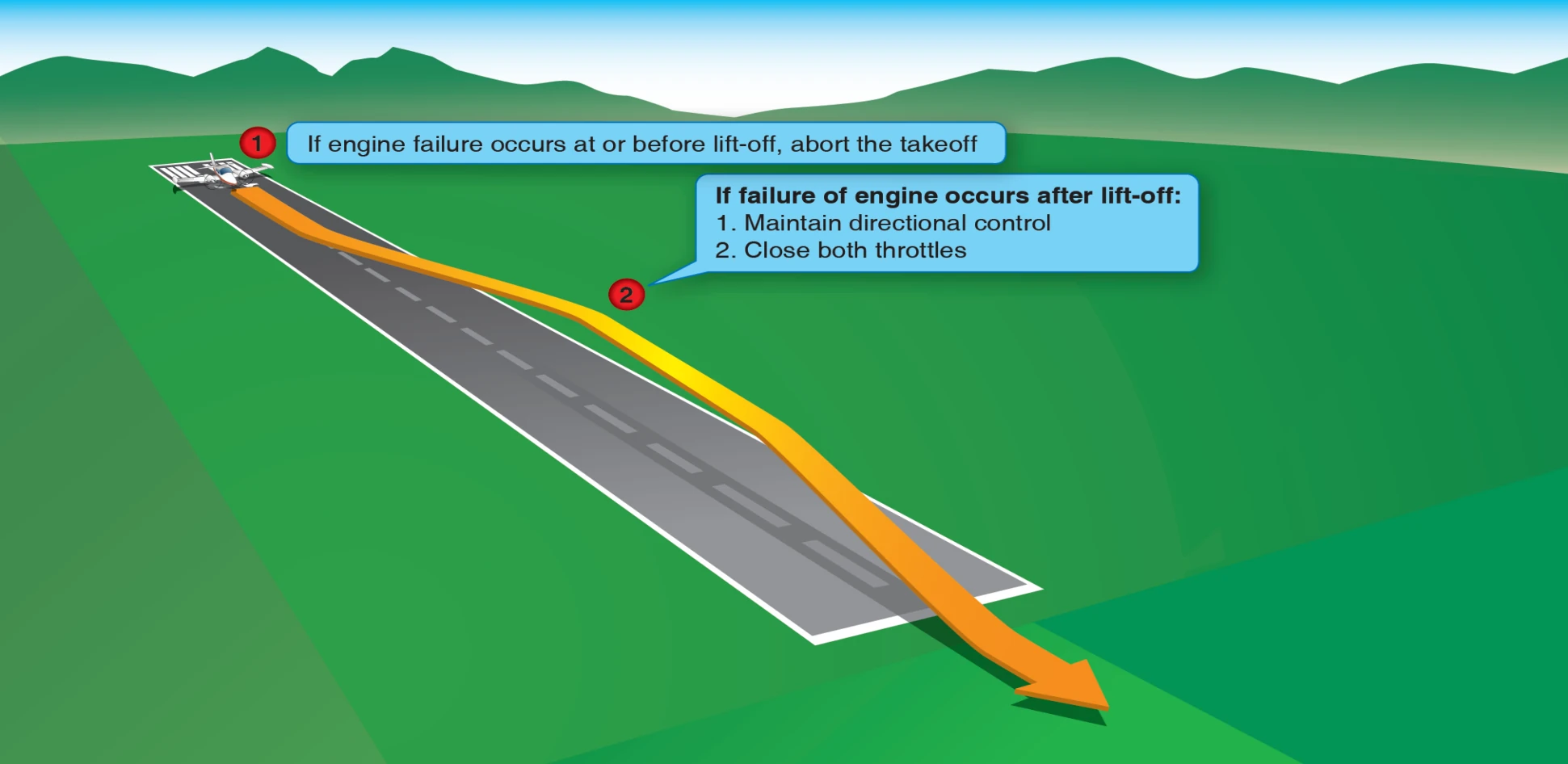
Landing Gear Control Selected Up, Single-Engine Climb Performance Inadequate
When operating near or above the single-engine ceiling and an engine failure is experienced shortly after lift-off, a landing needs to be accomplished on whatever essentially lies ahead. [Figure 13-19] There is also the option of continuing ahead, in a descent at VYSE with the remaining engine producing power, as long as the pilot is not tempted to remain airborne beyond the airplane’s performance capability. Remaining airborne and bleeding off airspeed in a futile attempt to maintain altitude is almost invariably fatal. Landing under control is paramount. The greatest hazard in a single-engine takeoff is attempting to fly when it is not within the performance capability of the airplane to do so. An accident is inevitable.

Analysis of engine failures on takeoff reveals a very high success rate of off-airport engine inoperative landings when the airplane is landed under control. Analysis also reveals a very high fatality rate in stall spin accidents when the pilot attempts flight beyond the performance capability of the airplane.
As mentioned previously, if the airplane’s landing gear retraction mechanism is dependent upon hydraulic pressure from a certain engine-driven pump, failure of that engine can mean a loss of hundreds of feet of altitude as the pilot either windmills the engine to provide hydraulic pressure to raise the gear or raises it manually with a backup pump.
Landing Gear Control Selected Up, Single-Engine Climb Performance Adequate
If the single-engine rate of climb is adequate, the procedures for continued flight should be followed. [Figure 13-20] There are four areas of concern: control, configuration, climb, and checklist.
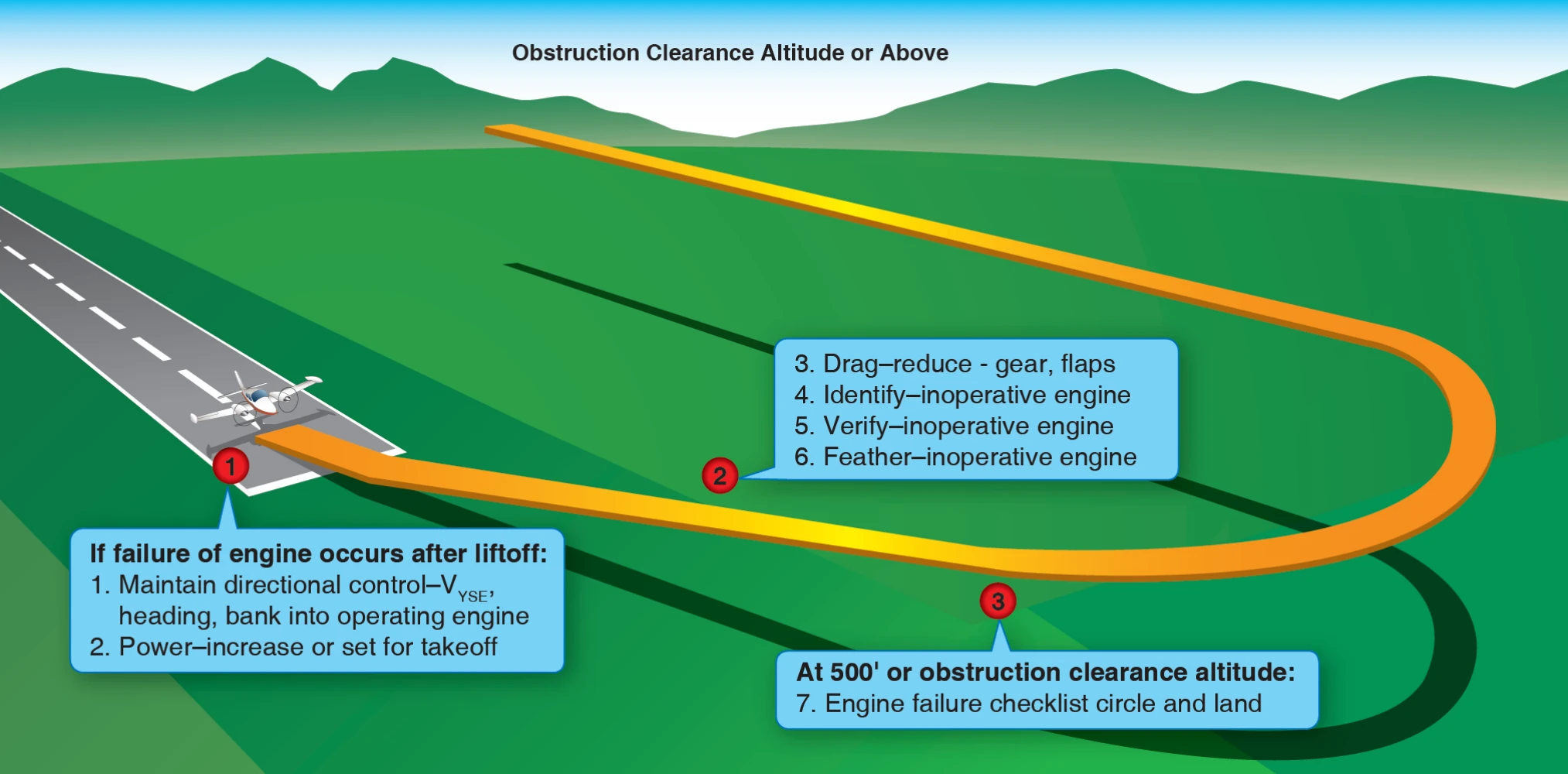
Control
The first consideration following engine failure during takeoff is to maintain control of the airplane. Maintaining directional control with prompt and often aggressive rudder application and STOPPING THE YAW is critical to the safety of flight. Ensure that airspeed stays above VMC. If the yaw cannot be controlled with full rudder applied, reducing thrust on the operative engine is the only alternative. Attempting to correct the roll with aileron without first applying rudder increases drag and adverse yaw and further degrades directional control. After rudder is applied to stop the yaw, a slight amount of aileron should be used to bank the airplane toward the operative engine. This is the most efficient way to control the aircraft, minimize drag, and gain the most performance. Control forces, particularly on the rudder, may be high. The pitch attitude for VYSE has to be lowered from that of VY. At least 5° and a maximum of 10° of bank toward the operative engine should be used initially to stop the yaw and maintain directional control. This initial bank input is held only momentarily, just long enough to establish or ensure directional control. Climb performance suffers when bank angles exceed approximately 2 or 3°, but obtaining and maintaining VYSE and directional control are paramount. Trim should be adjusted to lower the control forces.