
Chapter 15
Transition to Turbopropeller-Powered Airplanes
Introduction
The turbopropeller-powered airplane flies and handles just like any other airplane of comparable size and weight, since the aerodynamics are the same. The major differences between flying a turboprop and other non-turbine-powered airplanes are found in the handling of the airplane’s powerplant and its associated systems, which are unique to gas turbine engines. The turbopropeller-powered airplane also has the advantage of being equipped with a constant speed, full feathering and reversing propeller—something normally not found on piston-powered airplanes.
Gas Turbine Engine
Both piston (reciprocating) engines and gas turbine engines are internal combustion engines. They have a similar cycle of operation that consists of induction, compression, combustion, expansion, and exhaust. In a piston engine, each of these events is a separate distinct occurrence in each cylinder. Also in a piston engine, an ignition event occurs during each cycle in each cylinder. Unlike reciprocating engines, in gas turbine engines these phases of power occur simultaneously and continuously instead of successively one cycle at a time. Additionally, ignition occurs during the starting cycle and is continuous thereafter. The basic gas turbine engine contains four sections: intake, compression, combustion, and exhaust. [Figure 15-1]
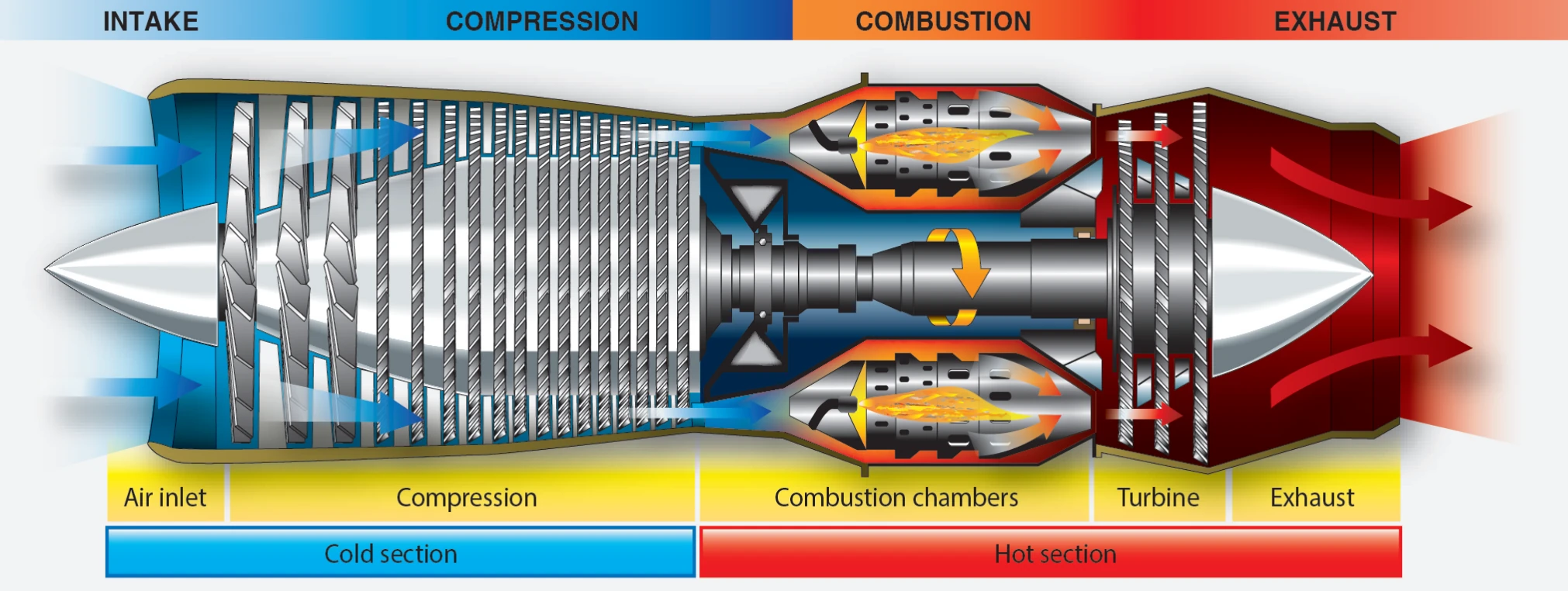
To start a gas turbine engine, the compressor section is normally rotated by an electric starter. As compressor revolutions per minute (rpm) increase, air flowing through the inlet is compressed to a high pressure, delivered to the combustion section, and ignited. In gas turbine engines, not all of the compressed air is used to support combustion. Some of the compressed air bypasses the burner section within the engine to provide internal cooling. The fuel/air mixture in the combustion chamber burns in a continuous combustion process and produces a very high temperature, typically around 4,000° Fahrenheit (F). When this hot air mixes with bypass air, the temperature of the mixed air mass drops to 1,600 – 2,400 °F. The mixture of hot air and gases expands and passes through the turbine blades forcing the turbine section to rotate. The turbine drives the compressor section by means of a direct shaft, a concentric shaft, or a combination of both. After powering the turbine section, the combustion gases and bypass air flow out of the engine through the exhaust. Once the hot gases from the burner section provide sufficient power to maintain engine operation through the turbine, the starter is de-energized, and the starting sequence ends. Combustion continues until the engine is shut down by cutting off the fuel supply.
Note: Because compression produces heat and pressure, some pneumatic aircraft systems tap into the source of hot compressed air from the engine compressor (bleed air) and use it for engine anti-ice, airfoil anti-ice, aircraft pressurization, and other ancillary systems after further conditioning its internal pressure and temperature.
Turboprop Engines
The turbojet engine (discussed in more detail in the Transition to Jet-Powered Airplanes chapter) excels the reciprocating engine in top speed and altitude performance. On the other hand, the turbojet engine has limited takeoff and initial climb performance when compared to its overall performance. In the matter of takeoff and initial climb performance, the reciprocating engine with a constant speed propeller produces maximum thrust on takeoff. Turbojet engines are most efficient at high speeds and high altitudes, while propellers are most efficient at slow and medium speeds (less than 400 miles per hour (mph)). Propellers also improve takeoff and climb performance. The development of the turboprop engine was an attempt to combine the best characteristics of both the turbojet and propeller-driven reciprocating engine.
The turboprop engine offers several advantages over other types of engines, such as:
- Light weight
- Mechanical reliability due to relatively few moving parts
- Simplicity of operation
- Minimum vibration
- High power per unit of weight
- Use of propeller for takeoff and landing
Turboprop engines are most efficient at speeds between 250 and 400 mph and altitudes between 18,000 and 30,000 feet. They also perform well at the slow speeds required for takeoff and landing and are fuel efficient. The minimum specific fuel consumption of the turboprop engine is normally available in the altitude range of 25,000 feet up to the tropopause.
The power output of a piston engine is measured in horsepower and is determined primarily by rpm and manifold pressure. The power of a turboprop engine, however, is measured in shaft horsepower (shp). Shaft horsepower is determined by the rpm and the torque (twisting moment) applied to the propeller shaft. Since turboprop engines are gas turbine engines, some jet thrust is produced by exhaust leaving the engine. This thrust is added to the shaft horsepower to determine the total engine power or equivalent shaft horsepower (eshp). Jet thrust usually accounts for less than 10 percent of the total engine power.
Although the turboprop engine is more complicated and heavier than a turbojet engine of equivalent size and power, it delivers more thrust at low subsonic airspeeds. However, the advantages decrease as flight speed increases. In normal cruising speed ranges, the propulsive efficiency (output divided by input) of a turboprop decreases as speed increases.
The propeller of a typical turboprop engine is responsible for roughly 90 percent of the total thrust under sea level conditions on a standard day. The excellent performance of a turboprop during takeoff and climb is the result of the ability of the propeller to accelerate a large mass of air while the airplane is moving at a relatively low ground and flight speed. “Turboprop,” however, should not be confused with “turbo supercharged” or similar terminology. All turbine engines have a similarity to normally aspirated (non-supercharged) reciprocating engines in that maximum available power decreases almost as a direct function of increased altitude.
Although power decreases as the airplane climbs to higher altitudes, engine efficiency in terms of specific fuel consumption (expressed as pounds of fuel consumed per horsepower per hour) is increased. Decreased specific fuel consumption plus the increased true airspeed at higher altitudes is a definite advantage of a turboprop engine.
All turbine engines should operate within their limiting temperatures, rotational speeds, and (in the case of turboprops) torque. Depending on the installation, the primary parameter for power setting might be temperature, torque, fuel flow, or rpm (either propeller rpm, gas generator (compressor) rpm, or both). In cold weather conditions, torque limits can be exceeded while temperature limits are still within acceptable range. In hot weather conditions, the maximum temperature limits may be exceeded without exceeding torque limits. In any weather, reaching one of these operating limits normally occurs before the pilot moves the throttles to the full forward position. The transitioning pilot should understand the importance of knowing and observing limits on turbine engines. An over temperature or over torque condition that lasts for more than a few seconds can destroy internal engine components.
Turboprop Engine Types
Fixed-Shaft
One type of turboprop engine is the fixed-shaft constant-speed type, such as the Garrett TPE331. [Figure 15-2] In this type engine, ambient air is directed to the compressor section through the engine inlet. An acceleration/diffusion process in the two-stage compressor increases air pressure and directs it rearward to a combustor. The combustor is made up of a combustion chamber, a transition liner, and a turbine plenum. Atomized fuel is added to the air in the combustion chamber. Air also surrounds the combustion chamber to provide for cooling and insulation of the combustor.