
Chapter 16
Transition to Jet-Powered Airplanes
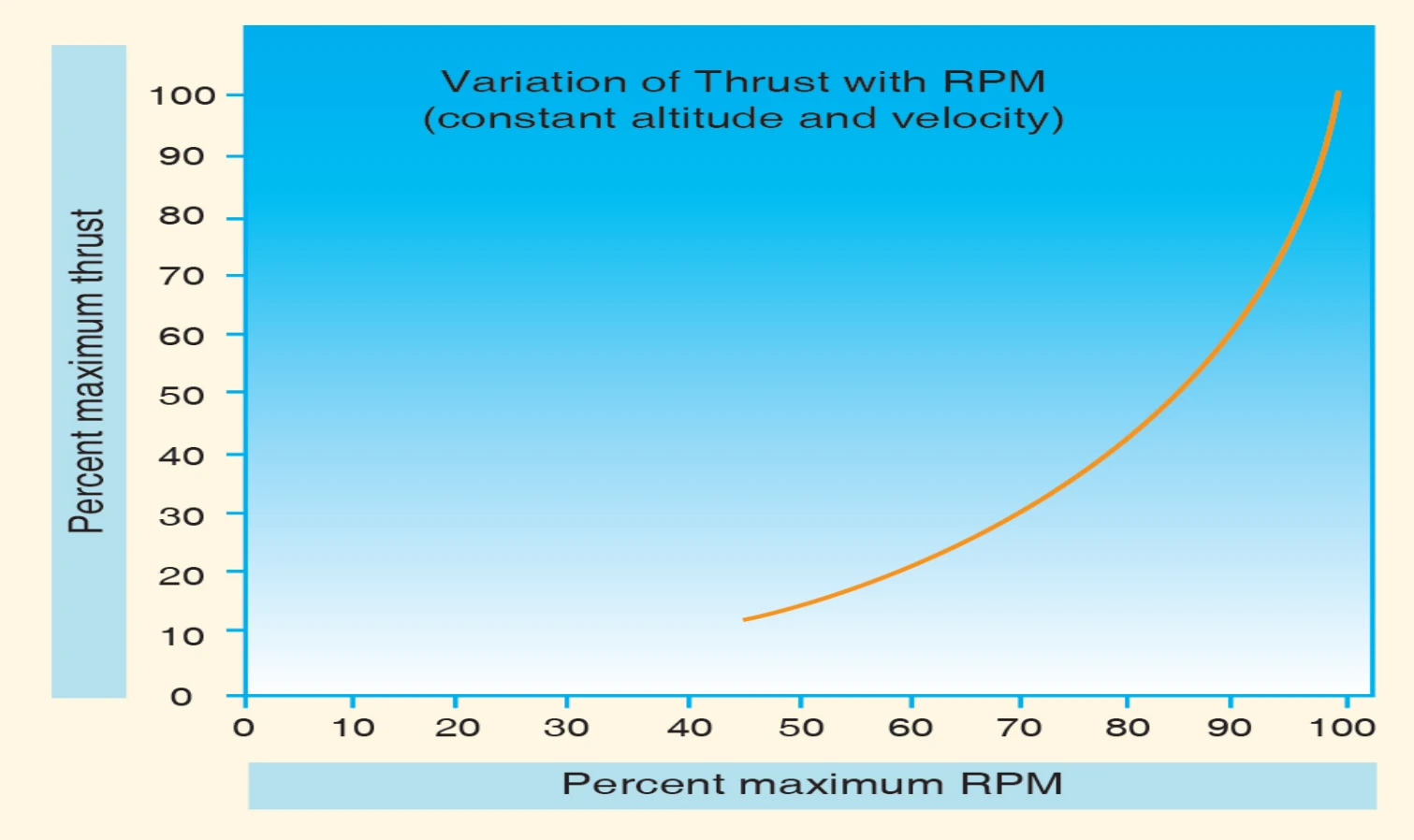
Variation of Thrust with RPM
Jets operate most efficiently in the 85 percent to 100 percent range. At idle rpm of approximately 55 percent to 60 percent, they produce a relatively small amount of thrust. An increase in rpm from 90 to 100 percent may increase thrust by as much as the total available at 70 percent. [Figure 16-3]
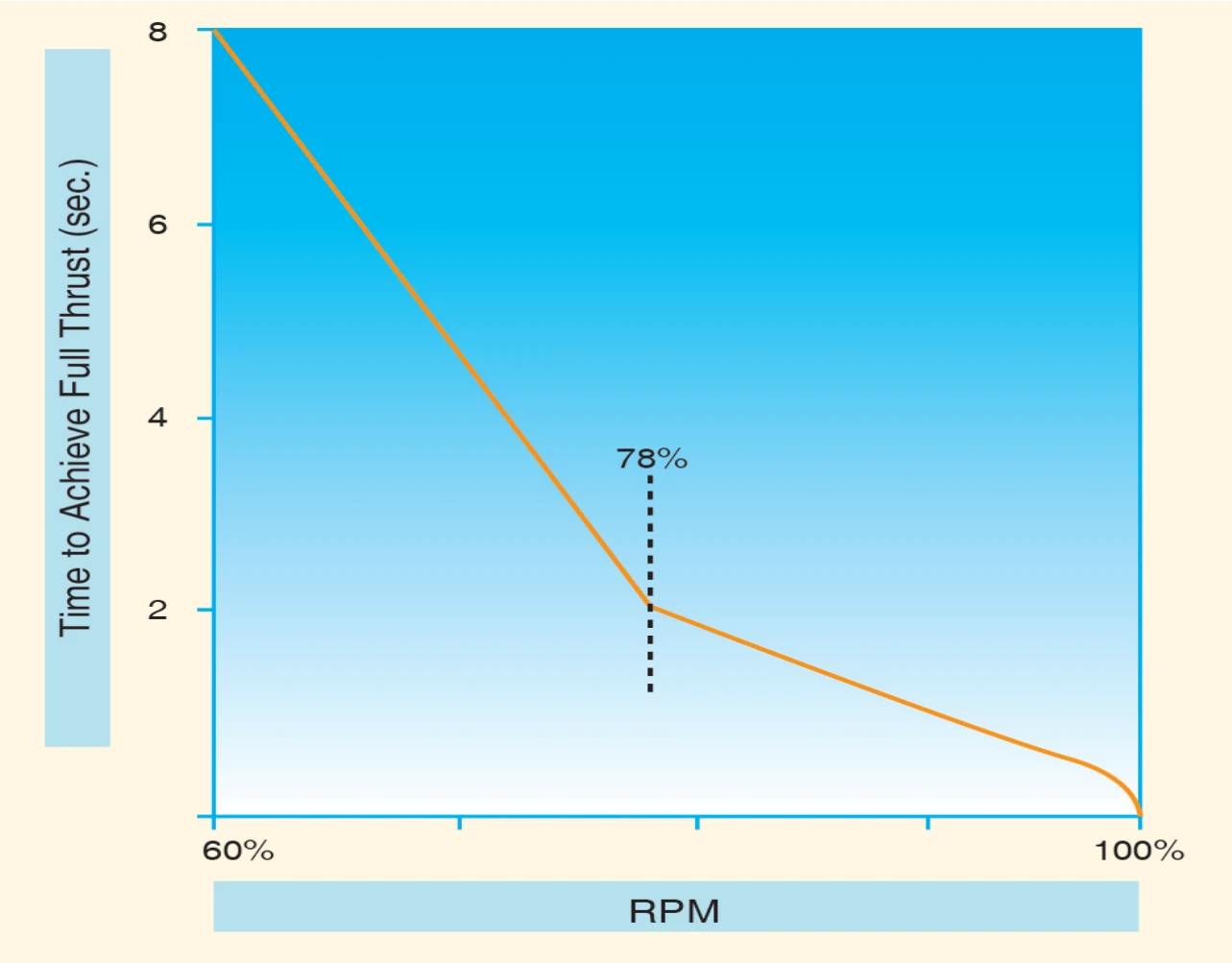
Slow Acceleration of the Jet Engine
Acceleration of a piston engine from idle to full power is relatively rapid. The acceleration on different jet engines can vary considerably, but it is usually much slower. In some cases, the transition to full power could take up to 10 seconds. [Figure 16-4] Pilots should anticipate the need for adding power from low power settings.
Jet Engine Efficiency
The efficiency of the jet engine increases in the cold temperatures found at high altitudes. The fuel consumption of jet engines decreases as the outside air temperature decreases for constant engine rpm and true airspeed (TAS). Thus, by flying at a high altitude, the airplane operates with improved fuel economy and speed. At high altitudes, engines may be operating close to rpm or temperature limits, and excess thrust may not be available. Therefore, pilots should accomplish all maneuvering within the limits of available thrust, stability, and controllability.
Absence of Propeller Effects
The absence of a propeller affects the operation of jet-powered airplanes. Specific effects include the absence of lift from the propeller slipstream and the absence of propeller drag.
Absence of Propeller Slipstream
A propeller produces thrust by accelerating a large mass of air rearward. With wing-mounted engines, this air passes over a comparatively large percentage of the wing area. The total lift equals the sum of the lift generated by the wing area not in the wake of the propeller (as a result of airplane speed) and the lift generated by the wing area influenced by the propeller slipstream. By increasing or decreasing the speed of the slipstream air, it is possible to increase or decrease the total lift on the wing without changing airspeed. Since the jet airplane has no propellers, the transitioning pilot should note the following:
- Lift is not increased instantly by adding power.
- The stall speed is not decreased by adding power.
The lack of ability to produce instant lift in the jet, along with the slow acceleration of jet engines, necessitates a stabilized approach where landing configuration, constant airspeed, controlled rate of descent, and stable power settings are maintained until over the threshold of the runway. This allows for better engine response when making minor changes in the approach speed or rate of descent and improves go-around performance.
Absence of Propeller Drag
When the throttles are closed on a piston-powered airplane, the propellers create significant drag. Airspeed or altitude is immediately decreased. The effect of reducing power to idle on the jet engine, however, produces no such drag effect. In fact, at an idle power setting, the jet engine still produces forward thrust. While this can be an advantage in certain descent profiles, it is a handicap when it is necessary to lose speed quickly. The lack of propeller drag, along with the aerodynamically clean airframe of the jet, are new to most pilots, and slowing the airplane down is one of the initial problems encountered by pilots transitioning into jets. In level flight at idle power, it takes about 1 mile to lose 10 knots of airspeed.
Speed Margins
Maximum speeds in jet airplanes are expressed differently and always define the maximum operating speed of the airplane, which is comparable to the VNE of the piston airplane. These maximum speeds in a jet airplane are referred to as:
- VMO —maximum operating speed expressed in terms of knots.
- MMO —maximum operating speed expressed as a Mach number (the decimal ratio of true airspeed to the speed of sound).
Mach number is the ratio of true airspeed to the speed of sound. The speed of sound varies with temperature. At low/warm altitudes, the speed of sound is so high that an aircraft is limited by indicated airspeed. At high/cold altitudes, the speed of sound is lower so the aircraft is limited by Mach. To observe both limits VMO and MMO, the pilot of a jet airplane needs both an airspeed indicator and a Mach indicator. In most jet airplanes, these are combined into a single display for airspeed and Mach number, as appropriate.