
Chapter 16
Transition to Jet-Powered Airplanes
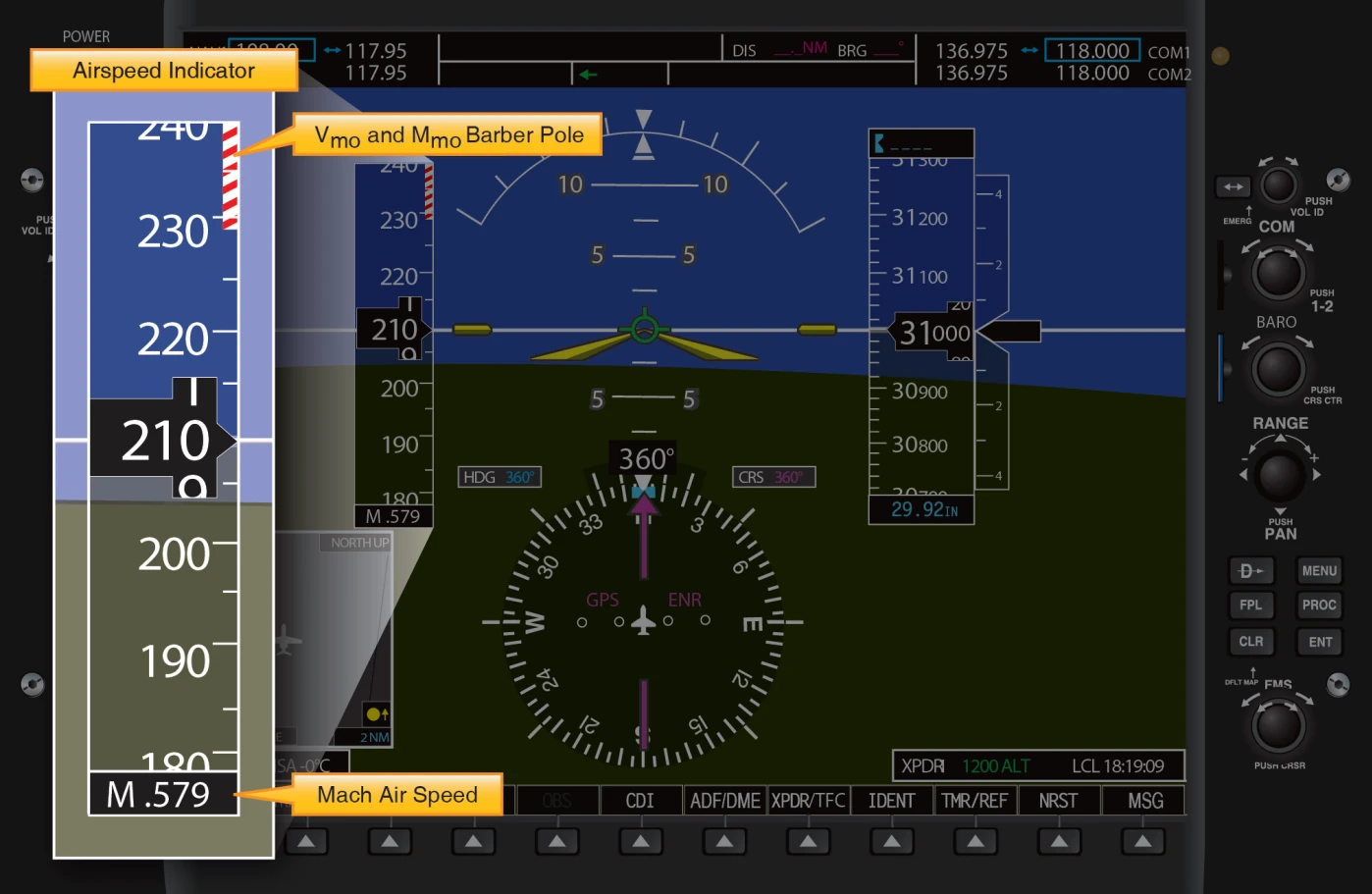
It looks much like a conventional airspeed display with the addition of a "barber pole" that automatically moves so as to indicate the applicable speed limit at all times. [Figure 16-5]
A jet airplane can easily exceed its speed limitations. The handling qualities of a jet may change significantly at speeds higher than the maximum allowed.
High-speed airplanes designed for subsonic flight are limited to some Mach number below the speed of sound. Shock waves (and the adverse effects associated with them) can occur when the airplane speed is substantially below Mach 1.0. The Mach number at which some portion of the airflow over the wing first equals Mach 1.0 is termed the critical Mach number (MCR ).
There is no particular problem associated with the acceleration of the airflow up to the critical Mach number, the point where Mach 1.0 airflow begins. However, a shock wave is formed at the point where the airflow suddenly returns to subsonic flow. This shock wave becomes more severe and moves aft on the wing as airflow velocity increases. Eventually, flow separation occurs behind the well-developed shock wave. [Figure 16-6]
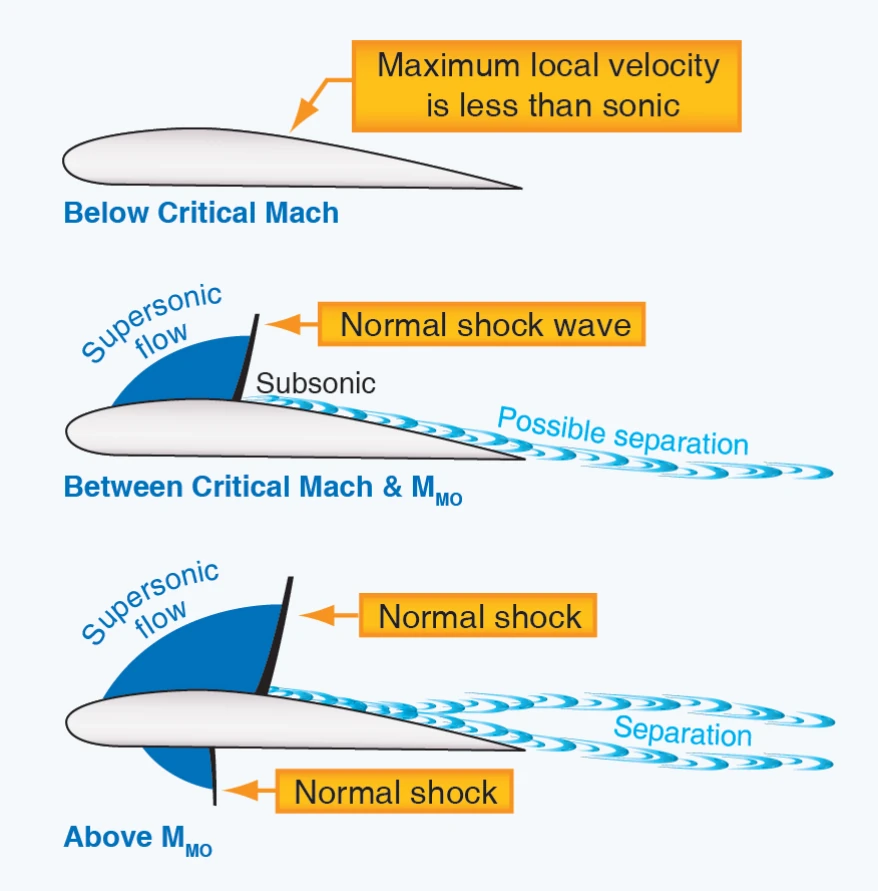
If airplane speed progresses sufficiently beyond MMO, the separation of air behind the shock wave may result in severe buffeting and possible loss of control or “upset.” Because of the accompanying changes to the center of lift, the airplane may exhibit pitch change tendencies.
With increased speed and the aft movement of the shock wave, the wing’s center of pressure moves aft causing the start of a nose-down tendency or “tuck.” Mach tuck develops gradually, and the condition should not be allowed to progress to where there is no longer enough elevator authority to prevent entry into a steep, sometimes unrecoverable, dive. An alert pilot should respond to excessive airspeed, buffeting, or warning devices before the onset of extreme nose-down forces.
Due to the critical aspects of high-altitude/high-Mach flight, most jet airplanes capable of operating in the Mach ranges use some form of automated Mach tuck compensation. If the system becomes inoperative, the airplane is typically limited to a reduced maximum Mach number.
Mach Buffet
Mach buffet arises when airflow separates on the upper surface of a wing behind a shock wave. All other things being equal, shock wave strength increases as the local airflow speed ahead of the shock wave increases. Mach buffet is a function of the speed of the airflow over the wing—not necessarily the forward speed of the airplane, and the shock wave strength, rather than a stall, creates the airflow separation.
Mach buffet may result from two different conditions in cruise. At high-speed cruise, a shock wave that becomes too strong as the airflow speeds up over the upper surface causes a buffet. At low-speed cruise, the flow has a greater turn to make to follow the wing's upper surface. The air speeds up to do that and may exceed Mach 1 over the upper surface.
The shock wave position is different between the two situations. At high speed and a lower AOA, the shock wave tends to move aft. So when the flow separates behind the shock, that separated flow acts over a small range of the chord. In some cases, the separated flow acting on a small surface area may produce a little buzz. At low-speed cruise, the true airspeed is still high, but the shock wave does not move as far aft as it does in high-speed cruise. The separated flow behind the shock wave acts over a larger portion of the chord, which leads to a more significant effect on aircraft control.
The altitude at which an airplane flying at MMO would experience buffeting with any increase in AOA determines the absolute or aerodynamic ceiling. This is the altitude where:
- If an airplane flew any faster, it would exceed MMO leading to high-speed Mach buffet.
- If an airplane flew any slower, it would require an angle of attack leading to low-speed Mach buffet.
This region of the airplane’s flight envelope is known as “coffin corner.” Conceivably, a buffet could be the first indication of an issue at altitude, and pilots should understand the cause of any buffet in order to respond appropriately.
An increase in load factor (G factor) will raise the low-end buffet speed. For example, a jet airplane flying at 51,000 feet altitude at 1.0 G and a speed of 0.73 Mach that experiences a 1.4 G load, may encounter low-speed buffet. Consequently, a maximum cruising flight altitude and speed should be selected, which will allow sufficient margin for maneuvering and turbulence. The pilot should know the manufacturer’s recommended turbulence penetration speed for the particular make and model airplane. This speed normally gives the greatest margin between the high-speed and low-speed buffets.
Low-Speed Flight
The jet airplane wing, designed primarily for high-speed flight, has relatively poor low-speed characteristics. As opposed to the normal piston-powered airplane,thejetwinghaslessarearelativetotheairplane’sweight,a loweraspectratio(longchord/short span), and thin airfoil shape—all of which amount to the need for speed to generate enough lift. The swept wing is additionally penalized at low speeds because its effective lift is proportional to airflow speed that is perpendicular to the leading edge.
In a typical piston-engine airplane, VMD (minimum drag) in the clean configuration is normally at a speed of about 1.3 VS. [Figure 16-7] Flight below VMD in a piston-engine airplane is well identified and predictable. In contrast, in a jet airplane, flight in the area of VMD (typically 1.5 – 1.6 VS ) does not normally produce any noticeable changes in flying qualities other than a lack of speed stability—a condition where a decrease in speed leads to an increase in drag, which leads to a further decrease in speed, which creates the potential for a speed divergence. A pilot who is not aware of a developing speed divergence may find a serious sink rate developing at a constant power setting, while pitch attitude appears to be normal. The fact that lack of speed stability may lead to a sinking flightpath, is one of the most important aspects of jet-airplane flying.