
Chapter 16
Transition to Jet-Powered Airplanes
The following information is generic in nature and, since most civilian jet airplanes require a minimum flight crew of two pilots, assumes a two-pilot crew. If any of the following information conflicts with FAA-approved AFM procedures for a particular airplane, the AFM procedures take precedence. Also, if any of the following procedures differ from the FAA-approved procedures developed for use by a specific air operator and/or for use in an FAA-approved training center or pilot school curriculum, the FAA-approved procedures for that operator and/or training center/pilot school take precedence.
V-Speeds
The following are speeds that affect the jet airplane’s takeoff performance. The jet airplane pilot should understand how to use these speeds when planning for takeoff.
- VS —stalling speed or minimum steady flight speed at which the airplane is controllable.
- V1 —critical engine failure speed or takeoff decision speed. It is the speed at which the pilot is to continue the takeoff in the event of an engine failure or other serious emergency. At speeds less than V1, it is considered safer to stop the aircraft within the accelerate-stop distance. It is also the minimum speed in the takeoff, following a failure of the critical engine at VEF, at which the pilot can continue the takeoff and achieve the required height above the takeoff surface within the takeoff distance.
- VEF —speed used during certification at which the critical engine is assumed to fail.
- VR —rotation speed, or speed at which the rotation of the airplane is initiated to takeoff attitude. This speed cannot be less than V1 or less than 1.05 × VMCA (minimum control speed in the air). On a single-engine takeoff, it also allows for the acceleration to V2 at the 35-foot height at the end of the runway.
- VLOF —lift-off speed, or speed at which the airplane first becomes airborne. This is an engineering term used when the airplane is certificated to meet certain requirements. The pilot takes this speed into consideration if the AFM lists it.
- V2 —takeoff safety speed, or a referenced airspeed obtained after lift-off at which the required one-engine-inoperative climb performance can be achieved.
Takeoff Roll
After confirming the runway and position match expectations, the airplane should be aligned in the center of the runway. When runway length is limited, the brakes should be held while the thrust levers are brought to a power setting specified in the AFM and the engines allowed to stabilize. The engine instruments should be checked for proper operation before the brakes are released or the power increased further. This procedure assures symmetrical thrust during the takeoff roll and aids in prevention of overshooting the desired takeoff thrust setting. After brake release, the power levers should be set to the pre-computed takeoff power setting and takeoff thrust adjustments made prior to reaching 60 knots. The final engine power adjustments are normally made by the pilot not flying. Retarding a thrust lever would only be necessary in case an engine exceeds any limitation.
Takeoff data, including V1R /V and V2 speeds, takeoff power settings, and required field length should be computed prior to each takeoff. For any make and model without an FMS, the data should be recorded on a takeoff data card. This data is based on airplane weight, runway length available, runway gradient, field temperature, field barometric pressure, wind, icing conditions, and runway condition. Both pilots should review the takeoff data entered in an FMS or separately compute the takeoff data and cross-check with the takeoff data card. If takeoff plans change while taxiing, the pilot or crew should recalculate the takeoff data.
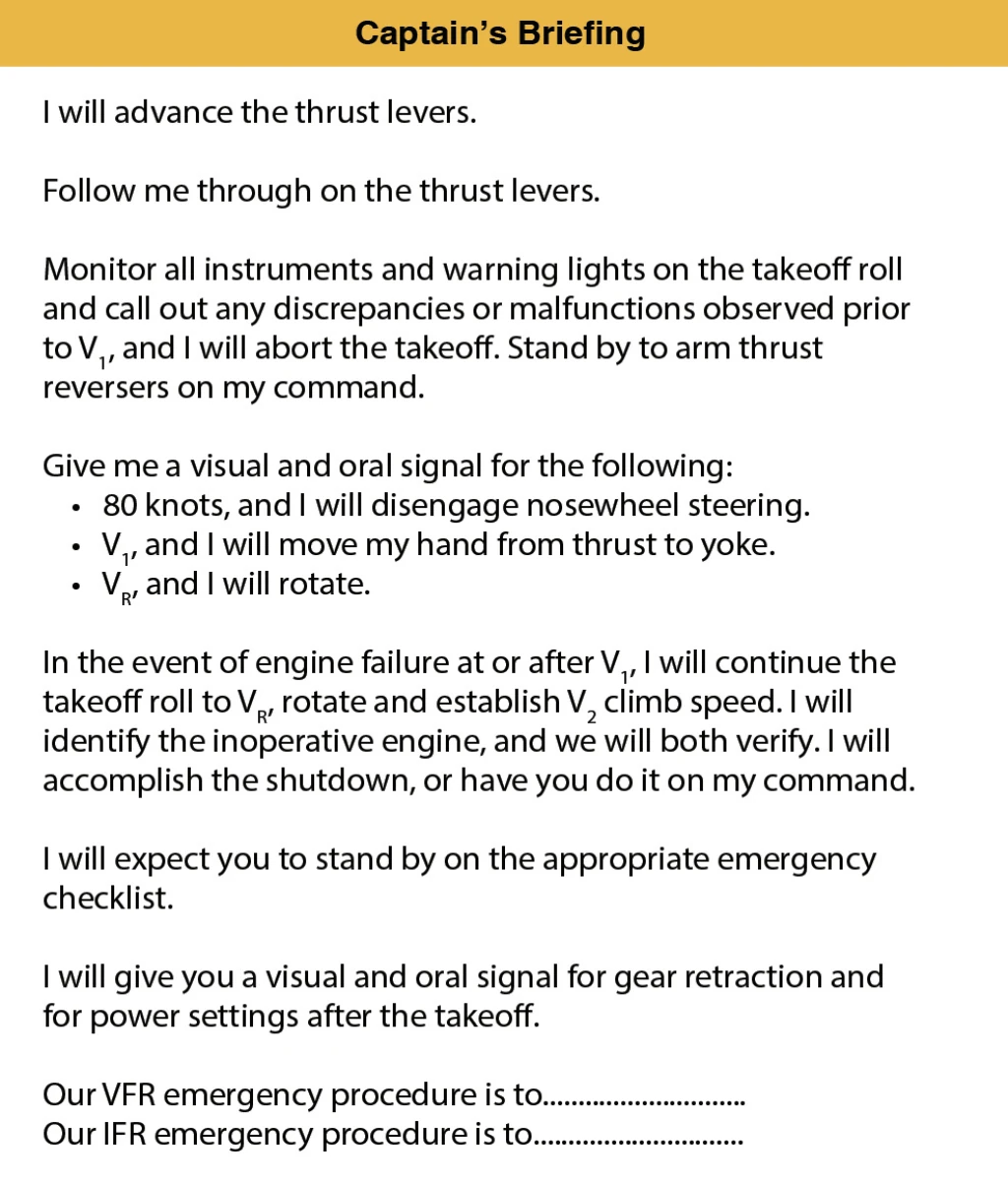
A captain’s briefing is an essential part of crew resource management (CRM) procedures and should be accomplished prior to takeoff. [Figure 16-12]
If sufficient runway length is available, a “rolling” takeoff may be made without stopping at the end of the runway. Using this procedure, as the airplane rolls onto the runway, the thrust levers should be smoothly advanced to the recommended intermediate power setting and the engines allowed to stabilize, and then proceed as in the static takeoff outlined above. Rolling takeoffs can also be made from the end of the runway by advancing the thrust levers from idle as the brakes are released.
During the takeoff roll, the pilot flying should concentrate on directional control of the airplane. This is made somewhat easier because there is no torque-produced yawing in a jet as there is in a propeller-driven airplane. The airplane should be maintained exactly on centerline with the wings level. This automatically aids the pilot when contending with an engine failure. If a crosswind exists, the wings should be kept level by displacing the control wheel into the crosswind. During the takeoff roll, the primary responsibility of the pilot not flying is to closely monitor the aircraft systems and to call out the proper V speeds as directed in the captain’s briefing.
Slight forward pressure should be held on the control column to keep the nose-wheel rolling firmly on the runway. If nose-wheel steering is being utilized, the pilot flying should monitor the nose-wheel steering to about 80 knots (or VMCG for the particular airplane) while the pilot not flying applies the forward pressure. After reaching VMCG, the pilot flying should bring his or her left hand up to the control wheel. The pilot’s other hand should be on the thrust levers until at least V1 speed is attained. Although the pilot not flying maintains a check on the engine instruments throughout the takeoff roll, the pilot flying (pilot-in-command) makes the decision to continue or reject a takeoff for any reason. A decision to reject a takeoff requires immediate retarding of thrust levers.
The takeoff and climb-out should be accomplished in accordance with a standard takeoff and departure profile developed for the particular make and model airplane. [Figure 16-13]
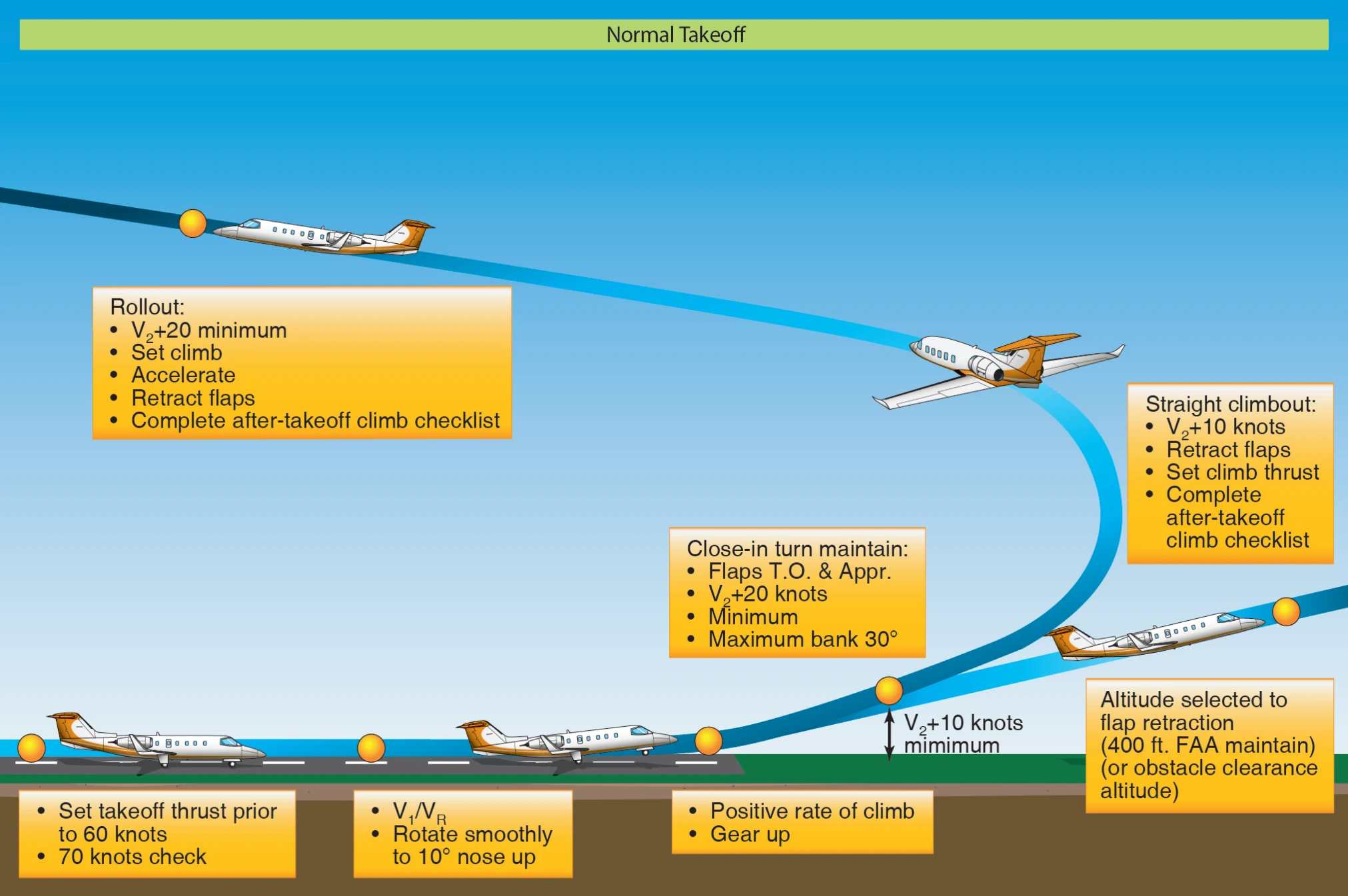
The pilot not flying should call out V1. After passing V1 speed on the takeoff roll, it is no longer mandatory for the pilot flying to keep a hand on the thrust levers. The point for abort has passed, and both hands may be placed on the control wheel. As the airspeed approaches VR, the control column should be moved to a neutral position. As the pre-computed VR speed is attained, the pilot not flying should make the appropriate call-out, and the pilot flying should smoothly rotate the airplane to the appropriate takeoff pitch attitude.
Rejected Takeoff
Every takeoff could potentially result in a rejected takeoff (RTO) for a variety of reasons: engine failure, fire or smoke, unsuspected equipment on the runway, bird strike, blown tires, direct instructions from the governing ATC authority, or recognition of a significant abnormality (split-airspeed indications, activation of a warning horn, etc.).
Ill-advised rejected takeoff decisions by flight crews and improper pilot technique during the execution of a rejected takeoff contribute to a majority of takeoff-related commercial aviation accidents worldwide. Statistically, although only 2 percent of rejected takeoffs are in this category, high-speed aborts above 120 knots account for the vast majority of RTO overrun accidents. A brief moment of indecision may mean the difference between running out of runway and coming to a safe halt after an aborted takeoff.
It is paramount to remember that FAA-approved takeoff data for any aircraft is based on aircraft performance demonstrated in ideal conditions, using a clean, dry runway, and maximum braking (reverse thrust is not used to compute stopping distance). In reality, stopping performance can be degraded by an array of factors as diversified as:
- Reduced runway friction (grooved/non-grooved)
- Mechanical runway contaminants (rubber, oily residue, debris)
- Natural contaminants (standing water, snow, slush, ice, dust)
- Wind direction and velocity
- Low air density
- Flap configuration
- Bleed air configuration
- Underinflated or failing tires
- Penalizing MEL or CDL items
- Deficient wheel brakes or RTO auto-brakes
- Inoperative anti-skid
- Pilot technique and individual proficiency