
Chapter 16
Transition to Jet-Powered Airplanes
Normally, a jet engine has one of two types of thrust reversers: a target reverser or a cascade reverser. [Figure 16-11] Target reversers are simple clamshell doors that swivel from the stowed position at the engine tailpipe to redirect thrust to a more forward direction.
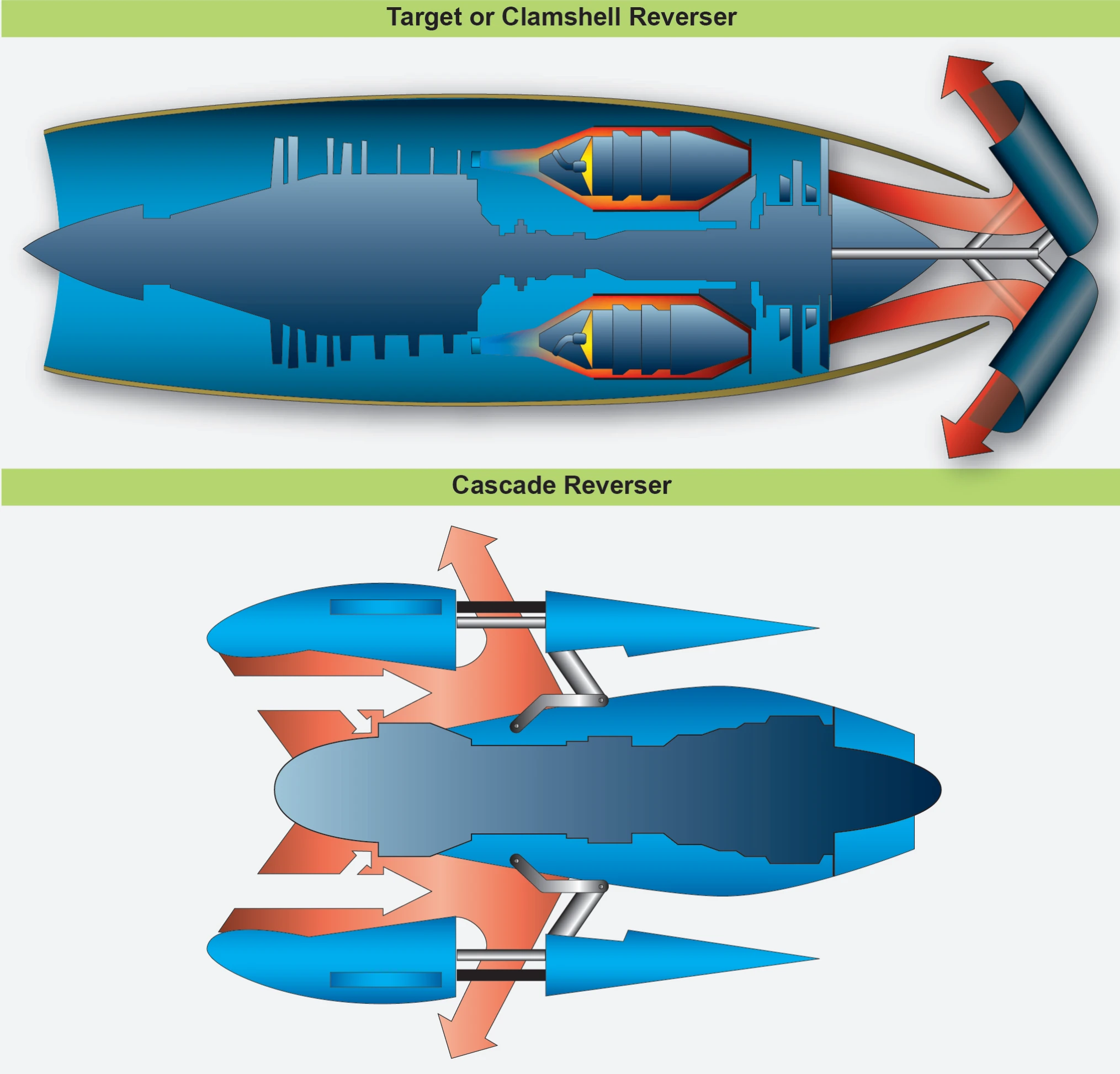
Cascade reversers are normally found on turbofan engines and are often designed to reverse only the fan air portion. Blocking doors in the shroud obstruct forward fan thrust and redirect it through cascade vanes to generate reverse thrust.
On most installations, the pilot selects reverse thrust with the thrust levers at idle by pulling up the reverse levers to a detent. Doing so positions the reversing mechanisms for operation but leaves the engines at idle rpm. Further upward and backward movement of the reverse levers increases engine power. Reverse is canceled by closing the reverse levers to the idle reverse position, then dropping them fully back to the forward idle position. This last movement selects the stowed position, and the reversers return to the forward thrust position.
Reverse thrust is more effective at high speed than at low speed. For maximum reverse thrust efficiency, the pilot should use it as soon as is prudent after touchdown. The pilot should remember that some airplanes tend to pitch nose-up when reverse is selected on landing and this effect, particularly when combined with the nose-up pitch effect from the spoilers, can cause the airplane to leave the ground again momentarily. On these types, the airplane should be firmly on the ground with the nose-wheel down before reverse is selected. Other types of airplanes have no change in pitch, and reverse idle may be selected after the main gear is down and before the nose-wheel is down. Since reverse thrust may affect directional control, runway surface conditions (e.g., contamination), factor into the use of reverse thrust. Specific procedures for reverse thrust operation for a particular airplane/engine combination are contained in the FAA-approved AFM for that airplane.
There is a significant difference between reverse pitch on a propeller and reverse thrust from a jet engine. Idle reverse on a propeller produces a large amount of drag. On a jet engine, however, selecting idle reverse produces very little reverse thrust. In a jet airplane, the pilot should select reverse, apply reverse thrust as appropriate, and remain within any AFM limitations.
It is essential that pilots understand not only the normal procedures and limitations of thrust reverser use, but also the procedures for coping with uncommanded reverse. While thrust reverser systems are designed to prevent unintentional deployment, an uncommanded or inadvertent deployment of thrust reversers, while airborne, is an emergency. The systems normally contain several lock systems: one to keep reversers from operating in the air, another to prevent operation with the thrust levers out of the idle detent, and/or an “auto-stow” circuit to command reverser stowage any time thrust reverser deployment would be inappropriate, such as during takeoff and while airborne.
Pilot Sensations in Jet Flying
Pilots transitioning into jets may notice these general sensations:
- response differences
- increased control sensitivity
- increased tempo of flight
In some flight conditions, airspeed changes may occur more slowly than in a propeller airplane. At high altitudes, the reduction in available thrust reduces the ability to accelerate. The long spool-up time required from low throttle settings also may affect acceleration. Finally, the clean aerodynamic design of a jet can result in more gradual deceleration when thrust is reduced.
The lack of propeller effects results in less drag at low power settings. Other changes the transitioning pilot should notice include the lack of effective slipstream over the lifting and control surfaces, and the lack of propeller torque effect.
Even though moving the power levers has less effect at low power settings, the pilot should change power settings smoothly. To slow the airplane, the transitioning pilot may also need to learn when to use available drag devices appropriately.
Transitioning pilots should learn power setting management for different situations. Power settings for desired performance vary because of significant changes in airplane weight as fuel is consumed. Therefore, the pilot needs to use a variety of cues to achieve desired performance. For example, airspeed trend information provides feedback for power required.
Power changes may result in a pitching tendency. These characteristics should be noticed and compensated for.
The jet airplane will differ regarding pitch tendencies with the lowering of flaps, landing gear, and drag devices. With experience, the jet airplane pilot will learn to anticipate the pitch change required for a particular operation. Most jet airplanes are equipped with a thumb operated pitch trim button on the control wheel. The usual method of operating the trim button is to apply several small, intermittent applications of trim in the direction desired rather than holding the trim button for longer periods of time, which can lead to overcontrolling.
The variation of pitch attitudes flown in a jet airplane also results from high thrust, flight characteristics of the low aspect ratio, and the swept wing. Flight at higher pitch attitudes requires greater reliance on the flight instruments for airplane control since outside references may be absent. Proficiency in attitude instrument flying, therefore, is essential to successful transition to jet airplane flying.
Control sensitivity will differ amongst various airplanes. Because of the higher speeds flown, the control surfaces are more effective and a variation of just a few degrees in pitch attitude in a jet can result in over twice the rate of altitude change that would be experienced in a slower airplane. The sensitive pitch control in jet airplanes is one of the first flight differences that the pilot may notice, and the transitioning pilot may have a tendency to overcontrol pitch during initial training flights. Accurate and smooth control is one of the first techniques the transitioning pilot should master. Rather than gripping the yoke with the hand at high speeds, just using fingertips will result in smoother control inputs.
The pilot flying a swept wing jet airplane should understand that it is normal to fly at higher angles of attack. Depending on weight, density altitude, and available thrust, the pitch angle on takeoff may seem high. It is also not unusual to have a noticeable nose-up pitch on an approach to a landing.