
Chapter 17
Transition to Light Sport Airplanes (LSA)
Introduction
The light-sport aircraft (LSA) concept broadens the access of flight to more people. LSA have been defined as a simple-to-operate, easy-to-fly aircraft; however, “simple-to-operate” and “easy-to-fly” do not negate the need for proper and effective training. This chapter introduces the light-sport category of airplanes and places emphasis on transition to a light-sport airplane.
Even though light-sport airplane flight may appear simple to an experienced pilot, a transition to a light-sport airplane should include the same methodical training approach as transitioning into any other airplane. A pilot seeking a transition into light-sport airplane flying should follow a systematic, structured light-sport airplane training course under the guidance of a competent instructor with recent experience in the specific training airplane.
Light-Sport Aircraft Background
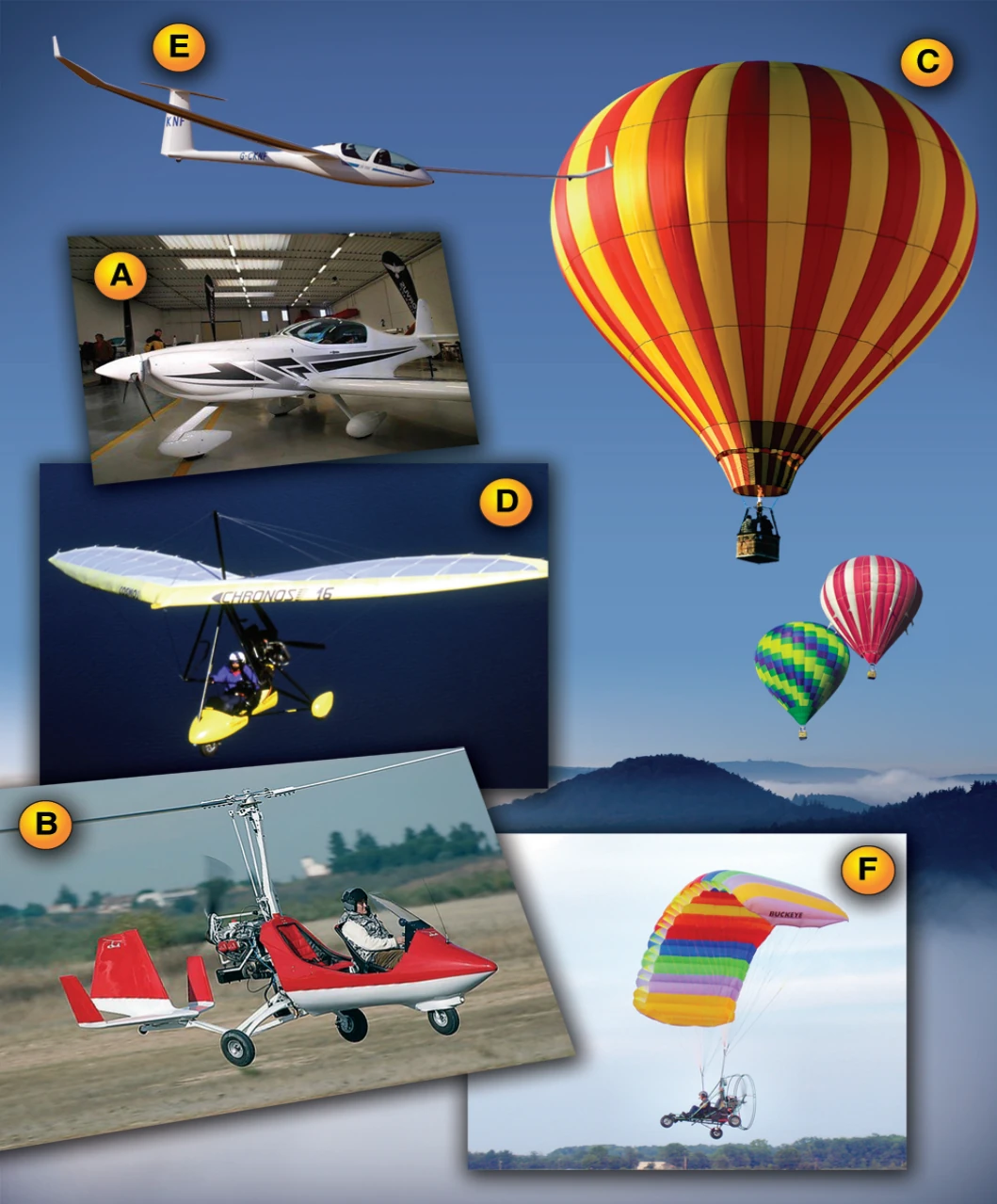
Several groups were instrumental in the development and success of the LSA concept. These included the Federal Aviation Administration (FAA), Light Aircraft Manufacturers Association, American Society for Testing and Materials (ASTM) International, and countless individuals who promoted the concept since the early 1990s. In 2004, the FAA released a rule that created a light-sport classification for airplane, gyroplane, lighter-than-air, weight-shift-control, glider, and powered parachute. [Figure 17-1]
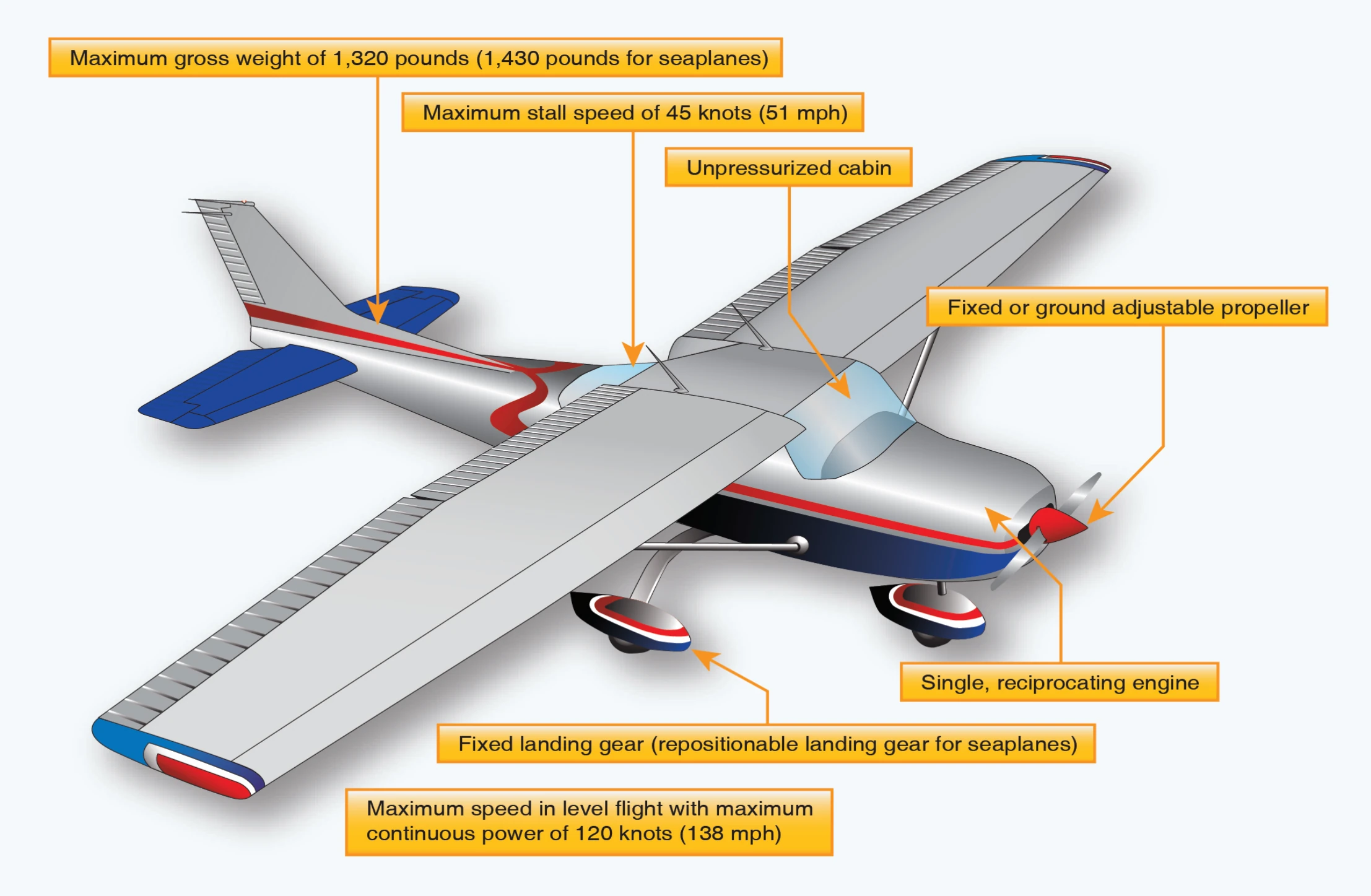
The primary concept of the LSA is built around a defined set of standards found in 14 CFR part 1, section 1.1:
- Powered (if powered) by single reciprocating engine.
- Fixed landing gear (except seaplanes and gliders).
- Fixed pitch or ground adjustable propeller.
- Maximum takeoff weight of 1,320 pounds for landplane, 1,430 for seaplane.
- Maximum of two occupants.
- Non-pressurized cabin.
- Maximum speed in level flight at maximum continuous power of 120 knots calibrated airspeed (CAS).
- Maximum stall speed of 45 knots. [Figure 17-2]
The LSA category includes standard, special, and experimental designations. Some standard airworthiness certificated aircraft (i.e., a Piper J-2 or J-3) may meet the Title 14 of the Code of Federal Regulation (14 CFR) part 1, section 1 definition of LSA. Type certificated aircraft that continue to meet the section 1.1 definition of LSA may be flown by a pilot who holds a sport pilot certificate with the appropriate endorsement for the aircraft (14 CFR part 61, section 61.315(a)). The sport pilot certificate is discussed later in this chapter. Aircraft that are specifically manufactured for the LSA market are included in either the Special (S-LSA) or Experimental (E-LSA) designations. An approved S-LSA is manufactured in a ready-to-fly condition and an E-LSA is either a kit or plans-built aircraft based on an approved S-LSA model.
It is important to note that S-LSAs or E-LSAs are not type certificated by the FAA and are not required to meet any airworthiness requirements of 14 CFR part 23. Instead, S-LSAs and E-LSAs are designed and manufactured in accordance with ASTM Committee F-37 Industry Consensus Standards. Therefore, LSA designs are not subjected to the scrutiny, demands, and testing of FAA standard airworthiness certification. Industry Consensus Standards are intended to be less costly and less restrictive than 14 CFR part 23 certification requirements and, as a result, LSA manufacturers have greater latitude with their designs. ASTM Industry Consensus Standards were accepted by the FAA in 2005, which established FAA-accepted industry-developed standards for the design and manufacture of aircraft for the first time.
ASTM Industry Consensus Standards for LSA cover the following areas:
- Design and performance
- Required equipment
- Quality assurance
- Production acceptance tests
- Aircraft operating instructions
- Maintenance and inspection procedures
- Identification and recording of major repairs and major alterations
- Continued airworthiness
- Manufacturer's assembly instructions (E-LSA aircraft)
Using the ASTM Industry Consensus Standards, an LSA manufacturer can design and manufacture their aircraft and assess its compliance to the consensus standards. The manufacturer then, through evaluation services offered by a designated airworthiness representative, completes the process by submitting the required paperwork to the FAA. Upon approval, an LSA manufacturer is permitted to sell ready-to-fly S-LSA aircraft.
Light-Sport Airplane Synopsis
- The airplane must meet the weight, speed, and other criteria listed in 14 CFR part 1, section 1 that define an LSA.
- Airplanes under the S-LSA certification commonly find use in sport and recreation, flight training, and aircraft rental.
- E-LSA-certified airplanes may be used for sport and recreation and flight instruction for the owner of the airplane. However, E-LSA certification is not the same as Experimental Amateur-Built aircraft certification. E-LSA certification is based on an approved S-LSA airplane.
- FAA policy allows sport pilots with an airplane rating to fly certain airplanes (i.e., a Piper J-2 or J-3) that continue to meet the 14 CFR part 1, section 1 LSA definition even though the airplane was originally issued a standard airworthiness type certificate.
- No person may operate the aircraft unless it has been registered by its owner, if eligible for registration, per 14 CFR part 47, section 47.3(b).
- United States or foreign manufacturers can be authorized.
- FAA policy allows holders of a sport pilot certificate or higher level pilot certificate (recreational, private, commercial, or ATP) to pilot sport aircraft.
- LSAs may be operated by VFR at night if the aircraft is equipped with the instruments and equipment specified in 14 CFR part 91, section 91.205(c), and if night operations are allowed by the airplane’s operating limitations. However, sport pilots may not fly at night (14 CFR 61.315(c)(5)).
- LSAs may be operated between sunset and sunrise by a recreational pilot as the sole occupant of the aircraft, in accordance with 14 CFR part 61, section 61.101(i)(3) for the purpose of obtaining additional certificates or ratings and while under the supervision of an authorized instructor and provided the flight or surface visibility is at least 5 statute miles.
Sport Pilot Certificate
In addition to the LSA rules, the FAA created a new sport pilot certificate in 2004 that lowered the minimum training time requirements, in comparison to other pilot certificates, for newly certificated pilots wishing to exercise privileges only in LSA aircraft. Pilots who hold recreational, private, commercial, or airline transport pilot certificates may pilot light-sport airplanes provided they possess the appropriate category/class rating and a U.S. driver's license or medical certificate that meets the requirements for the aircraft displayed in the 14 CFR part 61, section 61.303 table. For example, a commercial pilot rated in airplane multiengine land and rotorcraft gyroplane is qualified to fly a light-sport gyroplane as pilot in command (PIC) if also holding a medical certificate or a U.S. driver’s license. However, that pilot is not qualified to act as PIC of a light-sport airplane (sport airplanes are single-engine) without supervision from an authorized instructor.
Pilots holding higher level certificates with the appropriate category and class ratings may fly LSAs as long as the pilot holds a valid U.S. driver’s license as evidence of medical eligibility. However, if the pilot’s most recent medical certificate was denied, revoked, suspended, or withdrawn, a U.S. driver’s license is not sufficient. The pilot would then need to hold a valid FAA medical certificate to fly an LSA.