
Chapter 17
Transition to Light Sport Airplanes (LSA)
Takeoff and Climb
Takeoff and climb performance of LSAs can be spirited as they typically have a high horsepower-to-weight ratio and accelerate quickly. Due to design requirements for low stall speeds, LSAs typically have low rotation and climb speeds with impressive climb rates. Like other airplanes, the pilot should be flying the published speeds as given in the airplane’s POH. Stick (yoke or stoke) forces tend to be light, which may lead a transitioning pilot to initially over-control. The key is to relax, have reasonable patience, and input only appropriate flight control pressures needed to get the required response. If a transitioning pilot is inducing excessive control inputs, they should minimize flight control pressures, set attitudes based on outside references, and allow the airplane to settle.
During climbs, visibility over the nose may be difficult in some LSAs. As always, it is important to properly clear the airspace for traffic and other hazards. Occasionally lowering the airplane’s nose to get a good look out toward the horizon is important for managing flight safety. Shallow banked turns in both directions of 10° to 20° also allow for clearing. Because flight control pressures tend to be light, it is easy to get in the habit of flying with a light-sport airplane out of trim. This is to be avoided. Trim off any flight control pressures. This allows the pilot to focus as much time as possible looking outside.
Cruise
After leveling off at cruise altitude, the airplane should be allowed to accelerate to cruise speed, reduce power to cruise rpm, adjust pitch, and then trim off any flight control pressures. [Figure 17-15] The first time a transitioning pilot sees cruise rpm setting of 4,800 rpm (or as recommended), they may have a sense that the engine is turning too fast; however, remember that the engine has gear-reduction drive and the propeller is turning much slower. If the LSA is equipped with a standard aircraft engine, rpm should be in a range comparable to airplanes the transitioning pilot is used to. The pilot should refer to the Cruise Checklist to ensure that the airplane is properly configured.
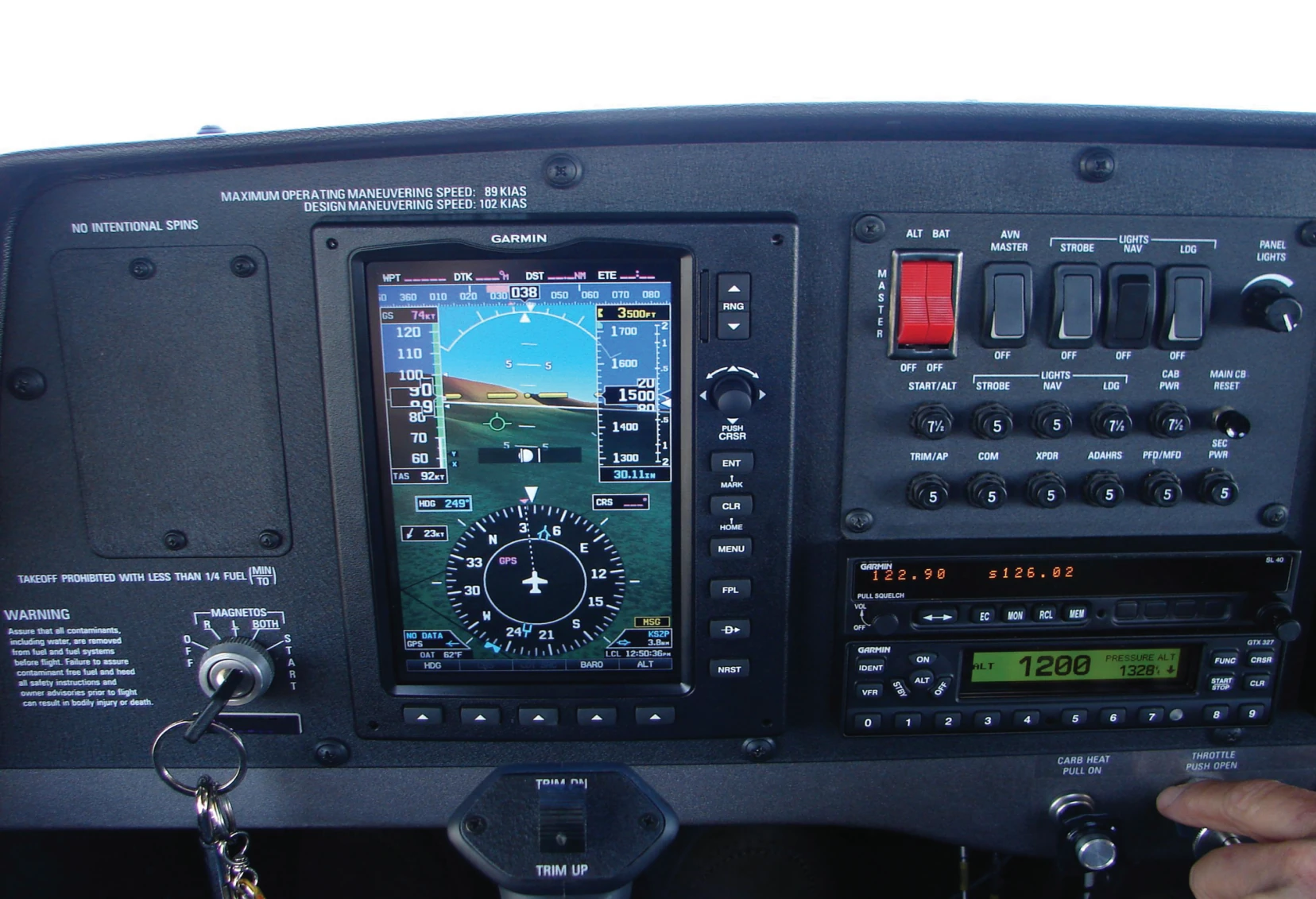
In slower cruise flight, stick forces are likely to be light; therefore, correction to pitch and roll attitudes should be made with light pressures. Excess pressure used to correct a deviation may cause a series of pilot-induced oscillations. The pilot should use fingertip pressures only and not use a wrapped palm of the hand. Stick forces can change dramatically as airspeed changes. For example, what could be considered light control pressures at 80 knots may become quite stiff at 100 knots. A flight instructor-S or flight instructor-A experienced in the light-sport airplane is able to demonstrate this effect, which is dependent on the specific model of LSA.
LSA maneuvers such as steep turns, slow flight, and stalls are typical. These maneuvers should be practiced as part of a good transition training program. Steep turns in LSA airplanes tend to be quite easy to perform with precision. Light flight control pressures, stick mounted trim (if installed), and highly differential ailerons (if part of the airplane’s design), make the maneuvers seem simpler than in heavier airplanes. Basic aerodynamics applies to any airplane. Factors, such as over-banking tendency, are still prevalent and should be expected.
Slow flight in LSAs is accomplished at slower airspeeds than standard airworthiness airplanes since stall speeds tend to be well below the 45-knot limit. Practicing slow flight demonstrates the unique capability of LSAs. Recovery from power-off stalls involves lowering the nose. Application of power puts the airplane back flying. However, a pilot should understand that control pressures tend to be light, and an aggressive forward movement of the elevator is generally not required. In addition, proper application of rudder to compensate for propeller forces is required, and retraction of any flap should be completed prior to reaching VFE, which occurs quickly if full power and nose down pitch attitude are maintained. Power-on stalls can result in a very high nose-up attitude unless the airplane is adequately slowed down prior to the maneuver. In addition, some manufacturers limit pitch attitudes to 30° during power-on stalls. If aggressive pitch attitudes are coupled with uncoordinated rudder inputs, spin entry is likely to be quick and aggressive.
Depending on the LSA design, especially those airplanes which use control tubes rather than wires and pulleys, flight in turbulence may couple motion to the stick rather distinctively. If a transitioning pilot’s flight experience is only with airplanes that have control cables and pulleys, the first flight in turbulence may be disconcerting; however, once the pilot becomes familiar with the control sensations induced by the turbulence, it only becomes another means for the pilot to feel the airplane.
Approach and Landing
Approach and landing in an LSA is routine and comfortable. Speeds in the pattern tend to be in the 60-knot range. Flap limit airspeeds tend to be lower in LSAs than standard airworthiness airplanes, so managing airspeed is important. Light control forces require smooth application of control pressures to avoid over-controlling. Pitch and power are the same in an LSA as in a standard airworthiness airplane.
The weight limit of light-sport airplanes makes crosswind landings an important subject to focus on. The pilot should realize that strong gusty crosswind conditions may exceed the airplane’s control capability resulting in loss of control during the landing. Manufacturers place a maximum demonstrated crosswind speed in the POH, and until sufficient practice and experience is gained in the airplane, a transitioning pilot should have personal minimums that do not approach the manufacturer’s demonstrated crosswind speed. Control application does not change for crosswind technique in an LSA. However, the LSA’s weight, slow landing speeds, and light control forces can result in a pilot making control deflections that exceed those necessary to compensate for the crosswind.
Emergencies
While an LSA is designed to be simple, a complete knowledge of its systems is needed such that a transitioning pilot is able to respond properly to any emergency.
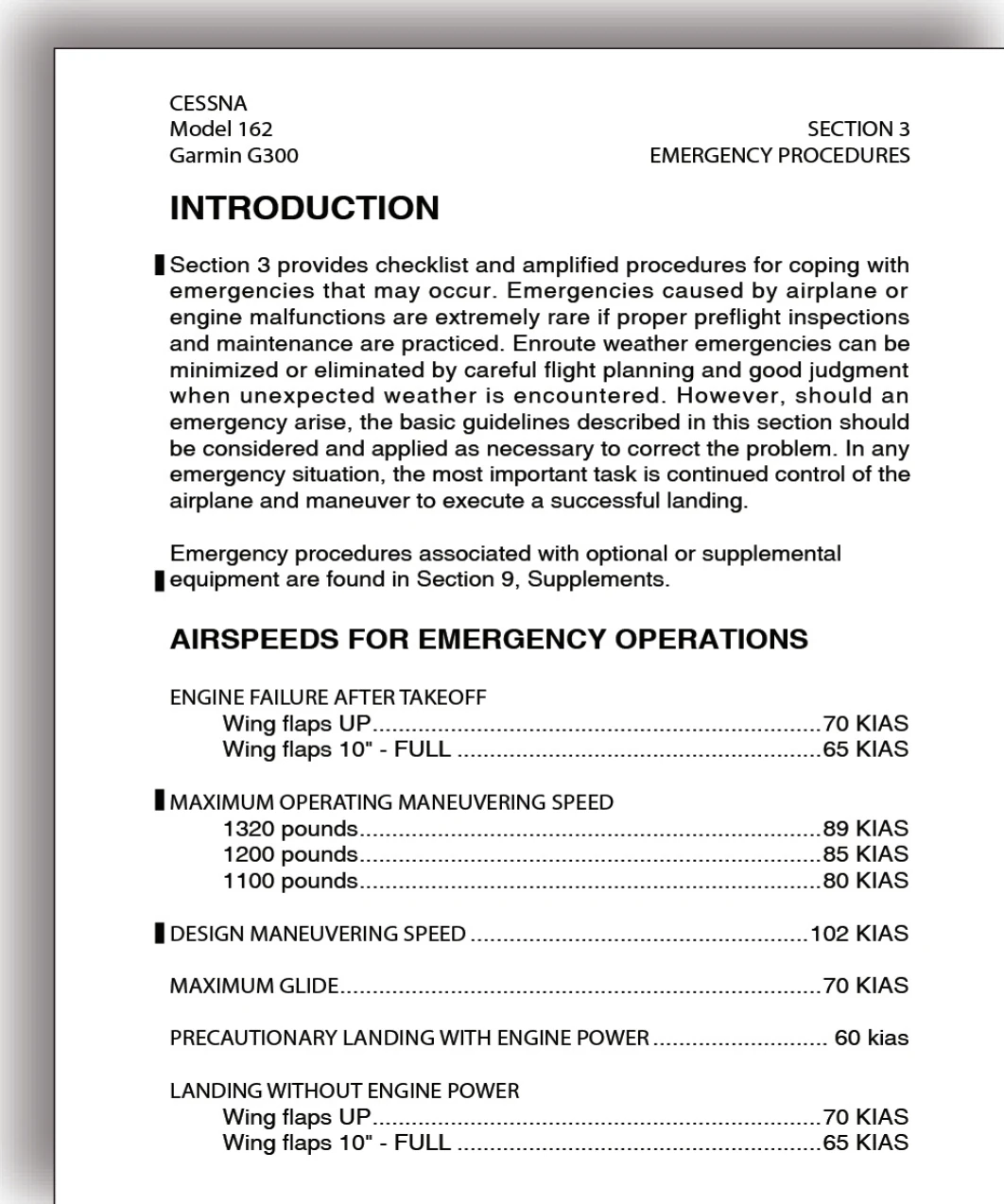
The airplane’s POH describes the appropriate responses to the various emergency situations that may be encountered. [Figure 17-16] Consider a few examples: the EFIS is displaying a red “X” across the airspeed tape, electric trim runaway, or control system failure. The pilot should be able to respond to immediate action items from memory and locate emergency procedures quickly. In the example of trim runaway, the pilot needs to quickly assess the trim runaway condition, locate and depress the trim disconnect (if installed), or pull the trim power circuit breaker. Then depending on control forces required to maintain pitch attitude, the pilot may need to make a no-flap landing due to the flap pitching moments. If the EFIS “blanks” out and POH recovery procedures do not reset the EFIS, an LSA pilot may have to be prepared to land without airspeed, altitude, or vertical speed information. An effective training program covers these emergency procedures.
Post-Flight
After the airplane has been shutdown, tied-down, and secured, the pilot should conduct a complete post-flight inspection. Any squawks or discrepancies should be noted and reported to maintenance. Transitioning pilots should insist on a training debriefing where critique and planning for the next lesson takes place. Documentation of the pilot’s progress should be noted in the student’s records.