
Chapter 5
Maintaining Aircraft Control: Upset Prevention and Recovery Training
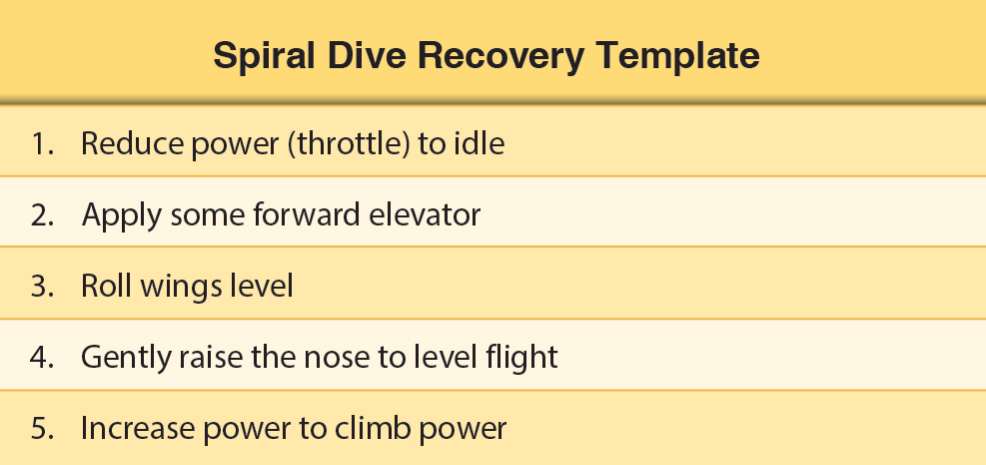
- Reduce power (throttle) to idle. Immediately reduce power to idle to slow the rate of acceleration.
- Apply some forward-elevator. Prior to rolling the wings level, it is important to unload the G-load on the airplane (“unload the wing”). This is accomplished by applying some forward-elevator pressure to return to about +1G. Apply just enough forward-elevator to ensure that you are not aggravating the spiral with aft- elevator. While generally a small input, this push has several benefits prior to rolling the wings level in the next step – the push reduces the AOA, reduces the G-load, and slows the turn rate while increasing the turn radius, and preventing a rolling pullout. The design limit of the airplane is exceeded more easily during a rolling pullout, so failure to reduce the G-load prior to rolling the wings level could result in structural damage or failure.
- Roll to wings level using coordinated aileron and rudder inputs. Even though the airplane is in a nose-low attitude, continue the roll until the wings are completely level again before performing step four.
- Gently raise the nose to level flight. It is possible that the airplane in a spiral dive might be at or even beyond VNE (never exceed speed) speed. Therefore, control inputs are made slowly and gently at this point to prevent structural failure. Raise the nose to a climb attitude only after speed decreases to safe levels.
- Increase power to climb power. Once the airspeed has stabilized to VY, apply climb power and climb back to a safe altitude.
In general, spiral dive recovery procedures are summarized in Figure 5-18.
Common Errors
Common errors in the recovery from spiral dives are:
- Failure to reduce power first
- Mistakenly adding power
- Attempting to pull out of dive without rolling wings level
- Simultaneously pulling out of dive while rolling wings level
- Not unloading the Gs prior to rolling level
- Not adding power once climb is established
UPRT Summary
A significant point to note is that UPRT skills are both complex and perishable. Repetition is needed to establish the correct mental models, and recurrent practice/training is necessary as well. The context in which UPRT procedures are introduced and implemented is also an important consideration. The pilot should clearly understand, for example, whether a particular procedure has broad applicability, or is type-specific. To attain the highest levels of learning possible, the best approach starts with the broadest form of a given procedure, then narrows it down to type-specific requirements.
Chapter Summary
A pilot’s most fundamental and important responsibility is to maintain aircraft control. Initial flight training thus provides skills to operate an airplane in a safe manner, generally within normal “expected” environments, with the addition of some instruction in upset and stall situations.
This chapter discussed the elements of basic airplane control, with emphasis on AOA. It offered a discussion of circumstances and scenarios that can lead to LOC-I, including stalls and airplane upsets. It discussed the importance of developing proficiency in slow flight, stalls, and stall recoveries, spin awareness and recovery, upset prevention and recovery, and spiral dive recovery.
Pilots need to understand that primary training cannot cover all possible contingencies that an airplane or pilot may encounter. They should seek recurrent/additional training for their normal areas of operation and seek appropriate training that develops their aeronautical skill set beyond the requirements for initial certification.
For additional considerations on performing some of these maneuvers in multiengine airplanes and turbojet-powered airplanes, refer to Chapters 12 and 15, respectively.
Additional advisory circular (AC) guidance is available at www.faa.gov:
- AC 61-67 (as revised), Stall and Spin Awareness Training;
- AC 120-109 (as revised), Stall Prevention and Recovery Training; and
- AC 120-111 (as revised), Upset Prevention and Recovery Training.