
Chapter 5
Maintaining Aircraft Control: Upset Prevention and Recovery Training
A spin is an aggravated stall condition that may result after a stall occurs. Mishandling of yaw control during a stall increases the likelihood of a spin entry. A spin results in the airplane following a downward corkscrew path. During a spin, the airplane rotates around its vertical axis affected by different lift and drag forces on each wing, and the airplane descends due to gravity, rolling, yawing, and pitching in a spiral path. [Figure 5-15] There are different types of spins. The spin type or types that occur in a particular airplane may be by airplane design, loading, control inputs, and density altitude. In all spins at least one of the wings is stalled. Refer to the airplane POH for spin recovery techniques appropriate to the make and model being flown. Techniques in the POH take precedence over information in this section.
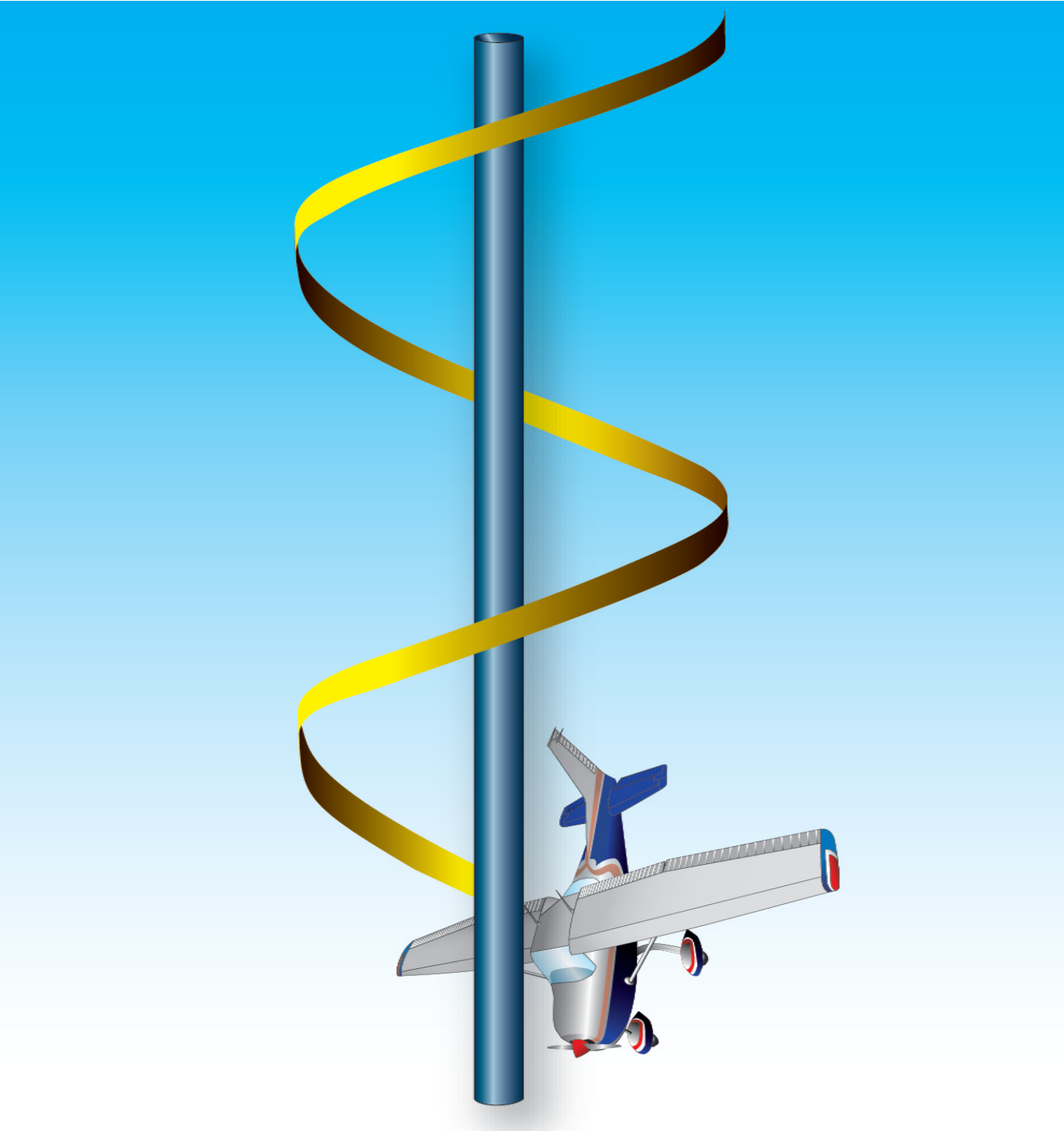
A spin occurs when at least one of the airplane’s wings exceed the critical AOA (stall) with a sideslip or yaw acting on the airplane at, or beyond, the actual stall. An airplane will yaw not only because of incorrect rudder application but because of adverse yaw created by aileron deflection; engine/prop effects, including p-factor, torque, spiraling slipstream, and gyroscopic precession; and wind shear, including wake turbulence. If the yaw had been created by the pilot because of incorrect rudder use, the pilot may not be aware that a critical AOA has been exceeded until the airplane yaws out of control toward the lowering wing. A stall that occurs while the airplane is in a slipping or skidding turn can result in a spin entry and rotation in the direction of rudder application, regardless of which wingtip is raised. If the pilot does not immediately initiate stall recovery, the airplane may enter a spin.
Maintaining directional control and not allowing the nose to yaw before stall recovery is initiated is key to averting a spin. The pilot should apply the correct amount of rudder to keep the nose from yawing and the wings from banking.
Modern airplanes tend to be more reluctant to spin compared to older designs, however it is not impossible for them to spin. Mishandling the controls in turns, stalls, and uncoordinated slow flight can put even the most reluctant airplanes into an accidental spin. Proficiency in avoiding conditions that could lead to an accidental stall/spin situation, and in promptly taking the correct actions to recover to normal flight, is essential. An airplane needs to be stalled and yawed in order to enter a spin; therefore, continued practice in stall recognition and recovery helps the pilot develop a more instinctive and prompt reaction in recognizing an approaching spin. Upon recognition of a spin or approaching spin, the pilot should immediately execute spin recovery procedures.
Spin Procedures
The first rule for spin demonstration is to ensure that the airplane is approved for spins. Please note that this discussion addresses generic spin procedures; it does not cover special spin procedures or techniques required for a particular airplane. Safety dictates careful review of the AFM/POH and regulations before attempting spins in any airplane. The review should include the following items:
- The airplane’s AFM/POH limitations section, placards, or type certification data to determine if the airplane is approved for spins
- Weight and balance limitations
- Recommended entry and recovery procedures
- The current 14 CFR part 91 parachute requirements
Also essential is a thorough airplane preflight inspection, with special emphasis on excess or loose items that may affect the weight, CG, and controllability of the airplane. It is also important to ensure that the airplane is within any CG limitations as determined by the manufacturer. Slack or loose control cables (particularly rudder and elevator) could prevent full anti-spin control deflections and delay or preclude recovery in some airplanes.
Prior to any intentional spin, clear the flight area above and below the airplane for other traffic. This task may occur while slowing the airplane for the spin entry. In addition, all spins should begin at an altitude high enough to complete recovery at or above 1,500 feet AGL. Note that the first turn in a spin results in an altitude loss of approximately 1,000 feet, while each subsequent turn loses about half that amount.
It may be appropriate to introduce spin training by first practicing both power-on and power-off stalls in a clean configuration. This practice helps familiarize the pilot with the airplane’s specific stall and recovery characteristics. In all phases of training, the pilot should take care with handling of the power (throttle), and apply carburetor heat, if equipped, according to the manufacturer’s recommendations
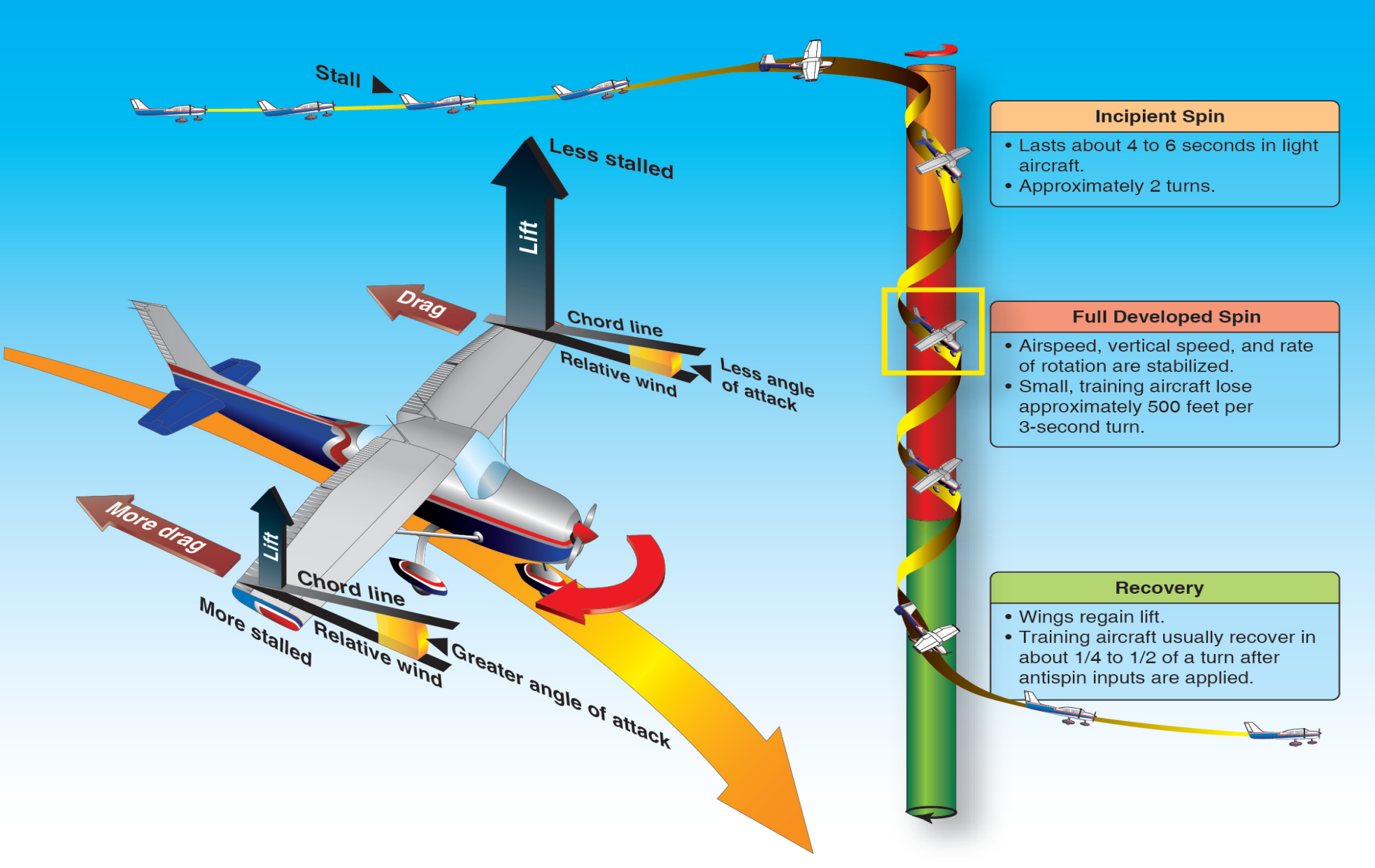
There are four phases of a spin: entry, incipient, developed, and recovery. [Figure 5-16]
Entry Phase
In the entry phase, the pilot intentionally or accidentally provides the necessary elements for the spin. The entry procedure for demonstrating a spin is similar to a power-off stall. During the entry, the pilot should slowly reduce power to idle, while simultaneously raising the nose to a pitch attitude that ensures a stall. As the airplane approaches a stall, the pilot smoothly applies full rudder in the direction of the desired spin rotation while applying full back (up) elevator to the limit of travel. Unless AFM/POH specifies otherwise, ailerons are maintained in the neutral position during the spin procedure.
Incipient Phase
The incipient phase occurs from the time the airplane stalls and starts rotating until the spin has fully developed. This phase may take two to four turns for most airplanes. In this phase, the aerodynamic and inertial forces have not achieved a balance. As the incipient phase develops, the indicated airspeed will generally stabilize at a low and constant airspeed and the symbolic airplane of the turn indicator should indicate the direction of the spin. The pilot should not use the slip/skid ball (inclinometer) to determine spin direction. The location of the instrument in the airplane determines how the ball will move rather than the direction of the spin. For example, the ball mounted on the left side of the airplane will always move to the left, even in spin with rotation to the right.
The pilot should initiate incipient spin recovery procedures prior to completing 360° of rotation. The pilot should apply full rudder opposite the direction of rotation. The turn indicator shows a deflection in the direction of rotation if disoriented.
Incipient spins that are not allowed to develop into a steady-state spin are the most commonly used maneuver in initial spin training and recovery techniques.