
Chapter 5
Maintaining Aircraft Control: Upset Prevention and Recovery Training
The developed phase occurs when the airplane’s angular rotation rate, airspeed, and vertical speed are stabilized in a flightpath that is nearly vertical. In the developed phase, aerodynamic forces and inertial forces are in balance, and the airplane’s attitude, angles, and self-sustaining motions about the vertical axis are constant or repetitive, or nearly so. The spin is in equilibrium. It is important to note that some training airplanes will not enter into the developed phase but could transition unexpectedly from the incipient phase into a spiral dive. In a spiral dive the airplane will not be in equilibrium but instead will be accelerating and G load can rapidly increase as a result.
Recovery Phase
The recovery phase occurs when rotation ceases and the AOA of the wings is decreased below the critical AOA. This phase may last for as little as a quarter turn or up to several turns depending upon the airplane and the type of spin. To recover, the pilot applies control inputs to disrupt the spin equilibrium by stopping the rotation and unstalling the wing. To accomplish spin recovery, the pilot should always follow the manufacturer’s recommended procedures. In the absence of the manufacturer’s recommended spin recovery procedures and techniques, use the six-step spin recovery procedure in Figure 5-17. If the flaps and/or retractable landing gear are extended prior to the spin, they should be retracted as soon as practicable after spin entry.
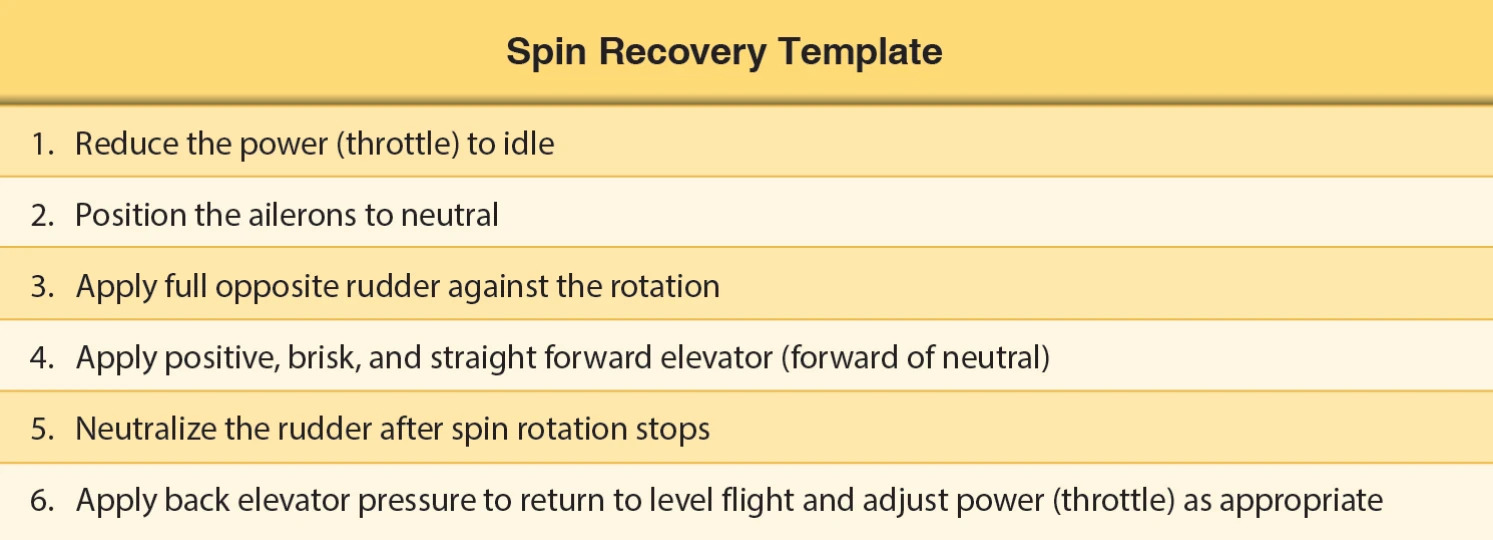
The following discussion explains each of the six steps a pilot should follow for spin recovery:
- Reduce the power (throttle) to idle. Power aggravates spin characteristics. It can result in a flatter spin attitude and usually increases the rate of rotation.
- Position the ailerons to neutral. Ailerons may have an adverse effect on spin recovery. Aileron control in the direction of the spin may accelerate the rate of rotation, steepen the spin attitude and delay the recovery. Aileron control opposite the direction of the spin may cause flattening of the spin attitude and delayed recovery; or may even be responsible for causing an unrecoverable spin. The best procedure is to ensure that the ailerons are neutral.
- Apply and hold full opposite rudder against the rotation until the rotation stops. Rudder tends to be the most important control for recovery in typical single-engine airplanes, and its application should be brisk and full opposite to the direction of rotation. Avoid slow and overly cautious opposite rudder movement during spin recovery, which can allow the airplane to spin indefinitely, even with anti-spin inputs. A brisk and positive technique results in a more positive spin recovery.
- Apply positive, brisk, and straight-forward elevator (forward of neutral). This step should be taken immediately after full rudder application. Do not wait for the rotation to stop before performing this step. The forceful movement of the elevator decreases the AOA and drives the airplane toward unstalled flight. In some cases, full forward elevator may be required for recovery. Hold the controls firmly in these positions until the spinning stops. (Note: If the airspeed is increasing, the airplane is no longer in a spin. In a spin, the airplane is stalled, and the indicated airspeed should therefore be relatively low and constant and should not be accelerating.)
- Neutralize the rudder after spin rotation stops. Failure to neutralize the rudder at this time, when airspeed is increasing, causes a yawing or sideslipping effect.
- Apply back elevator pressure to return to level flight and adjust power as appropriate. Be careful not to apply excessive back elevator pressure after the rotation stops and the rudder has been neutralized. Excessive back elevator pressure can cause a secondary stall and may result in another spin. Avoid exceeding the G-load limits and airspeed limitations during the pull out.
Again, it is important to remember that the spin recovery procedures and techniques described above are recommended for use only in the absence of the manufacturer’s procedures. The pilot must always be familiar with the manufacturer’s procedures for spin recovery.
Intentional Spins
If the manufacturer does not specifically approve an aircraft for spins, intentional spins are not authorized by the CFRs or suggested by this handbook. The official sources for determining whether the spin maneuver is approved are:
- Type Certificate Data Sheets or the aircraft specifications
- The limitation section of the FAA-approved AFM/ POH regarding and limiting gross weight, CG range, or amount of fuel
- On a placard located in clear view of the pilot in the airplane (e.g., “NO ACROBATIC MANEUVERS INCLUDING SPINS APPROVED”)
In airplanes placarded against spins, there is no assurance that recovery from a fully-developed spin is possible. Unfortunately, accident records show occurrences in which pilots intentionally ignored spin restrictions. Despite the installation of placards prohibiting intentional spins in these airplanes, some pilots and even some flight instructors attempt to justify the maneuver, rationalizing that the spin restriction results from a “technicality” in the airworthiness standards. They believe that if the airplane was spin tested during its certification process, no problem should result from demonstrating or practicing spins.
Such pilots overlook the fact that certification of normal category single-engine airplanes that occurred in accordance with 14 CFR part 23, section 23.221(a) (which still applies to aircraft certified under that regulation) only required the airplane to recover from a one-turn spin or a three-second spin, whichever takes longer, in not more than one additional turn after initiation of the first control action for recover, or demonstrate compliance with the optional spin resistant requirements of that section. In other words, many of these airplanes were never required to recover from a fully developed spin. 14 CFR part 23, section 23.2150 states the current certification requirements pertaining to spin characteristics for airplanes certified under that regulation going forward. In all airplanes placarded against spins, there is absolutely no assurance that recovery from a fully developed spin is possible under any circumstances. The pilot of an airplane placarded against intentional spins should assume that the airplane could become uncontrollable in a spin.
Weight and Balance Requirement Related to Spins
In airplanes that are approved for spins, compliance with weight and balance requirements is important for safe performance and recovery from the spin maneuver. Pilots should know that even minor weight or balance changes can affect the airplane’s spin recovery characteristics. Such changes can either degrade or enhance the spin maneuver and/or recovery characteristics. For example, the addition of weight in the aft baggage compartment, or additional fuel, may still permit the airplane to be operated within CG, but could seriously affect the spin and recovery characteristics. An airplane that may be difficult to spin intentionally in the utility category (restricted aft CG and reduced weight) could have less resistance to spin entry in the normal category (less restricted aft CG and increased weight). This situation arises from the airplane’s ability to generate a higher AOA. An airplane that is approved for spins in the utility category but loaded in accordance with the normal category may not recover from a spin that is allowed to progress beyond one turn.
Common Errors
Common errors in the performance of intentional spins are:
- Failure to apply full rudder pressure (to the stops) in the desired spin direction during spin entry
- Failure to apply and maintain full up-elevator pressure during spin entry, resulting in a spiral
- Failure to achieve a fully-stalled condition prior to spin entry
- Failure to apply full rudder (to the stops) briskly against the spin during recovery
- Failure to apply sufficient forward-elevator during recovery
- Waiting for rotation to stop before applying forward-elevator
- Failure to neutralize the rudder after rotation stops, possibly resulting in a secondary spin
- Slow and overly cautious control movements during recovery
- Excessive back-elevator pressure after rotation stops, possibly resulting in secondary stall
- Insufficient back-elevator pressure during recovery resulting in excessive airspeed
Spiral Dive
A spiral dive, a nose-low upset, is a descending turn during which airspeed and G-load can increase rapidly and often results from a botched turn. In a spiral dive, the airplane is flying very tight circles, in a nearly vertical attitude and will be accelerating because it is no longer stalled. Pilots typically get into a spiral dive during an inadvertent IMC encounter, most often when the pilot relies on kinesthetic sensations rather than on the flight instruments. A pilot distracted by other sensations can easily enter a slightly nose-low, wing-low, descending turn and, at least initially, fail to recognize this error. Especially in IMC, it may be only the sound of increasing speed that makes the pilot aware of the rapidly developing situation. Upon recognizing the steep nose-down attitude and steep bank, the startled pilot may react by pulling back rapidly on the yoke while simultaneously rolling to wings-level. This response can create aerodynamic loads capable of causing airframe structural damage and/or failure.
The following discussion explains each of the five steps a pilot should use to recover from a spiral dive: