
Chapter 5
Maintaining Aircraft Control: Upset Prevention and Recovery Training
For detailed information regarding causal factors of spatial disorientation, refer to Aerospace Medicine Spatial Disorientation and Aerospace Medicine Reference Collection, which provides spatial disorientation videos. The videos are available online at: www.faa.gov/about/office_org/headquarters_offices/avs/offices/aam/cami/library/online_libraries/aerospace_medicine/sd/videos/.
Surprise and Startle Response
Surprise is an unexpected event that violates a pilot’s expectations and can affect the mental processes used to respond to the event. Startle is an uncontrollable, automatic muscle reflex, raised heart rate, blood pressure, etc., elicited by exposure to a sudden, intense event that violates a pilot’s expectations.
This human response to unexpected events has traditionally been underestimated or even ignored during flight training. The reality is that untrained pilots often experience a state of surprise or a startle response to an airplane upset event. Startle may or may not lead to surprise. Pilots can protect themselves against a debilitating surprise reaction or startle response through scenario-based training, and in such training, instructors can incorporate realistic distractions to help provoke startle or surprise. To be effective the controlled training scenarios should have a perception of risk or threat of consequences sufficient to elevate the pilot’s stress levels. Such scenarios can help prepare a pilot to mitigate psychological/physiological reactions to an actual upset.
Upset Prevention and Recovery Training (UPRT)
Upsets are not intentional flight maneuvers, except in maneuver-based training; therefore, they are often unexpected. The reaction of an inexperienced or inadequately trained pilot to an unexpected abnormal flight attitude is usually instinctive rather than intelligent and deliberate. Such a pilot often reacts with abrupt muscular effort, which is without purpose and even hazardous in turbulent conditions, at excessive speeds, or at low altitudes.
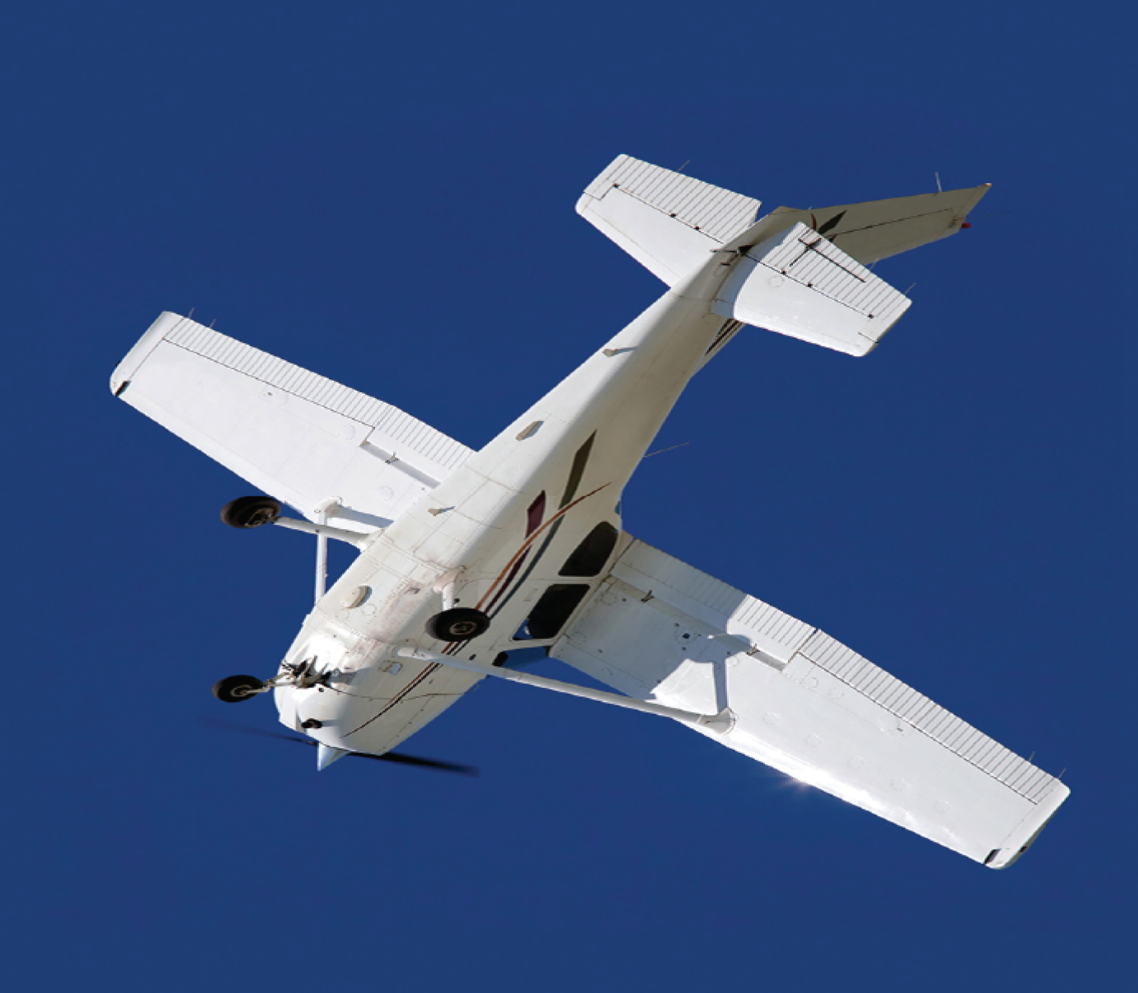
Without proper upset recovery training on interpretation and airplane control, the pilot can quickly aggravate an abnormal flight attitude into a potentially fatal LOC-I accident. Consequently, UPRT is intended to focus education and training on the prevention of upsets, and on recovering from these events if they occur. [Figure 5-1]
- Upset prevention refers to pilot actions to avoid a divergence from the desired airplane state. Awareness and prevention training serve to avoid incidents. Early recognition of an upset scenario coupled with appropriate preventive action often can mitigate a situation that could otherwise escalate into an LOC-I accident.
- Recovery refers to pilot actions that return an airplane that is diverging in altitude, airspeed, or attitude to a desired state from a developing or fully-developed upset. Recovery training serves to reduce accidents as a result of an unavoidable or inadvertently-encountered upset event. The pilot can learn to initiate a recovery to a normal flight mode immediately upon recognition of the developing upset condition. The pilot should ensure that control inputs and power adjustments applied to counter an upset are in direct proportion to the amount and rates of change of roll, yaw, and pitch, or airspeed so as to avoid overstressing the airplane unless ground contact is imminent.
UPRT Training Core Concepts
Airplane upsets are by nature time-critical events; they can also place pilots in unusual and unfamiliar attitudes that sometimes require counterintuitive control movements. Upsets have the potential to put a pilot into a life-threatening situation compounded by panic, diminished mental capacity, and potentially incapacitating spatial disorientation. Real-world upset situations often provide very little time to react, but exposure to such events during training can reduce surprise and mitigate confusion during an actual unexpected upset. The goal is to equip the pilot to promptly recognize an escalating threat pattern or sensory overload and quickly identify and correct an impending upset.
UPRT stresses that the first step is recognizing any time the airplane begins to diverge from the intended flightpath or airspeed. Pilots need to identify and determine what, if any, action should be taken. As a general rule, any time visual cues or instrument indications differ from basic flight maneuver expectations, the pilot should assume an upset and cross-check to confirm the attitude, instrument error or instrument malfunction.
To achieve maximum effect, it is crucial for UPRT concepts to be conveyed accurately and in a non-threatening manner. Reinforcing concepts through positive experiences significantly improves a pilot’s depth of understanding, retention of skills, and desire for continued training. Also, training in a carefully structured environment allows for exposure to these events and can help the pilot react more quickly, decisively, and calmly when the unexpected occurs during flight. However, like many other skills, the skills needed for upset prevention and recovery are perishable and thus require continuous reinforcement through training.
UPRT in the airplane and flight simulation training device (FSTD) should be conducted in both visual and simulated instrument conditions to allow pilots to practice recognition and recovery under both situations. UPRT should allow them to experience and recognize some of the physiological factors related to each, such as the confusion and disorientation that can result from visual cues in an upset event. Training that includes recovery from bank angles exceeding 90 degrees could further add to a pilot’s overall knowledge and skills for upset recognition and recovery. For such training, additional measures should be taken to ensure the suitability of the airplane or FSTD and that instructors are appropriately qualified.
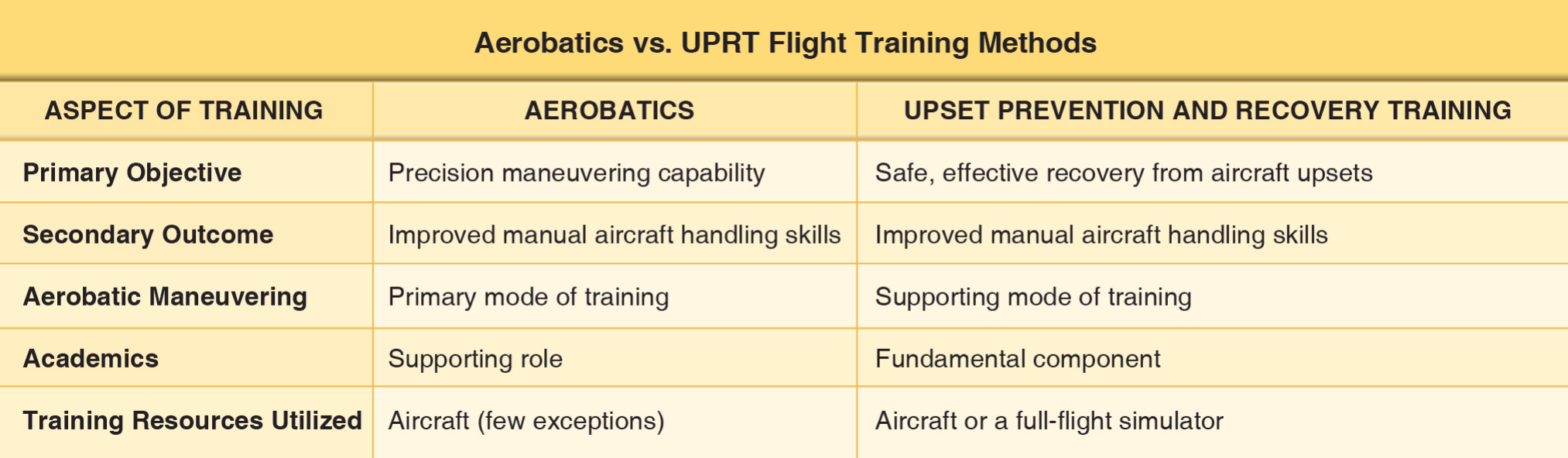
Upset prevention and recovery training is different from aerobatic training. [Figure 5-2] In aerobatic training, the pilot knows and expects the maneuver, so effects of startle or surprise are missing. The main goal of aerobatic training is to teach pilots how to intentionally and precisely maneuver an aerobatic-capable airplane in three dimensions. The primary goal of UPRT is to help pilots overcome sudden onsets of stress to avoid, prevent, and recover from unplanned excursions that could lead to LOC-I.
Comprehensive UPRT builds on three mutually supportive components: academics, airplane-based training and, typically at the transport category type-rating training level, use of FSTDs. Each has unique benefits and limitations but, when implemented cohesively and comprehensively throughout a pilot’s career, the components can offer maximum preparation for upset awareness, prevention, recognition, and recovery.
Academic Material (Knowledge and Risk Management)
Academics establish the foundation for development of situational awareness, insight, knowledge, and skills. As in practical skill development, academic preparation should move from the general to specific while emphasizing the significance of each basic concept. Although academic preparation is crucial and does offer a level of mitigation of the LOC-I threat, long-term retention of knowledge is best achieved when applied and correlated with practical hands-on experience.
The academic portion of UPRT should also address the prevention concepts surrounding aeronautical-decision making (ADM) and risk management (RM), and proportional counter response.