
Chapter 5
Maintaining Aircraft Control: Upset Prevention and Recovery Training
When considering upset training conducted in an aerobatic-capable airplane in particular, the importance of employing instructors with specialized UPRT experience in those airplanes cannot be overemphasized. Just as instrument or tailwheel instruction requires specific skill sets for those operations, UPRT demands that instructors possess the competence to oversee trainee progress, and the ability to intervene as necessary with consistency and professionalism. As in any area of training, the improper delivery of stall, spin, and upset recovery training often results in negative learning, which could have severe consequences not only during the training itself, but in the skills and mindset pilots take with them when they have passengers and place the lives of others at stake.
All-Attitude/All-Envelope Flight Training Methods
Sound UPRT encompasses operation in a wide range of possible flight attitudes and covers the airplane’s limit flight envelope. This training is essential to prepare pilots for unexpected upsets. As stated at the outset, the primary focus of a comprehensive UPRT program is the avoidance of, and safe recovery from, upsets. Much like basic instrument skills, which can be applied to flying a vast array of airplanes, the majority of skills and techniques required for upset recovery are not airplane-specific. Just as basic instrument skills learned in lighter and lower performing airplanes are applied to more advanced airplanes, basic upset recovery techniques provide lessons that remain with pilots throughout their flying careers.
FSTD–based UPRT
UPRT can be effective in high fidelity devices (i.e., Level C and D FFS); however, instructors and pilots should be mindful of the technical and physiological boundaries when using a particular FSTD for upset training. This training is a current requirement for pilots seeking a multiengine airplane ATP certificate in accordance with 14 CFR part 61, section 61.156, and the training course must be FAA approved.
Coordinated Flight
Coordinated flight occurs whenever the pilot is proactively correcting for yaw effects associated with power (engine/ propeller effects), aileron inputs, how an airplane reacts when turning, and airplane rigging. The airplane is in coordinated flight when the airplane’s nose is yawed directly into the relative wind and the ball is centered in the slip/skid indicator (except for certain multiengine airplane operation with an engine failure). [Figure 5-5]
Angle of Attack
The angle of attack (AOA) is the angle at which the chord of the wing meets the relative wind. The chord is a straight line from the leading edge to the trailing edge. At low angles of attack, the airflow over the top of the wing flows smoothly and produces lift with a relatively small amount of drag. As the AOA increases, lift as well as drag increases; however, above a wing’s critical AOA, the flow of air separates from the upper surface and backfills, burbles, and eddies, which reduces lift and increases drag. This condition is a stall, which can lead to loss of control if the AOA is not reduced.
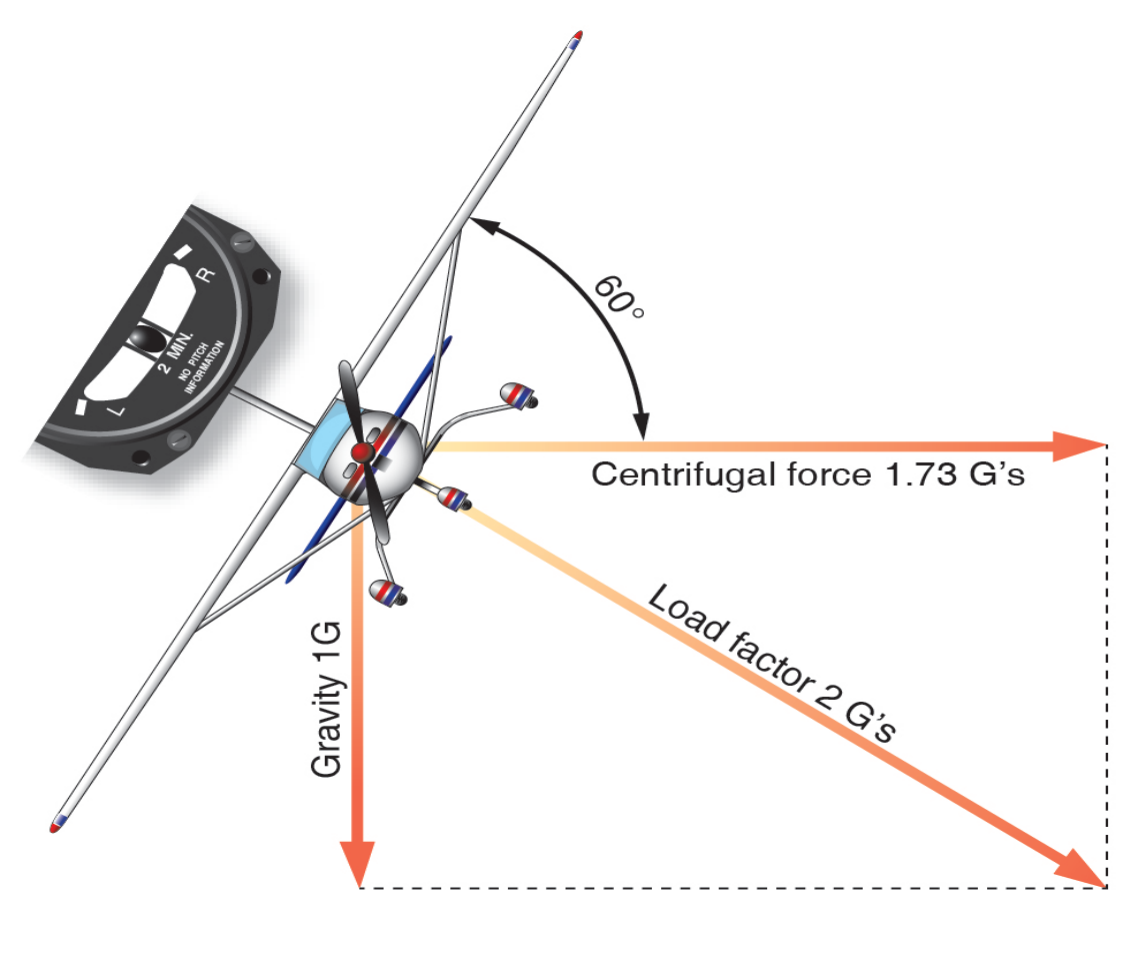
It is important for the pilot to understand that a stall is the result of exceeding the critical AOA, not of insufficient airspeed. The term “stalling speed” can be misleading, as this speed is often discussed when assuming 1G flight at a particular weight and configuration. Increased load factor directly affects stall speed (as well as do other factors such as gross weight, center of gravity, and flap setting). Therefore, it is possible to stall the wing at any airspeed, at any flight attitude, and at any power setting. For example, if a pilot maintains airspeed and rolls into a coordinated, level 60° banked turn, the load factor is 2G, and the airplane will stall at a speed that is 41 percent higher than the 1G stall speed. In that 2G level turn, the pilot has to increase AOA to increase the lift required to maintain altitude. At this condition, the pilot is closer to the critical AOA than during level flight and therefore closer to the higher stalling speed. Because “stalling speed” is not a constant number, pilots need to understand the underlying factors that affect it in order to maintain aircraft control in all circumstances.
Slow Flight
Flying at reduced airspeeds is normal in the takeoff/departure and approach/landing phases of flight. While pilots typically perform these operations at low airspeeds and close to the ground, pilots learn to maneuver an airplane in slow flight at a safe altitude. During slow flight, any further increase in angle of attack, increase in load factor, or reduction in power, will result in a stall warning (e.g., aircraft buffet, stall horn, etc.), and pilots should react to and correct for any stall indication. Note that stall training builds upon the knowledge and skill acquired from the slow flight maneuver and encompasses the period of time from the stall warning (e.g., aircraft buffet, stall horn, etc.) to the stall.
The objective of maneuvering in slow flight is to develop the pilot’s ability to fly at low speeds and high AOAs. Through practice, the pilot becomes familiar with the feel, sound, and visual cues of flight in this regime, where there is a degraded response to control inputs and where it is more difficult to maintain a selected altitude. It is essential that pilots:
- understand the aerodynamics associated with slow flight in various aircraft configurations and attitudes,
- recognize airplane cues in these flight conditions,
- smoothly manage coordinated flight control inputs while maneuvering without a stall warning, and
- make prompt appropriate correction should a stall warning occur.
For pilot training and testing purposes, slow flight includes two main elements:
- Slowing to, maneuvering at, and recovering from an airspeed at which the airplane is still capable of maintaining controlled flight without activating the stall warning—5 to 10 knots above the 1G stall speed is a good target.
- Performing slow flight in configurations appropriate to takeoffs, climbs, descents, approaches to landing, and go-arounds.
Slow flight should be introduced with the target airspeed sufficiently above the stall to permit safe maneuvering, but close enough to the stall warning for the pilot to experience the characteristics of flight at a low airspeed. One way to determine the target airspeed is to slow the aircraft to the stall warning when in the desired slow flight configuration, pitch the nose down slightly to eliminate the stall warning, and add power to maintain altitude and note the airspeed.
When practicing slow flight, a pilot learns to divide attention between aircraft control and other demands. How the airplane feels at the slower airspeeds demonstrates that as airspeed decreases, control effectiveness decreases. For instance, reducing airspeed from 30 knots to 20 knots above the stalling speed will result in a certain loss of effectiveness of flight control inputs because of less airflow over the control surfaces. As airspeed is further reduced, the control effectiveness is further reduced and the reduced airflow over the control surfaces results in larger control movements being required to create the same response. Pilots sometimes refer to the feel of this reduced effectiveness as “sloppy” or “mushy” controls.
When flying above the minimum drag speed (L/DMAX), more power is required to fly even faster. When flying at speeds below L/DMAX, more power is required to fly even slower. Since slow flight will be performed well below L/DMAX, the pilot should be aware that large power inputs or a reduction in AOA will be required to prevent the aircraft from decelerating. It is important to note that when flying below L/DMAX or on the backside of the power curve, as the AOA increases toward the critical AOA and the airplane’s speed continues to decrease, small changes in the pitch control result in disproportionally large changes in induced drag and therefore changes in airspeed. As a result, pitch becomes a more effective control of airspeed when flying below L/DMAX and power is an effective control of the path.