
Chapter 6
Takeoffs and Departure Climbs
Initial Climb
If a proper crosswind correction is applied, the aircraft will maintain alignment with the runway while accelerating to takeoff speed and then maintain that alignment once airborne. As takeoff acceleration occurs, the efficiency of the up-aileron will increase with aircraft speed causing the upwind wing to produce greater downward force and, as a result, counteract the effect of the crosswind. The yoke, having been initially turned into the wind, can be relaxed to the extent necessary to keep the aircraft aligned with the runway. As the aircraft becomes flyable and airborne, the wing that is upwind will have a tendency to be lower relative the other wing, requiring simultaneous rudder input to maintain runway alignment. This will initially cause the aircraft to sideslip. However, as the aircraft establishes its climb, the nose should be turned into the wind to offset the crosswind, wings brought to level, and rudder input adjusted to maintain runway alignment (crabbing). [Figure 6-6] Firm and positive use of the rudder may be required to keep the airplane pointed down the runway or parallel to the centerline. Unlike landing, the runway alignment (staying over the runway and its extended centerline) is paramount to keeping the aircraft parallel to the centerline. The pilot should then apply rudder pressure firmly and aggressively to keep the airplane headed straight down the runway. However, because the force of a crosswind may vary markedly within a few hundred feet of the ground, the pilot should check the ground track frequently and adjust the wind correction angle, as necessary. The remainder of the climb technique is the same used for normal takeoffs and climbs.
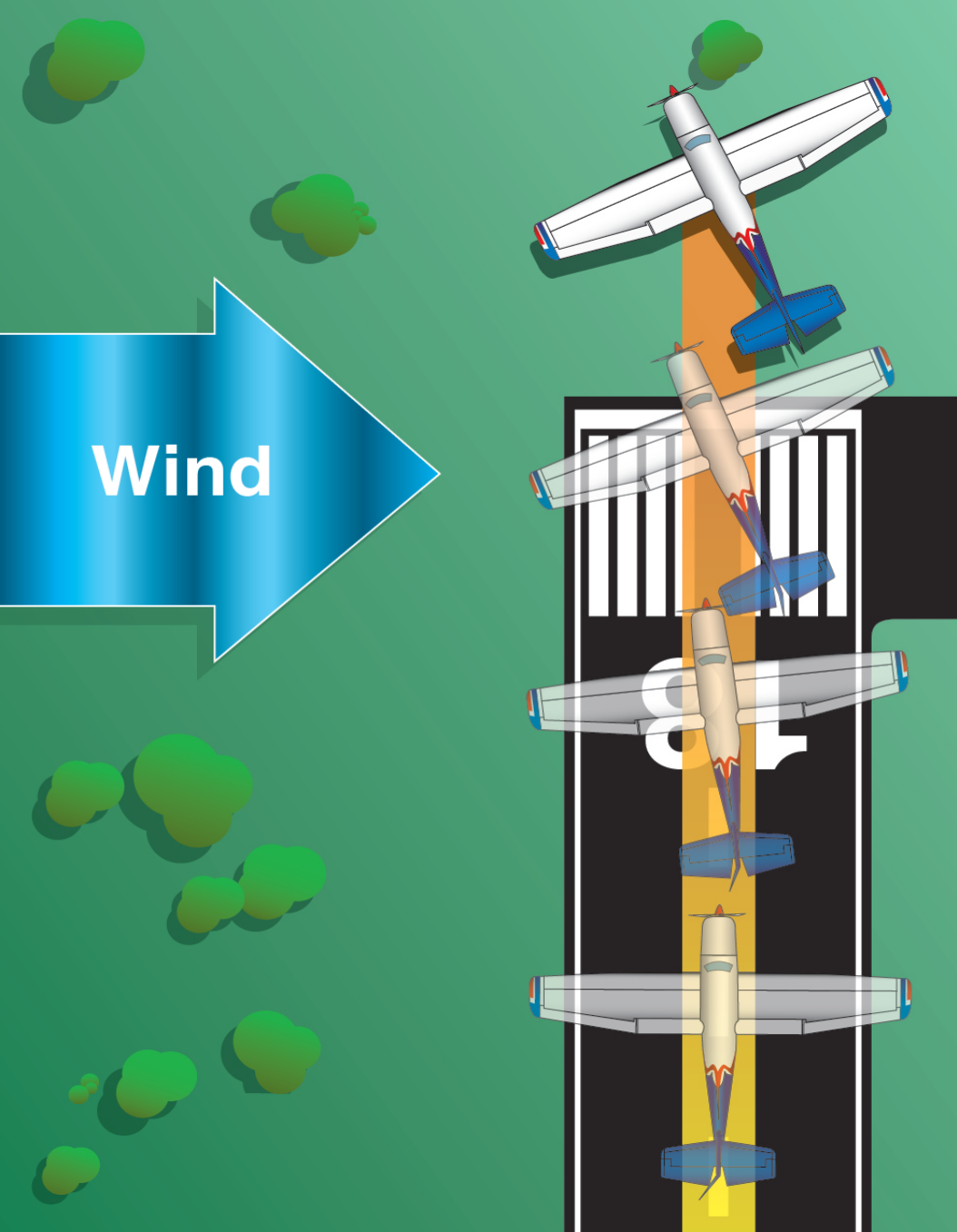
The most common errors made while performing crosswind takeoffs include the following:
- Failure to review AFM/POH performance and charts prior to takeoff.
- Failure to adequately clear the area prior to taxiing onto the active runway.
- Using less than full aileron pressure into the wind initially on the takeoff roll.
- Mechanical use of aileron control rather than judging lateral position of airplane on runway from visual clues and applying sufficient aileron to keep airplane centered laterally on runway.
- Side-skipping due to improper aileron application.
- Inadequate rudder control to maintain airplane parallel to centerline and pointed straight ahead in alignment with visual references.
- Excessive aileron input in the latter stage of the takeoff roll resulting in a steep bank into the wind at lift-off.
- Inadequate drift correction after lift-off.
Ground Effect on Takeoff
Ground effect is a condition of improved performance encountered when the airplane is operating very close to the ground. Ground effect can be detected and normally occurs up to an altitude equal to one wingspan above the surface. [Figure 6-7] Ground effect is most significant when the airplane maintains a constant attitude at low airspeed at low altitude (for example, during takeoff when the airplane lifts off and accelerates to climb speed, and during the landing flare before touchdown).
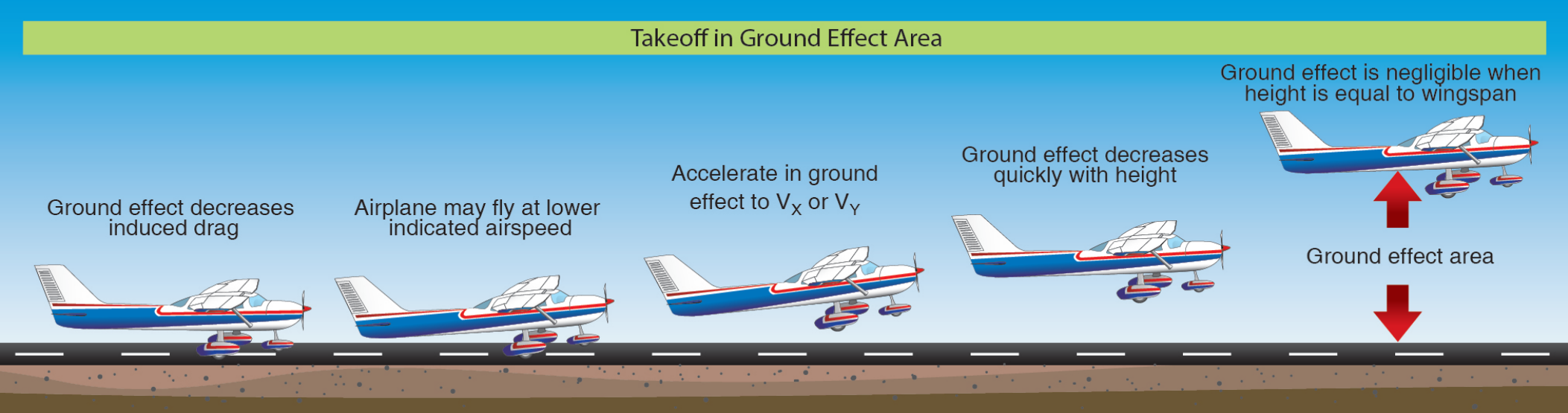
When the wing is under the influence of ground effect, there is a reduction in upwash, downwash, and wingtip vortices. As a result of the reduced wingtip vortices, induced drag is reduced. When the wing is at a height equal to 1/4 the span, the reduction in induced drag is about 25 percent. When the wing is at a height equal to 1/10 the span, the reduction in induced drag is about 50 percent. At high speeds where parasite drag dominates, induced drag is a small part of the total drag. Consequently, ground effect is a greater concern during takeoff and landing.
At takeoff, the takeoff roll, lift-off, and the beginning of the initial climb are accomplished within the ground effect area. The ground effect causes local increases in static pressure, which cause the airspeed indicator and altimeter to indicate slightly lower values than they should and usually cause the vertical speed indicator to indicate a descent. As the airplane lifts off and climbs out of the ground effect area, the following occurs:
- The airplane requires an increase in AOA to maintain lift coefficient.
- The airplane experiences an increase in induced drag and thrust required.
- The airplane experiences a pitch-up tendency and requires less elevator travel because of an increase in downwash at the horizontal tail.
- The airplane experiences a reduction in static source pressure and a corresponding increase in indicated airspeed.
VX is the speed at which the airplane achieves the greatest gain in altitude for a given distance over the ground. It is usually slightly less than VY, which is the greatest gain in altitude per unit of time. The specific speeds to be used for a given airplane are stated in the FAA-approved AFM/POH. The pilot should be aware that, in some airplanes, a deviation of 5 knots from the recommended speed may result in a significant reduction in climb performance; therefore, the pilot should maintain precise control of the airspeed to ensure the maneuver is executed safely and successfully.
Due to the reduced drag in ground effect, the airplane may seem to be able to take off below the recommended airspeed. However, as the airplane climbs out of ground effect below the recommended climb speed, initial climb performance will be much less than at VY or even VX. Under conditions of high density altitude, high temperature, and/or maximum gross weight, the airplane may be able to lift off but will be unable to climb out of ground effect. Consequently, the airplane may not be able to clear obstructions. Lift-off before attaining recommended flight airspeed incurs more drag, which requires more power to overcome. Since the initial takeoff and climb is based on maximum power, reducing drag is the only option. To reduce drag, pitch should be reduced which means losing altitude. Pilots should remember that many airplanes cannot safely takeoff at maximum gross weight at certain altitudes and temperatures, due to lack of performance. Therefore, under marginal conditions, it is important that the airplane takes off at the speed recommended for adequate initial climb performance.
Ground effect is important to normal flight operations. If the runway is long enough or if no obstacles exist, ground effect can be used to the pilot’s advantage by using the reduced drag to improve initial acceleration.
When taking off from an unsatisfactory surface, the pilot should apply as much weight to the wings as possible during the ground run and lift-off, using ground effect as an aid, prior to attaining true flying speed. The pilot should reduce AOA to attain normal airspeed before attempting to fly out of the ground effect areas.
Short-Field Takeoff and Maximum Performance Climb
When performing takeoffs and climbs from fields where the takeoff area is short or the available takeoff area is restricted by obstructions, the pilot should operate the airplane at the maximum limit of its takeoff performance capabilities. To depart from such an area safely, the pilot needs to exercise positive and precise control of airplane attitude and airspeed, so that takeoff and climb performance result in the shortest ground roll and the steepest angle of climb. [Figure 6-8] The pilot should consult and follow the performance section of the AFM/POH to obtain the power setting, flap setting, airspeed, and procedures prescribed by the airplane’s manufacturer.
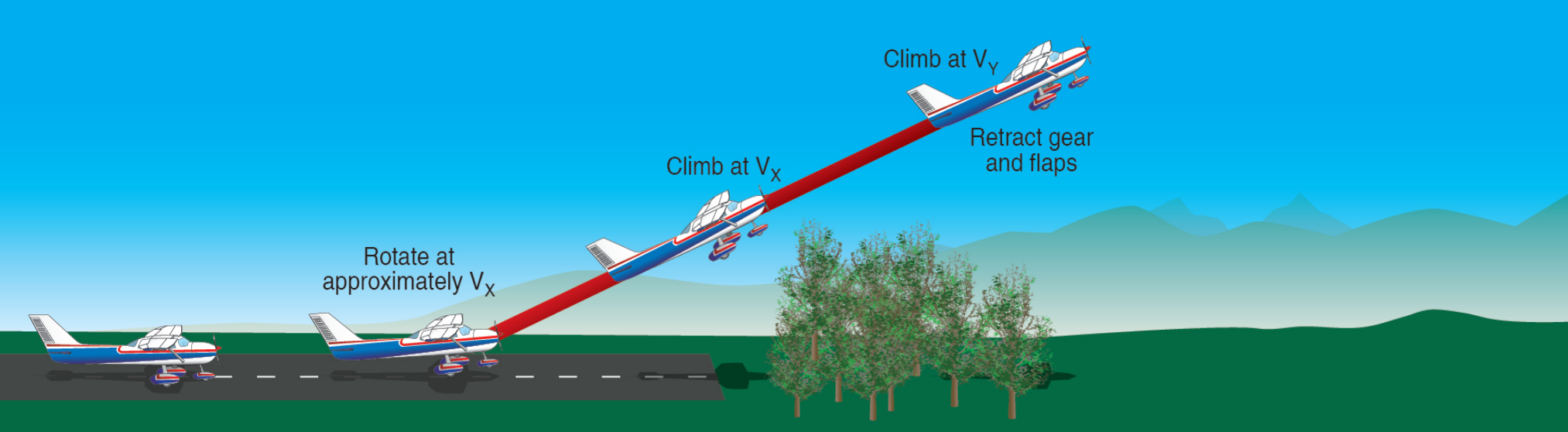
The pilot should have adequate knowledge in the use and effectiveness of the best angle-of-climb speed (VX ) and the best rate-of-climb speed (VY ) for the specific make and model of airplane being flown in order to safely accomplish a takeoff at maximum performance.