
Chapter 6
Takeoffs and Departure Climbs
Taking off from a short field requires the takeoff to be started from the very beginning of the takeoff area. At this point, the airplane is aligned with the intended takeoff path. If the airplane manufacturer recommends the use of flaps, they are extended the proper amount before beginning the takeoff roll. This allows the pilot to devote full attention to the proper technique and the airplane’s performance throughout the takeoff.
The pilot should apply takeoff power smoothly and continuously, without hesitation, to accelerate the airplane as rapidly as possible. Some pilots prefer to hold the brakes until the maximum obtainable engine revolutions per minute (rpm) are achieved before allowing the airplane to begin its takeoff run. However, it has not been established that this procedure results in a shorter takeoff run in all light, single-engine airplanes. The airplane is allowed to roll with its full weight on the main wheels and accelerate to the lift-off speed. As the takeoff roll progresses, the pilot should adjust the airplane’s pitch attitude and AOA to attain minimum drag and maximum acceleration. In nose-wheel type airplanes, this involves little use of the elevator control since the airplane is already in a low-drag attitude.
Lift-Off
As VX approaches, the pilot should apply back-elevator pressure until reaching the appropriate VX attitude to ensure a smooth and firm lift-off, or rotation. Since the airplane accelerates more rapidly after lift-off, the pilot should apply additional back-elevator pressure to hold a constant airspeed. After becoming airborne, the pilot will maintain a wings-level climb at VX until all obstacles have been cleared, or if no obstacles are present, until reaching an altitude of at least 50 feet above the takeoff surface. Thereafter, the pilot may lower the pitch attitude slightly and continue the climb at VY until reaching a safe maneuvering altitude. The pilot should always remember that an attempt to pull the airplane off the ground prematurely, or to climb too steeply, may cause the airplane to settle back to the runway or make contact with obstacles. Even if the airplane remains airborne, until the pilot reaches VX, the initial climb will remain flat, which diminishes the pilot's ability to successfully perform the climb and/or clear obstacles. [Figure 6-9]
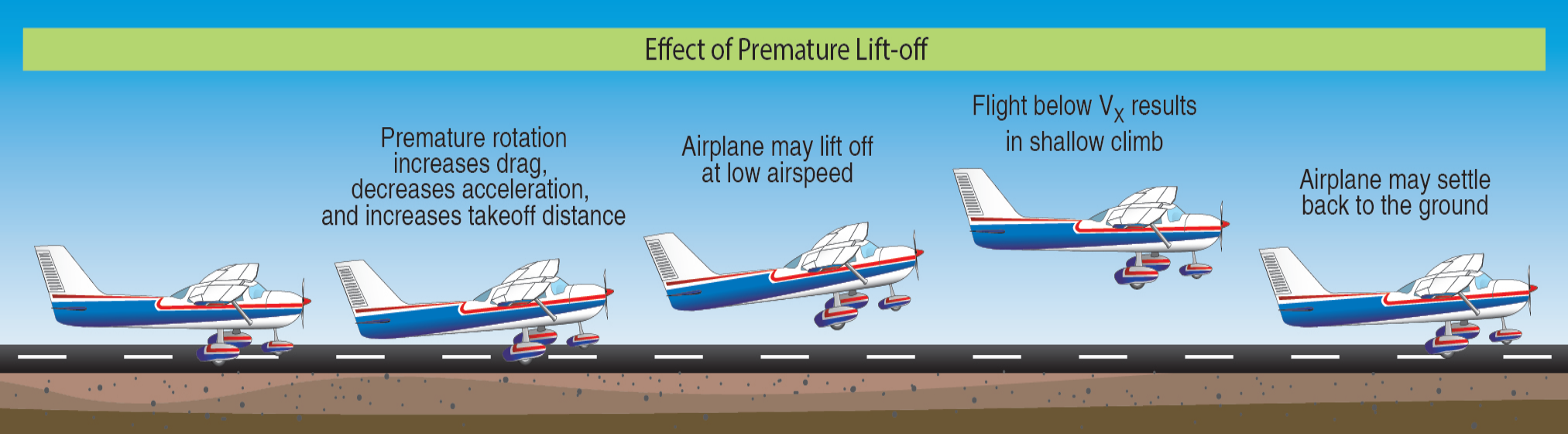
The objective is to rotate to the appropriate pitch attitude at (or near) VX. The pilot should be aware that some airplanes have a natural tendency to lift off well before reaching VX. In these airplanes, it may be necessary to allow the airplane to lift off in ground effect and then reduce pitch attitude to level until the airplane accelerates to VX with the wheels just clear of the runway surface. This method is preferable to forcing the airplane to remain on the ground with forward elevator-control pressure until VX is attained. Holding the airplane on the ground unnecessarily puts excessive pressure on the nose-wheel and may result in “wheel barrowing.” It also hinders both acceleration and overall airplane performance.
Initial Climb
On short-field takeoffs, the landing gear and flaps should remain in takeoff position until the airplane is clear of obstacles (or as recommended by the manufacturer) and VY has been established. Until all obstacles have been cleared, the pilot should maintain focus outside the airplane instead of reaching for landing gear or flap controls or looking inside the airplane for any reason. When the airplane is stabilized at VY, the landing gear (if retractable) and flaps should be retracted. It is usually advisable to raise the flaps in increments to avoid sudden loss of lift and settling of the airplane. The pilot should next reduce the power to the normal climb setting or as recommended by the airplane manufacturer.
Common errors in the performance of short-field takeoffs and maximum performance climbs are:
- Failure to review AFM/POH and performance charts prior to takeoff.
- Failure to adequately clear the area.
- Failure to utilize all available runway/takeoff area.
- Failure to have the airplane properly trimmed prior to takeoff.
- Premature lift-off resulting in high drag.
- Holding the airplane on the ground unnecessarily with excessive forward-elevator pressure.
- Inadequate rotation resulting in excessive speed after lift-off.
- Inability to attain/maintain VX.
- Fixation on the airspeed indicator during initial climb.
- Premature retraction of landing gear and/or wing flaps.
Soft/Rough-Field Takeoff and Climb
Takeoffs and climbs from soft fields require the use of operational techniques for getting the airplane airborne as quickly as possible to eliminate the drag caused by tall grass, soft sand, mud, and snow and may require climbing over an obstacle. The technique makes judicious use of ground effect to reduce landing gear drag and requires an understanding of the airplane’s slow speed characteristics and responses. These same techniques are also useful on a rough field where the pilot should get the airplane off the ground as soon as possible to avoid damaging the landing gear.
Taking off from a soft surface or through soft surfaces or long, wet grass reduces the airplane’s ability to accelerate during the takeoff roll and may prevent the airplane from reaching adequate takeoff speed if the pilot applies normal takeoff techniques. The pilot should be aware that the correct takeoff procedure for soft fields is quite different from the takeoff procedures used for short fields with firm, smooth surfaces. To minimize the hazards associated with takeoffs from soft or rough fields, the pilot should transfer the support of the airplane’s weight as rapidly as possible from the wheels to the wings as the takeoff roll proceeds by establishing and maintaining a relatively high AOA or nose-high pitch attitude as early as possible. The pilot should lower the wing flaps prior to starting the takeoff (if recommended by the manufacturer) to provide additional lift and to transfer the airplane’s weight from the wheels to the wings as early as possible. The pilot should maintain a continuous motion with sufficient power while lining up for the takeoff roll as stopping on a soft surface, such as mud or snow, might bog the airplane down.
Takeoff Roll
As the airplane is aligned with the takeoff path, the pilot should apply takeoff power smoothly and as rapidly as the powerplant can accept without faltering. As the airplane accelerates, the pilot should apply enough back-elevator pressure to establish a positive AOA and to reduce the weight supported by the nose-wheel.
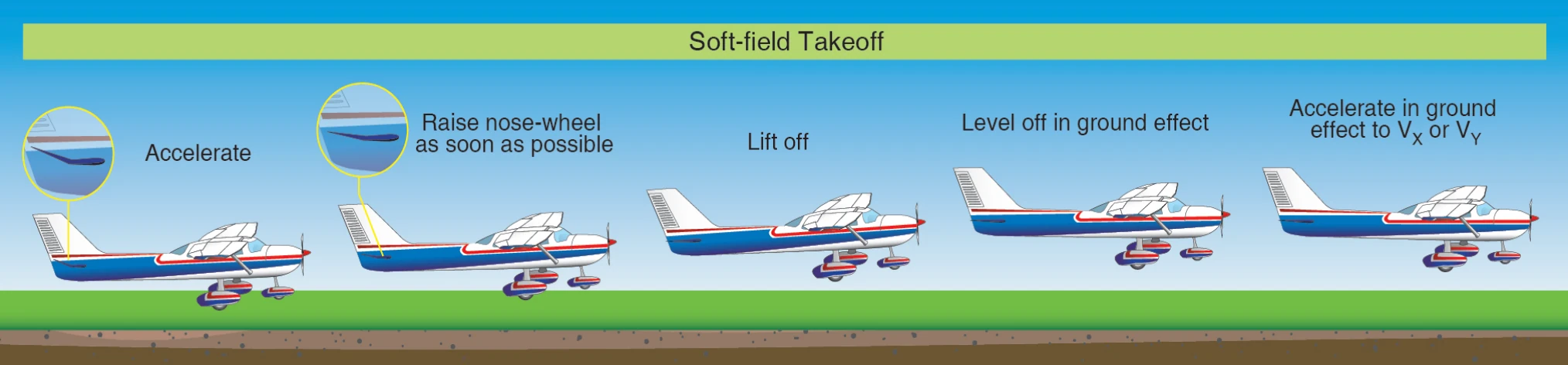
When the airplane is held at a nose-high attitude throughout the takeoff run, the wings increasingly relieve the wheels of the airplane’s weight as speed increases and lift develops, thereby minimizing the drag caused by surface irregularities or adhesion. If this attitude is accurately maintained, the airplane virtually flies itself off the ground, becoming airborne but at an airspeed slower than a safe climb speed because of ground effect. [Figure 6-10]
Lift-Off
After the airplane becomes airborne, the pilot should gently lower the nose with the wheels clear of the surface to allow the airplane to accelerate to a minimum safe climb out speed, Immediately after the airplane becomes airborne and while it accelerates, the pilot should be aware that, while transitioning out of the ground effect area, the airplane will have a tendency to settle back onto the surface, even with full power applied. Therefore, it is essential that the airplane remain in ground effect until at least VX is reached. This requires a good understanding of the control pressures, aircraft responses, visual clues, and acceleration characteristics of that particular airplane.