Chapter 7
Ground Reference Maneuvers
Introduction
During initial training, pilots learn how various flight control pressure inputs affect the airplane. After achieving a sufficient level of competence, the pilot is ready to apply this skill and maintain the airplane, not only at the correct attitude and power configuration, but also along an appropriate course relative to objects on the ground. This skill is the basis for traffic patterns, survey, photographic, sight-seeing, aerial application (crop dusting), and various other flight profiles requiring specific flightpaths referenced to points on the surface.
Ground reference maneuvers are the principal flight maneuvers that combine the four fundamentals (straight-and-level, turns, climbs, and descents) into a set of integrated skills that the pilot uses in everyday flight activity. From every takeoff to every landing, a pilot exercises these skills to control the airplane. Therefore, a pilot needs to develop the proper coordination, timing, and attention in order to accurately and safely maneuver the airplane with regard to the required attitudes and ground references.
The pilot should be introduced by their instructor to ground reference maneuvers as soon as the pilot shows proficiency in the four fundamentals. Ground reference maneuvers call for manipulation of the flight controls using necessary control pressures to affect the airplane’s attitude and position by using the outside natural horizon and ground-based references with brief periods of scanning the flight instruments.
Maneuvering by Reference to Ground Objects
Ground reference maneuvers train the pilot to accurately place the airplane in relationship to specific references and maintain a desired ground track. While vision is the most utilized sense, other senses are actively involved at different levels. For example, the amount of pressure needed to overcome flight control surface forces provides tactile feedback as to the airplane's airspeed and aerodynamic load.
It is a common error for beginning pilots to fixate on a specific reference, such as a single location on the ground or a spot on the natural horizon. A pilot fixating on any one reference loses the ability to determine rate, which significantly degrades a pilot’s performance. By visually scanning across several references, the pilot learns how to determine the rate of closure to a specific point. In addition, the pilot should scan between several visual references to determine relative motion and to determine if the airplane is maintaining, or drifting to or from, the desired ground track. Consider a skilled automobile driver in a simple intersection turn; the driver does not merely turn the steering wheel some degree and hope that it will work out. The driver picks out several references, such as an island to their side, a painted lane line, or the opposing curb, and uses those references to make almost imperceptible adjustments to the amount of deflection on the steering wheel. At the same time, the driver adjusts the pressure on the accelerator pedal to smoothly join the new lane. In the same manner, multiple references are required to precisely control the airplane in reference to the ground.
Not all ground-based references are visually equal. Awareness of typical visual illusions helps a pilot select appropriate references. For example, larger objects or references may appear closer than they actually are when compared to smaller objects or references. Prevailing visibility has a significant effect on the pilot’s perception of the distance to a reference. Excellent visibility with clear skies tends to make an object or reference appear closer than when compared to a hazy day with poor visibility. Rain can alter the visual image in a manner creating an illusion of being at a higher than actual altitude, and brighter objects or references may appear closer than dimmer objects. However, if using references of similar size and proportion, pilots find ground reference maneuvers easier to execute.
Ground-based references can be numerous. Examples include breakwaters, canals, fence lines, field boundaries, highways, railroad tracks, roads, pipe lines, power lines, water tanks, and many other objects; however, choices can be limited by geography, population density, infrastructure, or structures. The pilot should consider the type of maneuver being performed, altitude at which the maneuver will be performed, emergency landing requirements, density of structures, wind direction, visibility, and the type of airspace when selecting a ground-based reference.
Ground reference maneuvers develop a pilot's division of attention skill. A pilot needs to control the airplane's attitude while tracking a specific path over the ground. In addition, the pilot should be able to scan for hazards such as other aircraft, prepare for an emergency landing should the need arise, and scan the flight and engine instruments at regular intervals to ensure that a pending situation, such as decreasing oil pressure, does not turn into an unexpected incident.
Ground reference maneuvers place the airplane in a low altitude environment with associated hazards. Pilots should look for other aircraft, including helicopters, and look for obstructions such as radio towers and wires. In addition, pilots should consider engine failure and have one or more locations available for an emergency landing. Pilots should always clear the area with two 90° clearing turns looking to the left and the right, as well as above and below the airplane. The maneuver area should not cause disturbances and be well away from any open air assembly of persons, congested areas of a city, town, or settlement, or herd of livestock. Before performing any maneuver, the pilot should complete the required checklist items, make any radio announcements (such as on a practice area frequency), and safety clearing turns. As a general note, a ground reference maneuver should not exceed a bank angle of 45° or an airspeed greater than the maneuvering speed. As part of preflight planning, the pilot should determine the predicted (POH/AFM) stall speed at 50° or at the highest bank angle expected during the maneuver to assure there will be a safety margin above the stall speed during the maneuver.
Drift and Ground Track Control
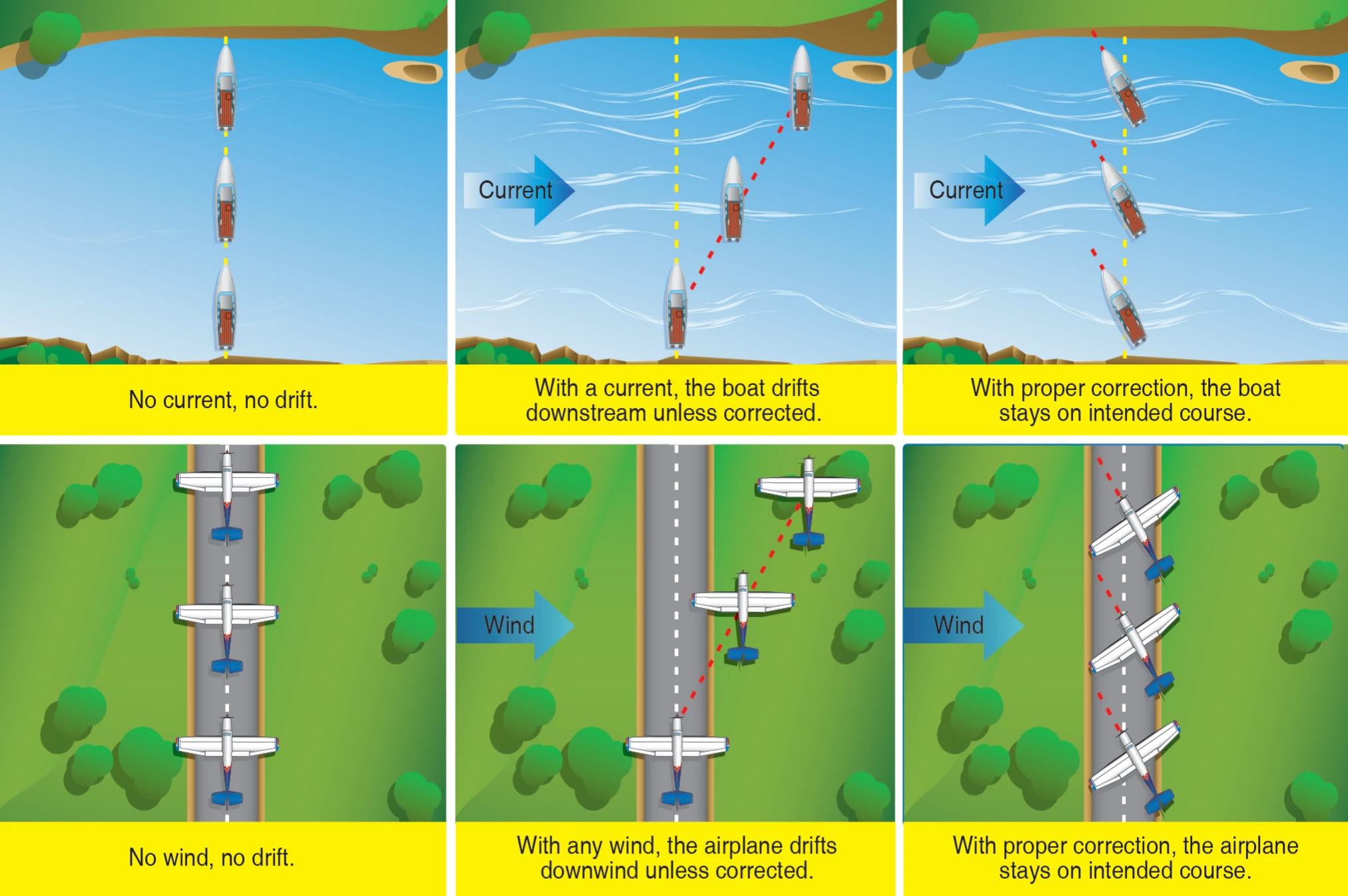
Wind direction and velocity variations create the need for flightpath corrections during a ground reference maneuver. In a similar way that water currents affect the progress of a boat or ship, wind directly influences the path that the airplane travels in reference to the ground. Whenever the airplane is in flight, the movement of the air directly affects the actual ground track of the airplane.
For example, an airplane is traveling at 90 knots (90 nautical miles per hour) and the wind is blowing from right to left at 10 knots. The airplane continues forward at 90 knots but also travels left 10 nautical miles for every hour of flight time. If the airplane, in this example doubles its speed to 180 knots, it still drifts laterally to the left 10 nautical miles every hour. Unless in still air, traveling to a point on the surface requires compensation for the movement of the air mass.
Ground reference maneuvers are generally flown at altitudes between 600 and 1,000 feet above ground level (AGL). The pilot should consider the following when selecting the maneuvering altitude:
- The lower the maneuvering altitude, the faster the airplane appears to travel in relation to the ground.
- Drift should be easily recognizable from both sides of the airplane.
- The altitude should provide obstruction clearance of no less than 500 feet vertically above the obstruction and 2,000 feet horizontally.
- In the event of an engine failure, lower altitudes equate to less time to configure the airplane and reduced gliding distance before a forced landing.
- What specific altitude or altitude range does the testing standard call for?
Correcting Drift During Straight-and-Level Flight
When flying straight and level and following a selected straight-line direct ground track, the preferred method of correcting for wind drift is to angle the airplane sufficiently into the wind to cancel the effect of the sideways drift caused by the wind. The wind’s speed, the angle between the wind direction and the airplane’s longitudinal axis, and the airspeed of the airplane determine the required wind correction angle. For example, an airplane with an airspeed of 100 knots in an air mass moving at 20 knots directly from the side, should turn 12° into the wind to cancel the airplane's drift. If the wind in the above example is only 10 knots, the wind correction angle required to cancel the drift is six degrees. When the drift has been neutralized by heading the airplane into the wind, the airplane will fly the direct straight ground track.
To further illustrate this point, if a boat is crossing a river and the river’s current is completely still, the boat could head directly to a point on the opposite shore on a straight course without any drift. However, rivers tend to have a downstream current that needs to be considered if the captain wants the boat to arrive at the opposite shore using a direct straight path. Any downstream current pushes the boat sideways and downstream at the speed of the current. To counteract this downstream movement, the boat needs to move upstream at the same speed as the river is moving the boat downstream. This is accomplished by angling the boat upstream to counteract the downstream flow. If done correctly, the boat follows a direct straight track across the river to the intended destination point. A slower forward speed of the boat or a faster river current requires a greater angle to counteract the drift. [Figure 7-1]