
Chapter 7
Ground Reference Maneuvers
The next leg is where the airplane turns from an upwind leg position to the crosswind leg. The pilot should slowly roll the airplane into a shallow-banked turn, as the developing crosswind drifts the airplane into the inside of the rectangular course with coordinated aileron and rudder pressures. As the airplane turns onto the crosswind leg, the headwind lessens and becomes a crosswind. As the turn nears completion, the bank angle is reduced with coordinated aileron and rudder pressures. To compensate for the crosswind, the pilot maintains an angle into the wind, toward the outside of the rectangular course, which requires the turn to be less than 90°.
The final turn is back to the downwind leg, which requires a medium-banked angle and a turn greater than 90°. The groundspeed will be increasing as the turn progresses and the bank should be held and then rolled out in a rapid, but not excessive, manner using coordinated aileron and rudder pressures.
For the maneuver to be executed properly, the pilot should visually utilize the ground-based, nose, and wingtip references to properly position the airplane in attitude and in orientation to the rectangular course. In order to maintain a constant ground-based radius during the turns, each turn requires the bank angle to be adjusted to compensate for the changing groundspeed—the higher the groundspeed, the steeper the bank. If the groundspeed is initially higher and then decreases throughout the turn, the bank angle should progressively decrease throughout the turn. The converse is also true, if the groundspeed is initially slower and then increases throughout the turn, the bank angle should progressively increase throughout the turn until rollout is started. Also, the rate for rolling in and out of the turn should be adjusted to prevent drifting in or out of the course. When the wind is from a direction that could drift the airplane into the course, the banking roll rate should be slow. When the wind is from a direction that could drift the airplane to the outside of the course, the banking roll rate should be quick.
The following are the most common errors made while performing rectangular courses:
- Failure to adequately clear the surrounding area for safety hazards, initially and throughout the maneuver.
- Failure to establish a constant, level altitude prior to entering the maneuver.
- Failure to maintain altitude during the maneuver.
- Failure to properly assess wind direction.
- Failure to establish the appropriate wind correction angle.
- Failure to apply coordinated aileron and rudder pressure, resulting in slips and skids.
- Failure to manipulate the flight controls in a smooth and continuous manner.
- Failure to properly divide attention between airplane control and orientation with ground references.
- Failure to execute turns with accurate timing.
Turns Around a Point
Turns around a point are a logical extension of both the rectangular course and S-turns across a road. The maneuver is a 360° constant radius turn around a single ground-based reference point. [Figure 7-5] The principles are the same in any turning ground reference maneuver—higher groundspeeds require steeper banks and slower ground speeds require shallower banks. The objectives of turns around a point are as follows:
- Maintaining a specific relationship between the airplane and the ground.
- Dividing attention between the flightpath, ground-based references, manipulating the flight controls, and scanning for outside hazards and instrument indications.
- Adjusting the bank angle during turns to correct for groundspeed changes in order to maintain a constant radius turn—steeper bank angles for higher ground speeds, shallow bank angles for slower groundspeeds.
- Improving competency in managing the quickly-changing bank angles.
- Establishing and adjusting the wind correction angle in order to maintain the track over the ground.
- Developing the ability to compensate for drift in quickly-changing orientations.
- Developing further awareness that the radius of a turn is correlated to the bank angle.
To perform a turn around a point, the pilot needs to complete at least one 360° turn; however, to properly assess wind direction, velocity, bank required, and other factors related to turns in wind, the pilot should complete two or more turns. As in other ground reference maneuvers, when wind is present, the pilot adjusts the airplane’s bank and wind correction angle to maintain a constant radius turn around a point. In contrast to the ground reference maneuvers discussed previously, in which turns were approximately limited to either 90° or 180°, turns around a point are consecutive 360° turns, where pilot constantly adjusts the bank angle and the resulting rate of turn as the airplane sequences through the various wind directions. The pilot should make these adjustments by applying coordinated aileron and rudder pressure throughout the turn.
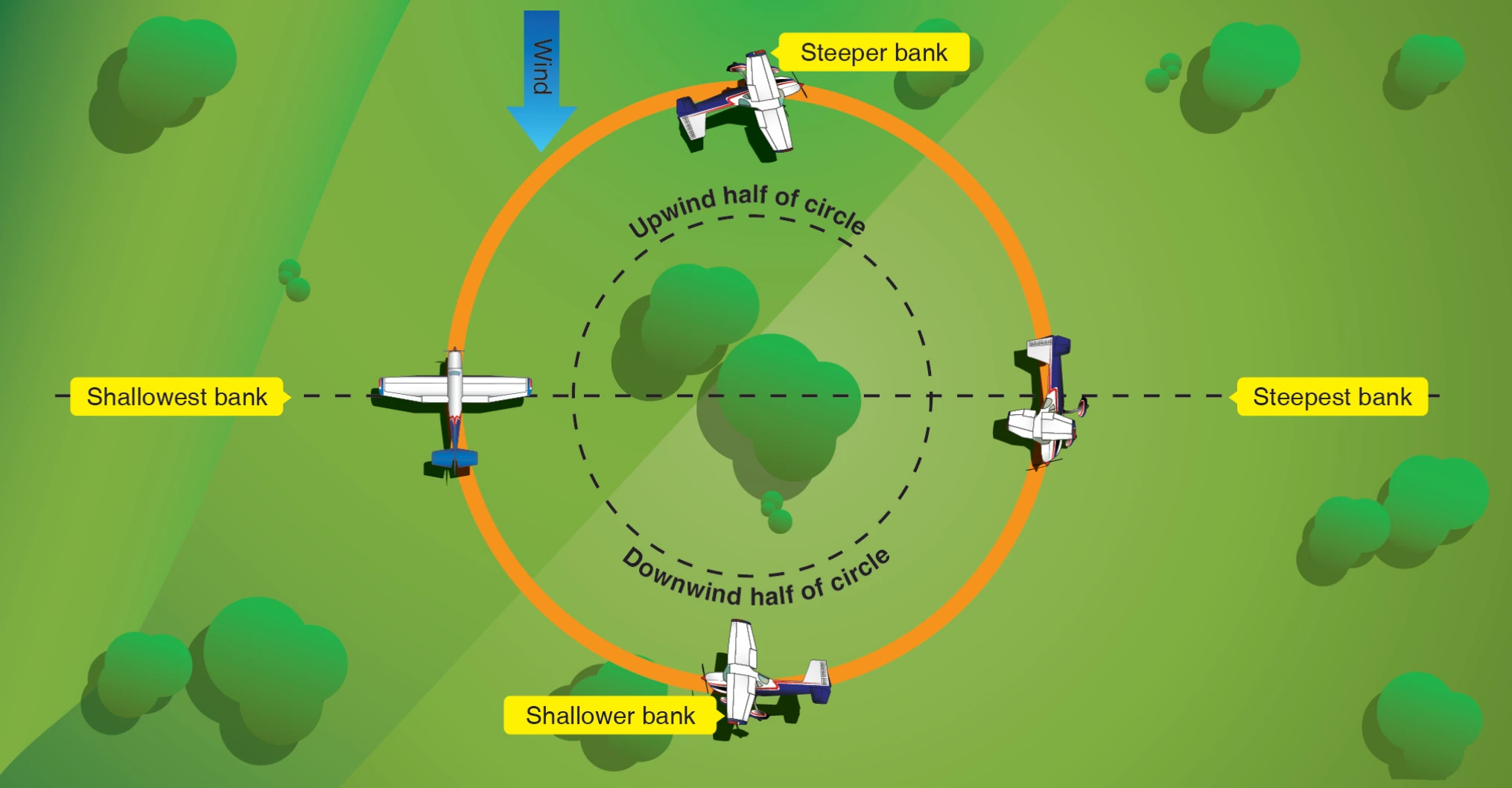
When performing a turn around a point, the pilot should select a prominent, ground-based reference that is easily distinguishable yet small enough to present a precise reference. The pilot should enter the maneuver downwind, where the groundspeed is at its fastest, at the appropriate radius of turn and distance from the selected ground-based reference point. In a high-wing airplane, the lowered wing may block the view of the ground reference point, especially in airplanes with side-by-side seating during a left turn (assuming that the pilot is flying from the left seat). To prevent this, the pilot may need to change the maneuvering altitude or the desired turn radius. The pilot should ensure that the reference point is visible at all times throughout the maneuver, even with the wing lowered in a bank.
Upon entering the maneuver, depending on the wind’s speed, it may be necessary to roll into the initial bank at a rapid rate so that the steepest bank is set quickly to prevent the airplane from drifting outside of the desired turn radius. This is best accomplished by repeated practice and assessing the required roll in rate. Thereafter, the pilot should gradually decrease the angle of bank until the airplane is headed directly upwind. As the upwind becomes a crosswind and then a downwind, the pilot should gradually steepen the bank to the steepest angle upon reaching the initial point of entry.
During the downwind half of the turn, the pilot should progressively adjust the airplane’s heading toward the inside of the turn. During the upwind half, the pilot should progressively adjust the airplane’s heading toward the outside of the turn. Put another way, the airplane’s heading should be ahead of its position over the ground during the downwind half of the turn and behind its position during the upwind half. Remember that the goal is to make a constant-radius turn over the ground and, because the airplane is flying through a moving air mass, the pilot should constantly adjust the bank angle to achieve this goal.
The following are the most common errors in the performance of turns around a point:
- Failure to adequately clear the surrounding area for safety hazards, initially and throughout the maneuver.
- Failure to establish a constant, level altitude prior to entering the maneuver.
- Failure to maintain altitude during the maneuver.
- Failure to properly assess wind direction.
- Failure to properly execute constant-radius turns.
- Failure to manipulate the flight controls in a smooth and continuous manner.
- Failure to establish the appropriate wind correction angle.
- Failure to apply coordinated aileron and rudder pressure, resulting in slips or skids.
S-Turns
An S-turn is a ground reference maneuver in which the airplane’s ground track resembles two opposite but equal half-circles on each side of a selected ground-based straight-line reference. [Figure 7-6] This ground reference maneuver presents a practical application for the correction of wind during a turn. The objectives of S-turns across a road (or line) are as follows:
- Maintaining a specific relationship between the airplane and the ground.
- Dividing attention between the flightpath, ground-based references, manipulating the flight controls, and scanning for outside hazards and instrument indications.
- Adjusting the bank angle during turns to correct for groundspeed changes in order to maintain a constant-radius turn—steeper bank angles for higher groundspeeds, shallow bank angles for slower groundspeeds.
- Rolling out from a turn with the required wind correction angle to compensate for any drift cause by the wind.
- Establishing and correcting the wind correction angle in order to maintain the track over the ground.
- Developing the ability to compensate for drift in quickly-changing orientations.
- Arriving at specific points on required headings.
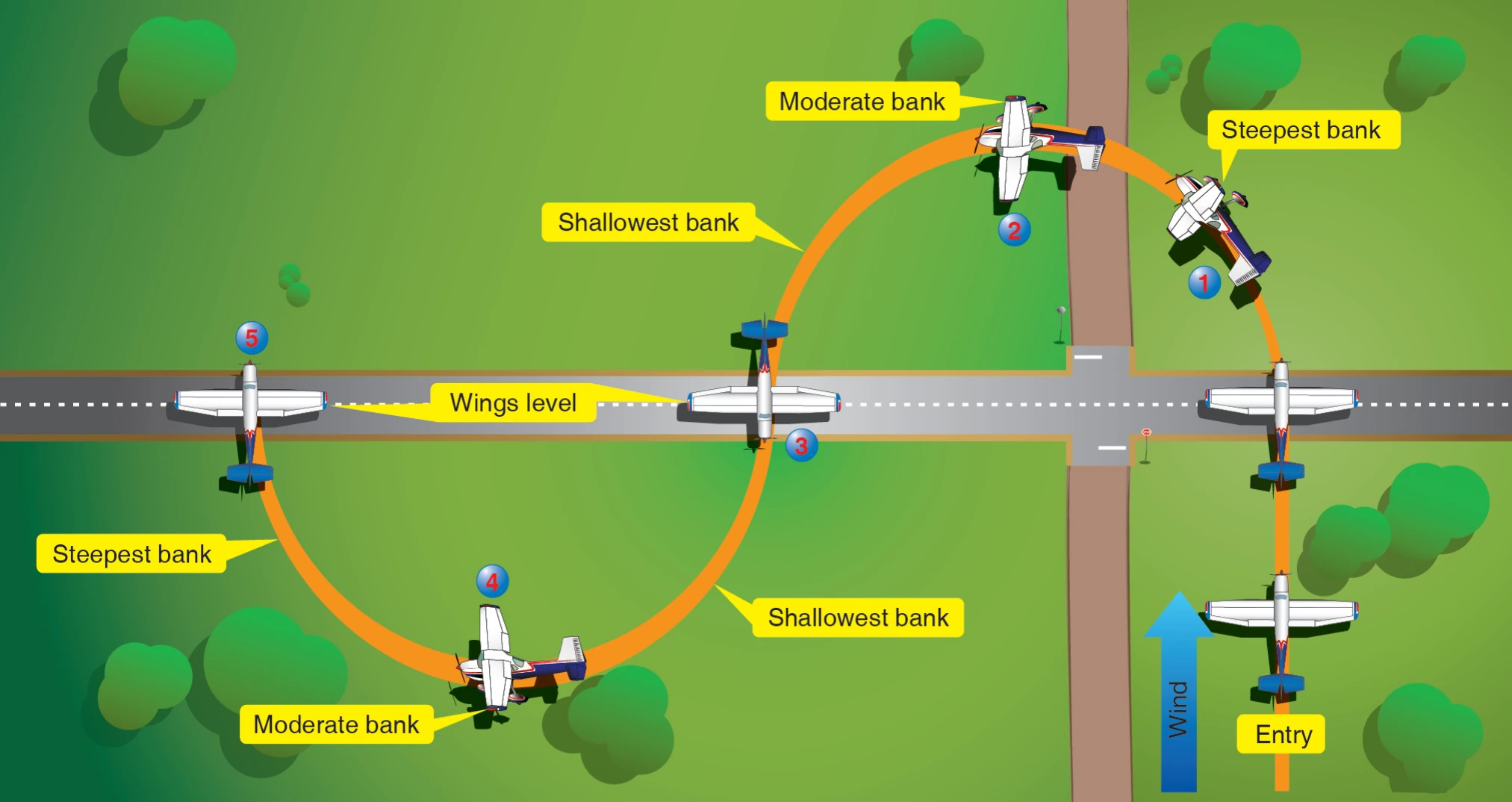
With the airplane in the downwind position, the maneuver consists of crossing a straight-line ground reference at a 90° angle and immediately beginning a 180° constant-radius turn. The pilot will then adjust the roll rate and bank angle for drift effects and changes in groundspeed, and re-cross the straight-line ground reference in the opposite direction just as the first 180° constant-radius turn is completed. The pilot will then immediately begin a second 180° constant-radius turn in the opposite direction, adjusting the roll rate and bank angle for drift effects and changes in groundspeed, again re-crossing the straight-line ground reference as the second 180° constant-radius turn is completed. If the straight-line ground reference is of sufficient length, the pilot may complete as many as can be safely accomplished.