
Chapter 7
Ground Reference Maneuvers
As soon as the pilot lifts off the surface and levels the wings in a crosswind, the airplane begins tracking sideways. The force of the crosswind acts on the mass of the airplane, and the speed of drift increases up to the speed of the crosswind component. A wind that is directly to the right or the left (at a 90° angle) will cause the airplane to accelerate sideways at the same speed as the wind. When the wind is halfway between the side and the nose of the airplane (at a 45° angle), it causes a sideways drift up to just over 70 percent of the total speed of the wind. It should be understood that pilots do not calculate the required drift correction angles for ground reference maneuvers; they merely use the references and adjust the airplane’s relationship to those references to cancel any drift. The groundspeed of the airplane is also affected by the wind. As the wind direction becomes parallel to the airplane’s longitudinal axis, the magnitude of the wind’s effect on the groundspeed is greater; as the wind becomes perpendicular to the longitudinal axis, the magnitude of the wind’s effect on the groundspeed is less. In general, When the wind is blowing straight into the nose of the airplane, the groundspeed will be less than the airspeed. When the wind is blowing from directly behind the airplane, the groundspeed will be faster than the airspeed. In other words, when the airplane is headed upwind, the groundspeed is decreased; when headed downwind, the groundspeed is increased.
Constant Radius During Turning Flight
In a no-wind condition, a pilot may make a constant-radius turn over the ground using a fixed bank angle. If wind is present, however, a pilot will observe a change in the radius of a turn while maintaining that same constant bank angle. [Figure 7-2] As groundspeed increases, the observed radius of the turn increases. Conversely, as groundspeed decreases, the radius of the turn over the ground will decrease. For a ground-referenced constant-radius turn, the pilot compensates for changes in groundspeed by varying the bank angle throughout the turn. When groundspeed increases, the pilot banks more steeply to maintain a constant-radius turn over the ground. The converse is also true: when groundspeed decreases, the pilot uses a shallower bank.
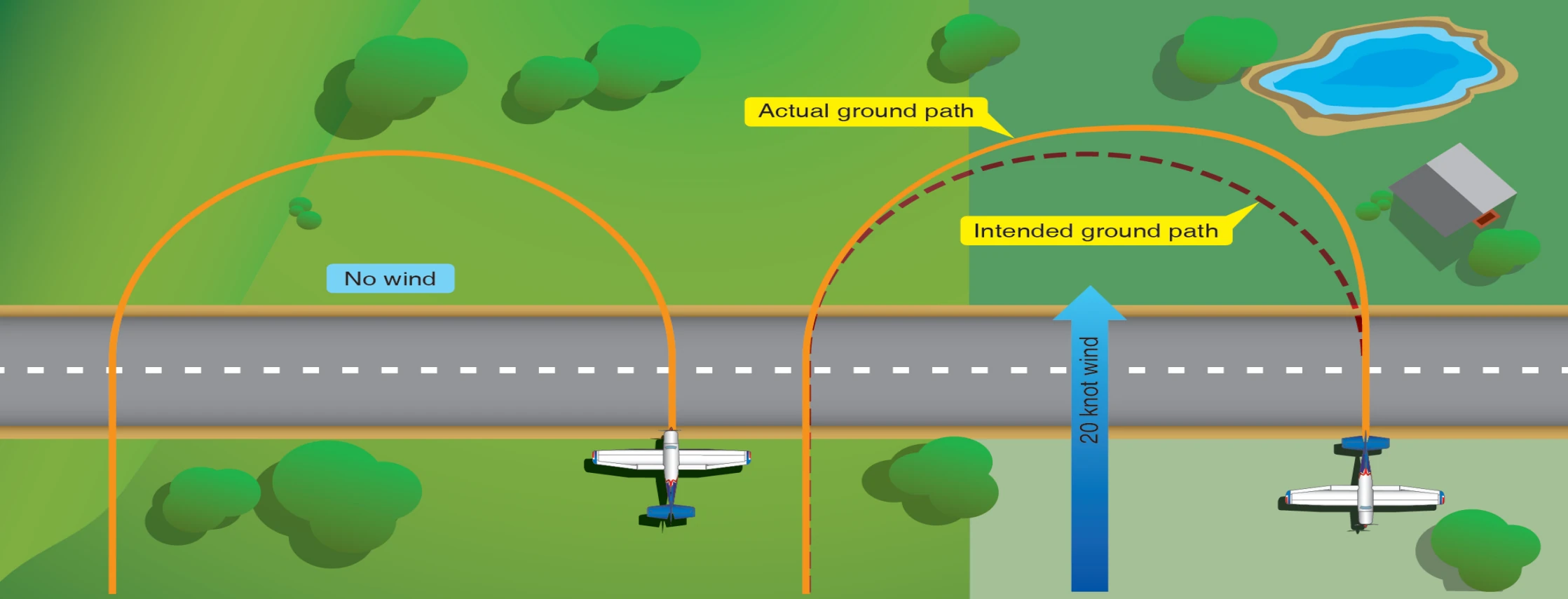
For a given true airspeed, the radius of turn in the air varies proportionally with the bank angle. To maintain a constant radius over the ground, the bank angle used is proportional to groundspeed. For example, an airplane is in the downwind position at 100 knots groundspeed. In this example, the wind is 10 knots, meaning that the airplane has an airspeed of 90 knots (for this discussion, assume true, calibrated, and indicated airspeed are all the same). If the pilot starts a turn using a 45° bank angle, the turn radius over the ground at that moment is approximately 890 feet. As the airplane turns, the groundspeed decreases and the bank angle needs to be reduced in order to maintain the same turn radius of 890 feet over the ground. At the upwind point of the turn, the bank angle should be approximately 33°. In another example, if the downwind is flown at an airspeed of 90 knots in a 10 knot tailwind with a desired turn radius of 2,000 feet, the bank angle would be approximately 24°. The bank angle flying upwind would be approximately 16°.
Put another way, at a higher groundspeed, there is less time to turn the airplane while trying to maintain a ground-referenced constant-radius turn. The pilot increases the bank angle in order to increase the rate of turn, and the increased rate of turn offsets the reduced time available to make the turn. Conversely, when flying at a lower groundspeed, the pilot reduces the angle of bank and rate of turn to compensate for the additional time taken while making the turn. With some experience, pilots may notice how wind direction affects the time needed for various segments of ground-referenced turns.
To demonstrate the effect that wind has on turns, the pilot should select a straight-line ground reference, such as a road or railroad track. [Figure 7-3] Choosing a straight-line ground reference that is parallel to the wind, the airplane would be flown into the wind and directly over the selected straight-line ground reference. Once a straight-line ground reference is established, the pilot makes a 360° constant medium-banked turn. As the airplane completes the 360° turn, it should return directly over the straight-line ground reference but downwind from the starting point. Choosing a straight-line ground reference that has a crosswind, and using the same 360° constant medium-banked turn, demonstrates how the airplane drifts away from the reference even as the pilot holds a constant bank angle. In both examples, the path over the ground is not circular, although in reference to the air, the airplane flew a perfect continuous radius.
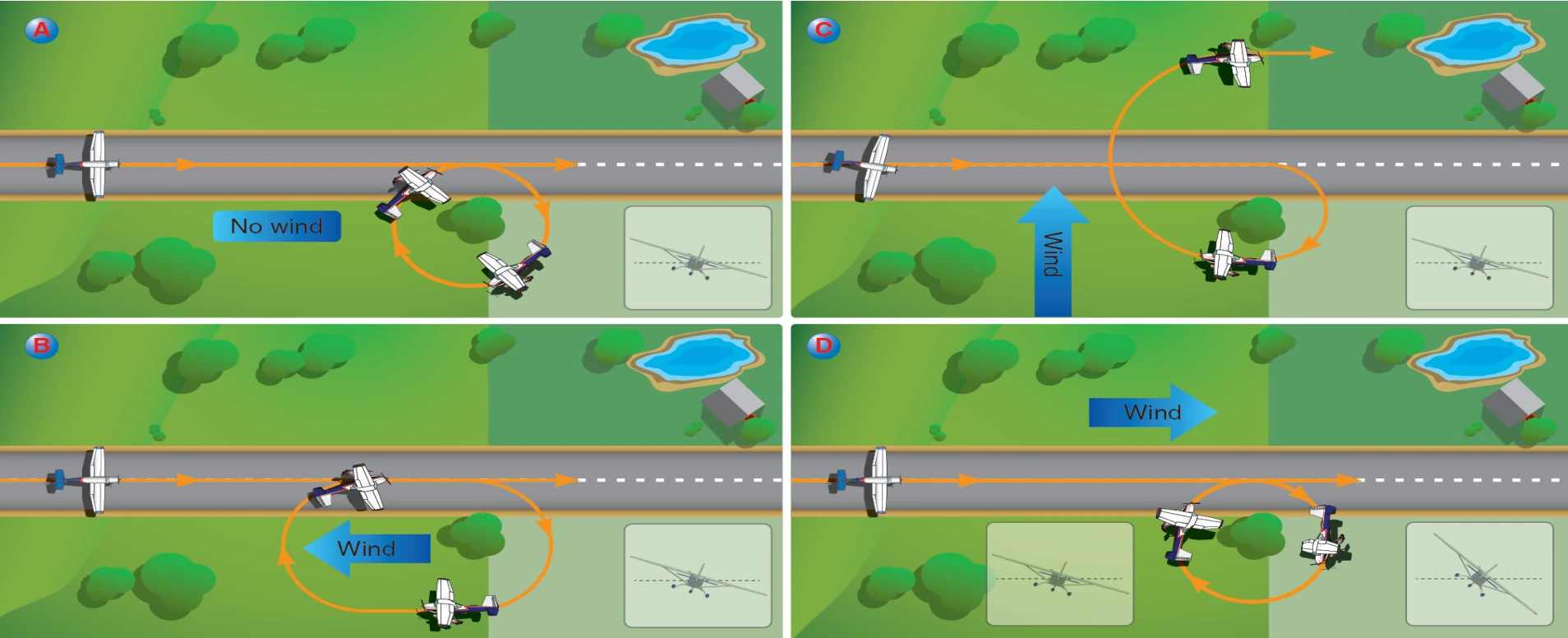
In order to compensate for the effects of wind drift, the pilot adjusts the bank angle as the groundspeed changes throughout the turn. Where groundspeed is the fastest, such as when the airplane is headed downwind, the bank angle should be steepest. Where groundspeed is the slowest, such as when the airplane is headed upwind, the bank angle should be shallow. It is necessary to increase or decrease the angle of bank, which increases or decreases the rate of turn, to achieve the desired constant radius track over the ground.
Ground reference maneuvers should always be entered from a downwind position. This allows the pilot to establish the steepest bank angle required to maintain a constant radius ground track. If the bank is too steep, the pilot should immediately exit the maneuver and re-establish a lateral position that is further from the ground reference. The pilot should avoid bank angles in excess of 45°due to the increased stalling speed.
Tracking Over and Parallel to a Straight Line
The pilot should first be introduced to ground reference maneuvers by correcting for the effects of a crosswind over a straight-line ground reference, such as road or railroad tracks. If a straight road or railroad track is unavailable, the pilot should choose multiple references (three minimum) which line up along a straight path. The reference line should be suitably long so the pilot has sufficient time to understand the concepts of wind correction and practice the maneuver. Initially, the maneuver should be flown directly over the ground reference line with the pilot angling the airplane’s longitudinal axis into the wind sufficiently such as to cancel the effect of drift. The pilot should scan between far ahead and close to the airplane to practice tracking multiple references.
When proficiency has been demonstrated by flying directly over the ground reference line, the pilot should then practice flying a straight parallel path that is offset from the ground reference. The offset parallel path should not be more than three-fourths of a mile from the reference line. The maneuver should be flown offset from the ground references with the pilot angling the airplane’s longitudinal axis into the wind sufficiently to cancel the effect of drift while maintaining a parallel track.
Rectangular Course
A principal ground reference maneuver is the rectangular course. [Figure 7-4] The rectangular course is a training maneuver in which the airplane maintains an equal distance from all sides of the selected rectangular references. The maneuver is accomplished to replicate the airport traffic pattern that an airplane typically maneuvers while landing. While performing the rectangular course maneuver, the pilot should maintain a constant altitude, airspeed, and distance from the ground references. The maneuver assists the pilot in practicing the following:
- Maintaining a specific relationship between the airplane and the ground.
- Dividing attention between the flightpath, ground-based references, manipulating the flight controls, and scanning for outside hazards and instrument indications.
- Adjusting the bank angle during turns to correct for groundspeed changes in order to maintain constant-radius turns.
- Rolling out from a turn with the required wind correction angle to compensate for any drift caused by the wind.
- Establishing and correcting the wind correction angle in order to maintain the track over the ground.
- Preparing the pilot for the airport traffic pattern and subsequent landing pattern practice.
To fly the rectangular course, the pilot should first locate a square field, a rectangular field, or an area with suitable ground references on all four sides. Note that a square meets the definition of a rectangle. As previously mentioned, this area should be selected consistent with safe practices. The airplane should be flown parallel to and at an equal distance between one-half to three-fourths of a mile away from the field boundaries or selected ground references. The flightpath should be positioned outside the field boundaries or selected ground references so that the references may be easily observed from either pilot seat. It is not practical to fly directly above the field boundaries or selected ground references. The pilot should avoid flying close to the references, as this will require the pilot to turn using very steep bank angles, thereby increasing aerodynamic load factor and the airplane’s stall speed, especially in the downwind to crosswind turn.
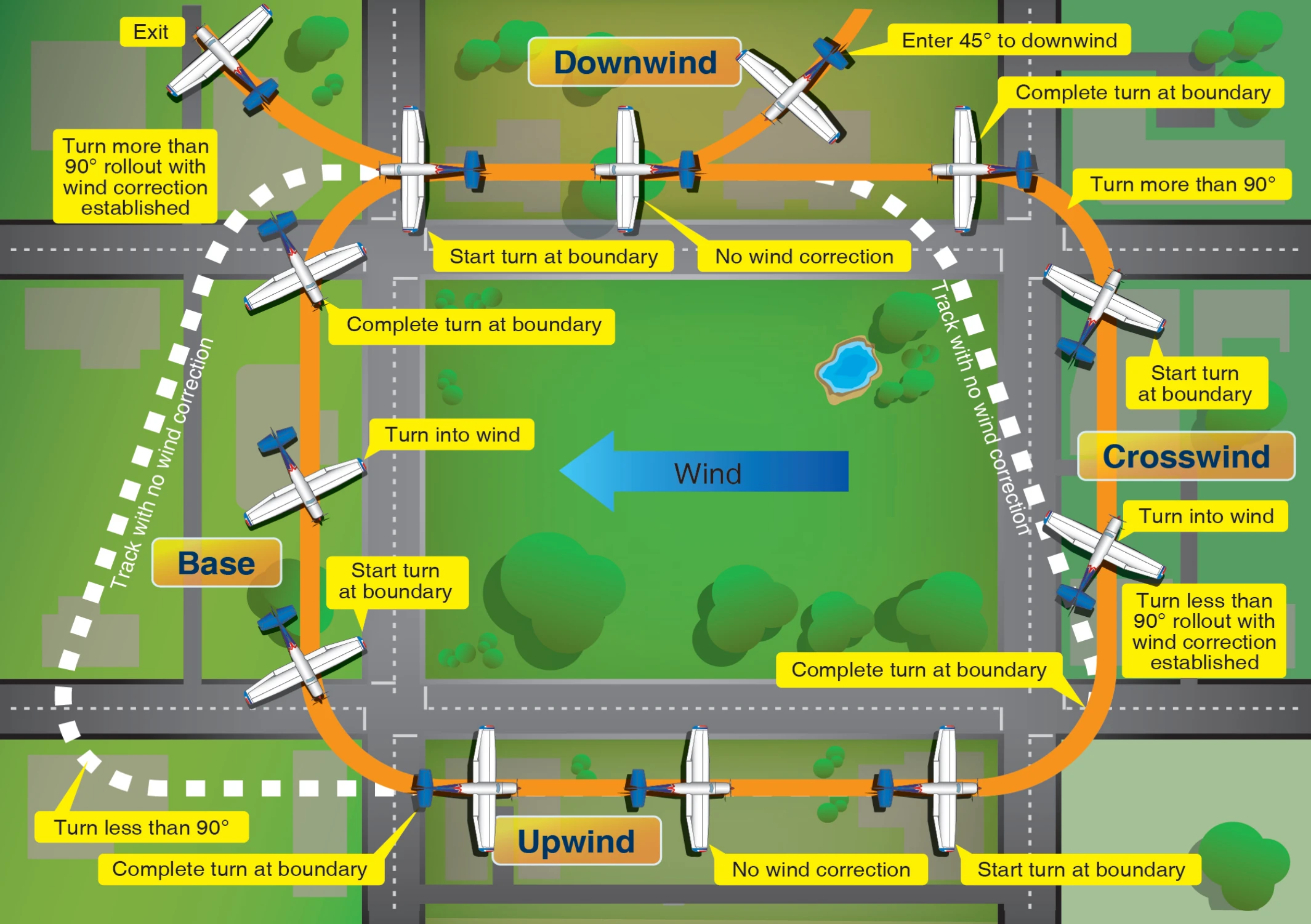
The entry into the maneuver should be accomplished downwind. This places the wind on the tail of the airplane and results in an increased groundspeed. There should be no wind correction angle if the wind is directly on the tail of the airplane; however, a real-world situation often results in some drift correction. The turn from the downwind leg onto the base leg is entered with a relatively steep bank angle. The pilot should roll the airplane into a steep bank with rapid, but not excessive, coordinated aileron and rudder pressures. As the airplane turns onto the following base leg, the tailwind lessens and becomes a crosswind; the bank angle is reduced gradually with coordinated aileron and rudder pressures. The pilot should be prepared for the lateral drift and compensate by turning more than 90° angling toward the inside of the rectangular course.
The next leg is where the airplane turns from a base leg position to the upwind leg. Ideally, on the upwind, the wind is directly on the nose of the airplane resulting in a direct headwind and decreased groundspeed; however, some drift correction may be necessary. The pilot should roll the airplane into a medium-banked turn with coordinated aileron and rudder pressures. As the airplane turns onto the upwind leg, the crosswind lessens and becomes a headwind, and the bank angle is gradually reduced with coordinated aileron and rudder pressures. Because the pilot was angled into the wind on the base leg, the turn to the upwind leg is less than 90°.