
Chapter 7
Ground Reference Maneuvers
In the same manner as the rectangular course, it is standard practice to enter ground-based maneuvers downwind where groundspeed is greatest. As such, the roll into the turn should be rapid, but not aggressive, and the angle of bank should be steepest when initiating the turn. As the turn progresses, the bank angle and the rate of rollout should be decreased as the groundspeed decreases to ensure that the turn’s radius is constant. During the first turn, when the airplane is at the 90° point, it will be directly crosswind. In addition to the rate of rollout and bank angle, the pilot should control the wind correction angle throughout the turn.
Controlling the wind correction angle during a turn can be complex to understand. The concept may be understood by comprehending the difference between the number of degrees that the airplane has turned over the ground versus the number of degrees that the airplane has turned in the air. As an example, assume the airplane is exactly crosswind, meaning directly at a point that is 90° to the straight-lined ground reference. In this example, if the wind requires a 10° wind correction angle (for this example, this is a left turn with the crosswind from the left), the airplane would be at a heading that is 10° ahead when directly over the 90° ground reference point. In other words, the first 90° track over the ground would result in a heading change of 100° and the last 90° track over the ground would result in 80° of heading change.
As the turn progresses from a downwind position to an upwind position, the pilot should gradually decrease the bank angle with coordinated aileron and rudder pressure. The pilot should reference the airplane’s nose, wingtips, and the ground references and adjust the rollout timing so that the wings become level just as the airplane crosses the straight-line ground reference at the proper heading, altitude, and airspeed. As the airplane re-crosses the straight-lined ground reference, the opposite turn begins—there should be no delay in rolling out from one turn and rolling into the next turn. Because the airplane is now upwind, the roll in should be smooth and gentle and the initial bank angle should be shallow. As the turn progresses, the wind changes from upwind, to crosswind, to downwind. In a similar manner described above, the pilot should adjust the bank angle to correct for changes in groundspeed. As the groundspeed increases, the pilot should increase the bank angle to maintain a constant-radius turn over the ground. At the 90° crosswind position, the airplane should also have the correct wind correction angle. As the airplane turns downwind and the groundspeed increases, the bank angle should be increased so that the rate of turn maintains a constant-radius turn.
The following are the most common errors made while performing S-turns across a road:
- Failure to adequately clear surrounding area for safety hazards, initially and throughout the maneuver.
- Failure to establish a constant, level altitude prior to entering the maneuver.
- Failure to maintain altitude during the maneuver.
- Failure to properly assess wind direction.
- Failure to properly execute constant-radius turns.
- Failure to manipulate the flight controls in a smooth and continuous manner when transitioning into turns.
- Failure to establish the appropriate wind correction angle.
- Failure to apply coordinated aileron and rudder pressure, resulting in slips or skids.
Elementary Eights
Elementary eights are a family of maneuvers in which each individual maneuver is one that the airplane tracks a path over the ground similar to the shape of a figure eight. There are various types of eights, progressing from the elementary to advanced types. Each eight is intended to develop a pilot’s flight control coordination skills, strengthen their awareness relative to the selected ground references, and enhance division of attention so that flying becomes more instinctive than mechanical. Eights require a greater degree of focused attention to the selected ground references; however, the real significance of eights is that the pilot develops the ability to fly with precision.
Elementary eights include eights along a road, eights across a road, and eights around pylons. Each of these maneuvers is a variation of a turn around a point. Each eight uses two ground reference points about which the airplane turns first in one direction and then the opposite direction—like a figure eight.
Eights maneuvers are designed for the following purposes:
- Further development of the pilot’s skill in maintaining a specific relationship between the airplane and the ground references.
- Improving the pilot’s ability to divide attention between the flightpath and ground-based references, manipulation of the flight controls, and scanning for outside hazards and instrument indications during both turning and straight-line flight.
- Developing the pilot’s skills to visualize each specific segment of the maneuver and the maneuver as a whole, prior to execution.
- Developing a pilot’s ability to intuitively manipulate flight controls to adjust the bank angle during turns to correct for groundspeed changes in order to maintain constant-radius turns and proper ground track between ground references.
Eights Along a Road
An eight along a road is a ground reference maneuver in which the ground track consists of two opposite 360° adjacent turns. An imaginary line drawn through the center of each 360° turn is perpendicular to the straight-line ground reference (road, railroad tracks, fence line, pipeline right-of-way, etc.) as illustrated in Figure 7-7. Like the other ground reference maneuvers, the objective is to further develop division of attention while compensating for drift, maintaining orientation with ground references, and maintaining a constant altitude.
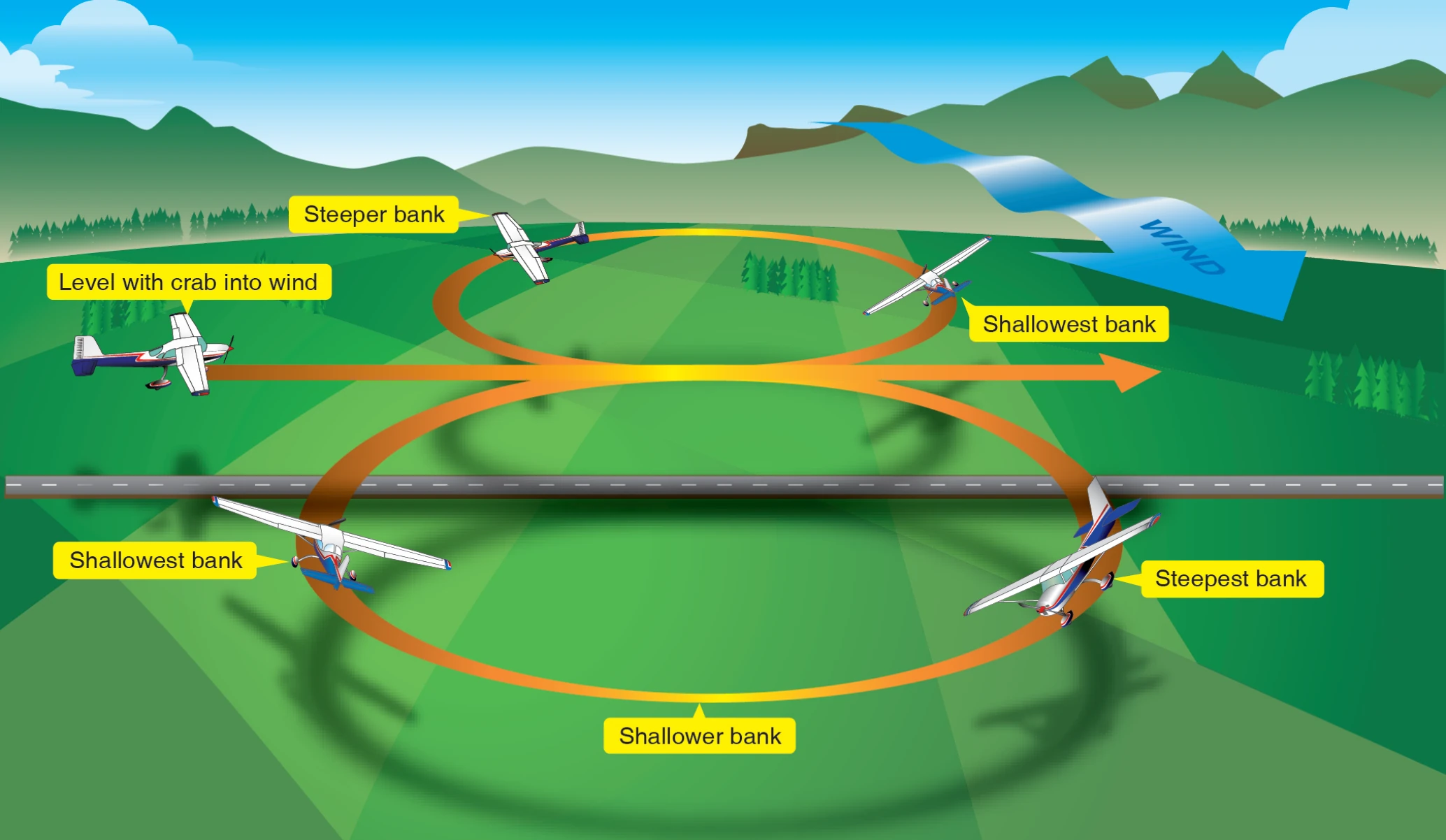
Although eights along a road may be performed with the wind blowing parallel or perpendicular to the straight-line ground reference, only the perpendicular wind situation is explained since the principles involved are common to each. The pilot should select a straight-line ground reference that is perpendicular to the wind and position the airplane parallel to and directly above the straight-line ground reference. Since this places the airplane in a crosswind position, the pilot should compensate for the wind drift with an appropriate wind correction angle.
The following description is illustrated in Figure 7-7. The airplane is initially in a crosswind position, perpendicular to the wind, and over the ground-based reference. The first turn should be to the right toward a downwind position starting with a steepening bank. When the entry is made into the turn, it requires that the turn begin with a medium bank and gradually steepen to its maximum bank angle when the airplane is directly downwind. As the airplane turns from downwind to crosswind, the bank angle needs to be gradually reduced since groundspeed is decreasing; however, 1/2 of the reduction in groundspeed occurs during the first 2/3 of the turn from downwind to crosswind.
The pilot needs to control the bank angle as well as the rate at which the bank angle is reduced so that the wind correction angle is correct. Assuming that the wind is coming from the right side of the airplane, the airplane heading should be slightly ahead of its position over the ground. When the airplane completes the first 180° of ground track, it is directly crosswind, and the airplane should be at the maximum wind correction angle.
As the turn is continued toward the upwind, the airplane’s groundspeed is decreasing, which requires the pilot to reduce the bank angle to slow the rate of turn. If the pilot does not reduce the bank angle, the continued high rate of turn would cause the turn to be completed prematurely. Another way to explain this effect is—the wind is drifting the airplane downwind at the same time its groundspeed is slowing. If the airplane has a steeper-than-required bank angle, its rate of turn will be too fast and the airplane will complete the turn before it has had time to return to the ground reference.
When the airplane is directly upwind, which is at 270° into the first turn, the bank angle should be shallow with no wind correction. As the airplane turns crosswind again, the airplane’s groundspeed begins increasing; therefore, the pilot should adjust the bank angle and corresponding rate of turn proportionately in order to reach the ground reference at the completion of the 360° ground track. The pilot may vary the bank angle to correct for any previous errors made in judging the returning rate and closure rate. The pilot should time the rollout so that the airplane is straight-and-level over the starting point with enough drift correction to hold it over the straight-line ground reference. Assuming that the wind is now from the left, the airplane should be banked at a left wind correction angle.
After momentarily flying straight-and-level with the established wind correction, along the ground reference, the pilot should roll the airplane into a medium bank-turn in the opposite direction to begin the 360° turn on the upwind side of the ground reference. The wind will decrease the airplane’s groundspeed and drift the airplane back toward the ground reference; therefore, the pilot should decrease the bank slowly during the first 90° of the upwind turn in order to establish a constant radius. During the next 90° of turn, the pilot should increase the bank angle, since the groundspeed is increasing, to maintain a constant radius and establish the proper wind correction angle before reaching the 180° upwind position.
As the remaining 180° of turn continues, the wind becomes a tailwind and then a crosswind. Consistent with previous downwind and crosswind descriptions, the pilot should increase the bank angle as the airplane reaches the downwind position and decrease the bank angle as the airplane reaches the crosswind position. Further, the rate of roll-in and roll-out should be consistent with how fast the groundspeed changes during the turn. Remember, when turning from an upwind or downwind position to a crosswind position, 1/2 of the groundspeed change occurs during the first 2/3 of the 90° turn. The final 1/2 of the change in groundspeed occurs during the last 1/3 of the turn. In contrast, when turning from a crosswind position to an upwind or downwind position, the first 1/2 of the groundspeed change occurs during the first 1/3 of the 90° turn. The final 1/2 of the change in groundspeed occurs during the last 2/3 of the turn.