
Chapter 7
Ground Reference Maneuvers
To successfully perform eights along a ground reference, the pilot should be able to smoothly and accurately coordinate changes in bank angle to maintain a constant-radius turn and counteract drift. The speed in which the pilot can anticipate these corrections directly affects the accuracy of the overall maneuver and the amount of attention that can be directed toward scanning for outside hazards and instrument indications.
Eights Across a Road
This maneuver is a variation of eights along a road and involves the same principles and techniques. The primary difference is that at the completion of each loop of the figure eight, the airplane should cross an intersection or a specific ground reference point. [Figure 7-8]
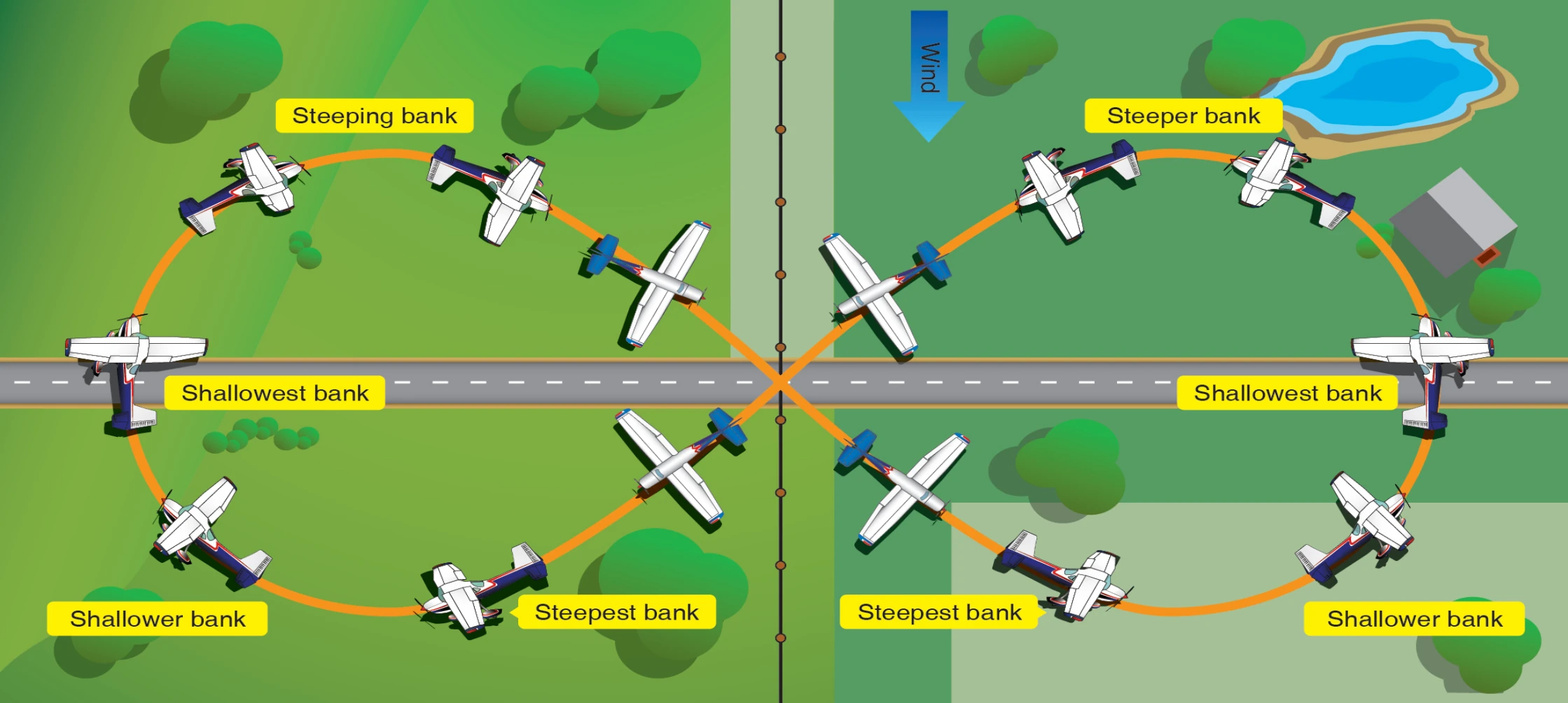
The loops should be across the road and the wind should be perpendicular to the loops. Each time the reference is crossed, the crossing angle should be the same, and the wings of the airplane should be level. The eights may also be performed by rolling from one bank immediately to the other, directly over the reference.
Eights Around Pylons
Eights around pylons is a ground reference maneuver with the same principles and techniques of correcting for wind drift as used in turns around a point and the same objectives as other ground track maneuvers. Eights around pylons utilizes two ground reference points called “pylons.” Turns around each pylon are made in opposite directions to follow a ground track in the form of a figure 8. [Figure 7-9]
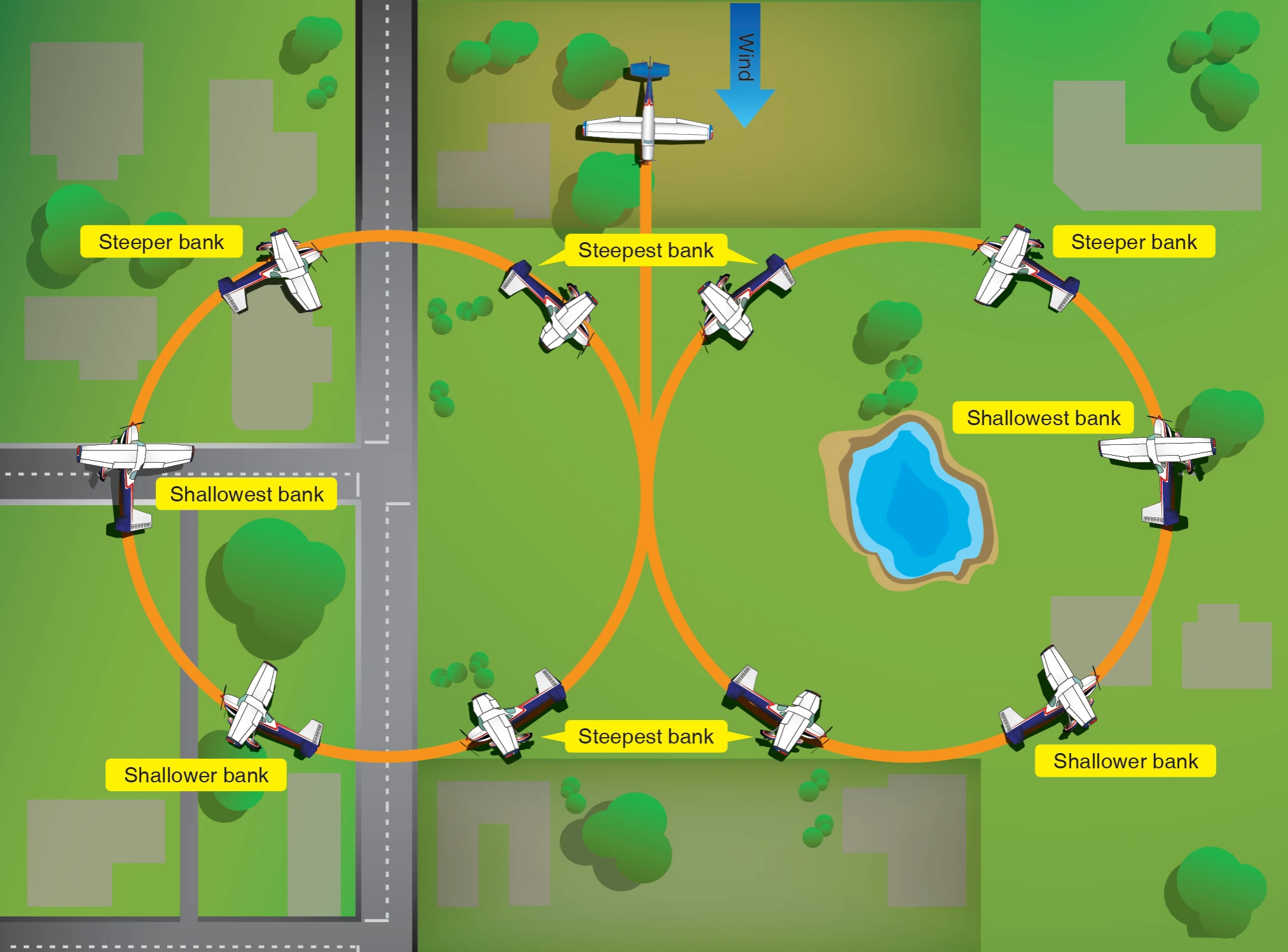
The pattern involves flying downwind between the pylons and upwind outside of the pylons. It may include a short period of straight-and-level flight while proceeding diagonally from one pylon to the other. The pylons should be on a line perpendicular to the wind. The maneuver should be started with the airplane on a downwind heading while passing mid-way between the pylons. The distance between the pylons and the wind velocity determines the initial angle of bank required to maintain a constant turn radius from the pylons during each turn. The steepest banks are necessary just after each turn entry and just before the rollout from each turn where the airplane is headed downwind and the groundspeed is highest. The shallowest banks are when the airplane is headed directly upwind and the groundspeed is lowest.
As in other ground reference maneuvers, the rate at which the bank angle changes depends on the wind velocity. If the airplane proceeds diagonally from one turn to the other, the rollout from each turn needs to be completed on the proper heading with sufficient wind correction angle to ensure that after brief straight-and-level flight, the airplane arrives at the point where a turn of the same radius can be made around the other pylon. The straight-and-level flight segments should be tangent to both circular patterns.
Common Errors
Common errors in the performance of elementary eights are:
- Failure to adequately clear the surrounding area for safety hazards, initially and throughout the maneuver.
- Poor selection of ground references.
- Failure to establish a constant, level altitude prior to entering the maneuver.
- Failure to maintain adequate altitude control during the maneuver.
- Failure to properly assess wind direction.
- Failure to properly execute constant-radius turns.
- Failure to manipulate the flight controls in a smooth and continuous manner.
- Failure to establish the appropriate wind correction angles.
- Failure to apply coordinated aileron and rudder pressure, resulting in slips or skids.
- Failure to maintain orientation as the maneuver progresses.
Eights on Pylons
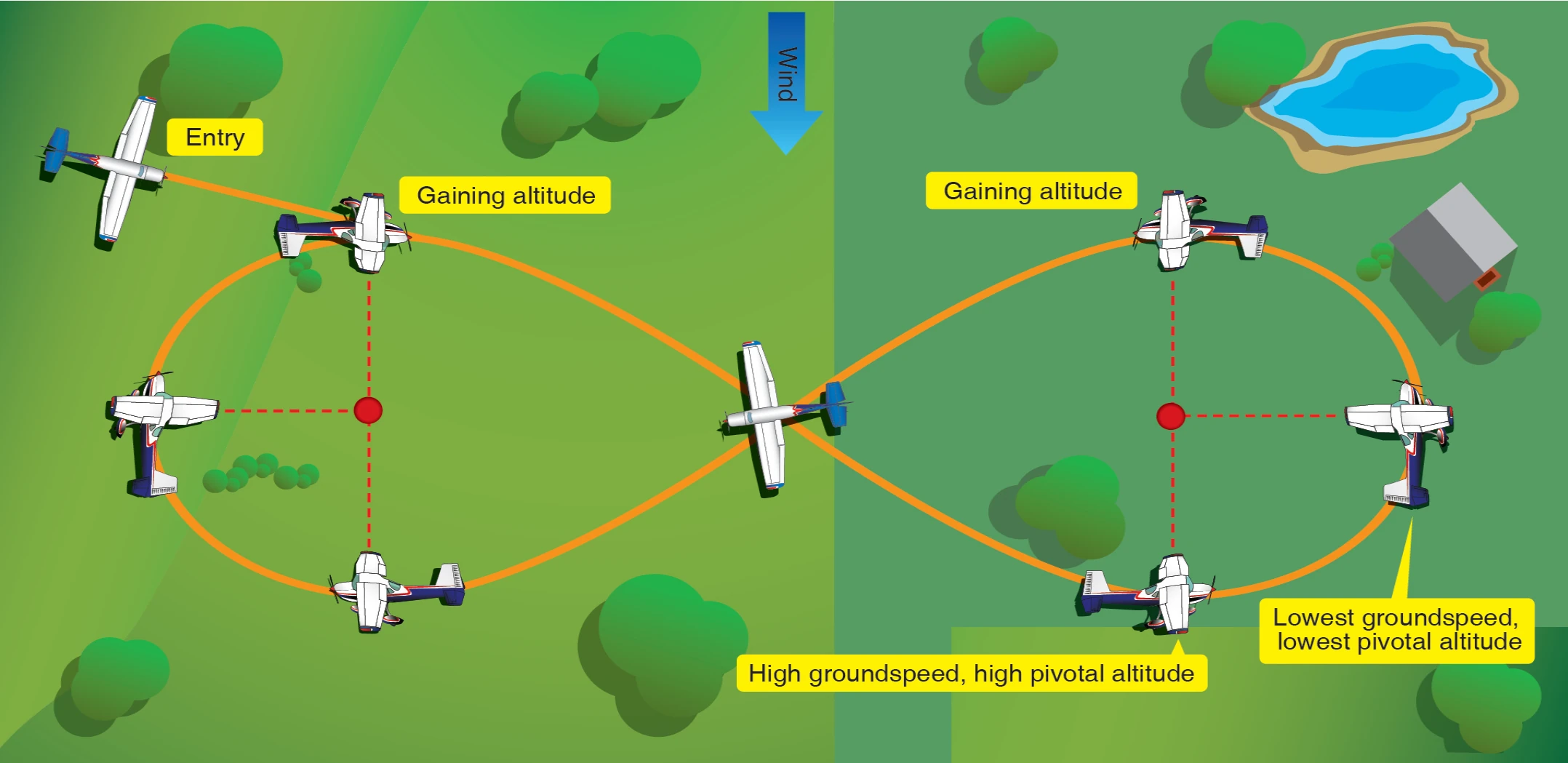
The eights on pylons is the most advanced and difficult of the ground-reference maneuvers. Because of the techniques involved, the eights on pylons are unmatched for developing intuitive control of the airplane. Similar to eights around pylons except altitude is varied to maintain a specific visual reference to the pivot points.
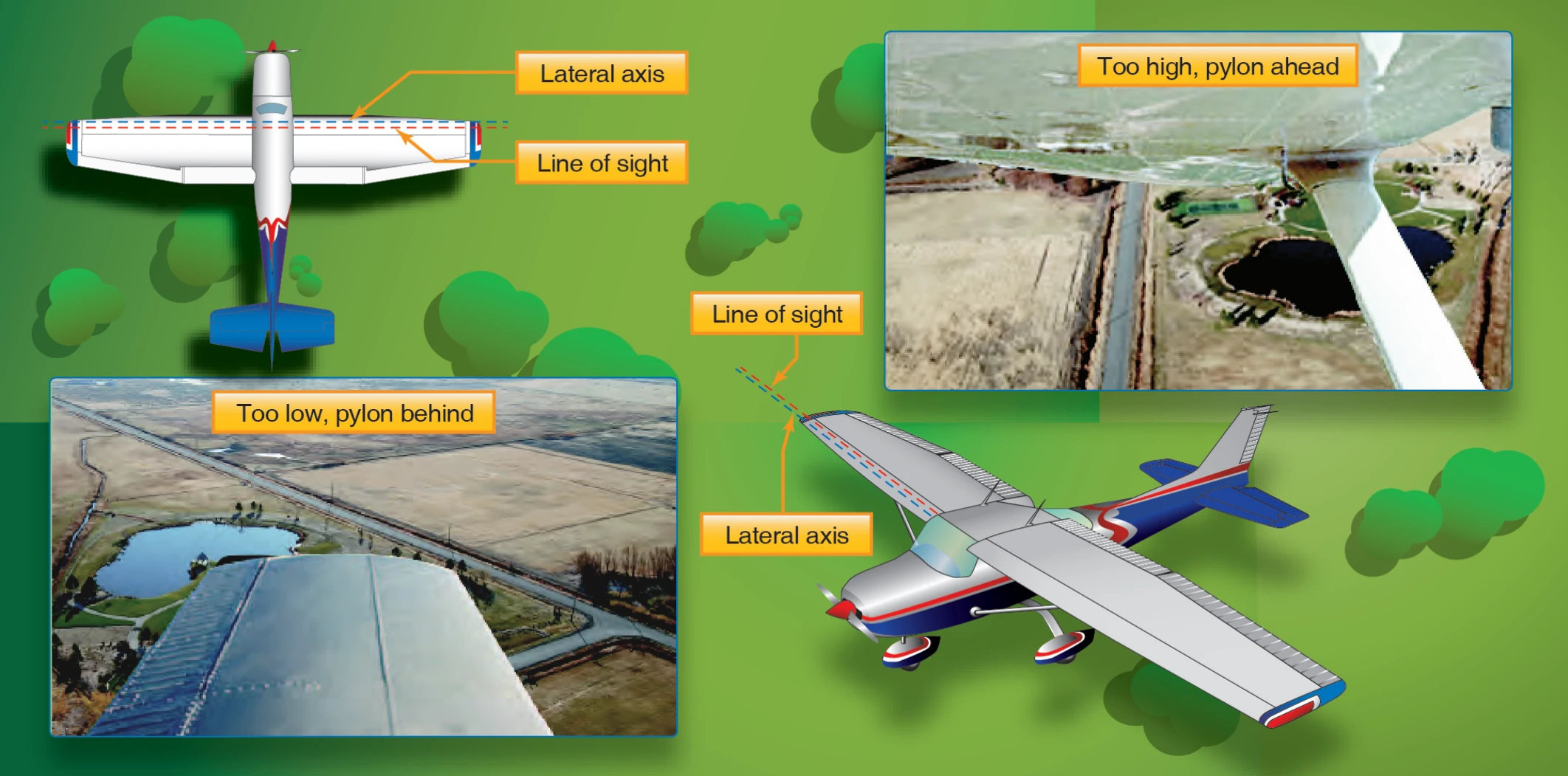
When performing eights on pylons, the pilot imagines there is a line parallel to the airplane's lateral axis that extends from the pilot’s eyes to the pylon. Along this line, the airplane appears to pivot as it turns around the pylon. In other words, if a taut string extended from the pilot's eyes to the pylon, the string would remain parallel to lateral axis as the airplane makes a turn around the pylon. The goal of eights on pylons is to keep the line from the pilot's eyes to the pylon parallel to the lateral axis. The string should not be at an angle to the lateral axis while the airplane flies around the pylon. [Figure 7-10] When explaining eights on pylons, instructors sometimes use the term “wingtip” to represent the proper visual reference line to the pylon. This interpretation is not correct. High-wing, low-wing, swept-wing, and tapered-wing airplanes, as well as those with tandem or side-by-side seating, all present different angles from the pilot’s eye to the wingtip. [Figure 7-11]
The visual reference line, while not necessarily on the wingtip itself, may be positioned in relation to the wingtip (ahead, behind, above, or below), and differs for each pilot and from each seat in the airplane. This is especially true in tandem (fore and aft) seat airplanes. In side-by-side type airplanes, there is very little variation in the visual reference lines for different people, if those people are seated with their eyes at approximately the same level. Therefore, in the correct performance of eights on pylons, as in other maneuvers requiring a lateral reference, the pilot should use a visual reference line that, from eye level, parallels the lateral axis of the airplane.
The altitude that is appropriate for eights on pylons is called the “pivotal altitude” and is determined by the airplane's groundspeed. In previous ground-track maneuvers, the airplane flies a prescribed path over the ground and the pilot attempts to maintain the track by correcting for the wind. With eights on pylons, the pilot maintains lateral orientation to a specific spot on the ground. This develops the pilot’s ability to maneuver the airplane accurately while dividing attention between the flightpath and the selected pylons on the ground.