Chapter 9
Approaches and Landings
Introduction
There is an old saying that while takeoff is optional, landing is mandatory. In consideration of that adage, this chapter focuses on the approach to landing, factors that affect landings, types of landings, and aspects of faulty landings. A careful pilot knows that the safe outcome of a landing should never be in doubt. Pilots who respect their own limitations are able to approach each landing with confidence and achieve the satisfaction that comes from successful aircraft control. After any landing, a pilot performs a self-evaluation. If there is a question, a read of the relevant section in this chapter may help. When needed, additional flight instruction enhances safety.
The manufacturer’s recommended procedures, including airplane configuration and airspeeds, and other information relevant to approaches and landings in a specific make and model airplane are contained in the Federal Aviation Administration (FAA)-approved Airplane Flight Manual and/or Pilot’s Operating Handbook (AFM/POH) for that airplane. If any of the information in this chapter differs from the airplane manufacturer’s recommendations as contained in the AFM/POH, the airplane manufacturer’s recommendations take precedence.
Use of Flaps
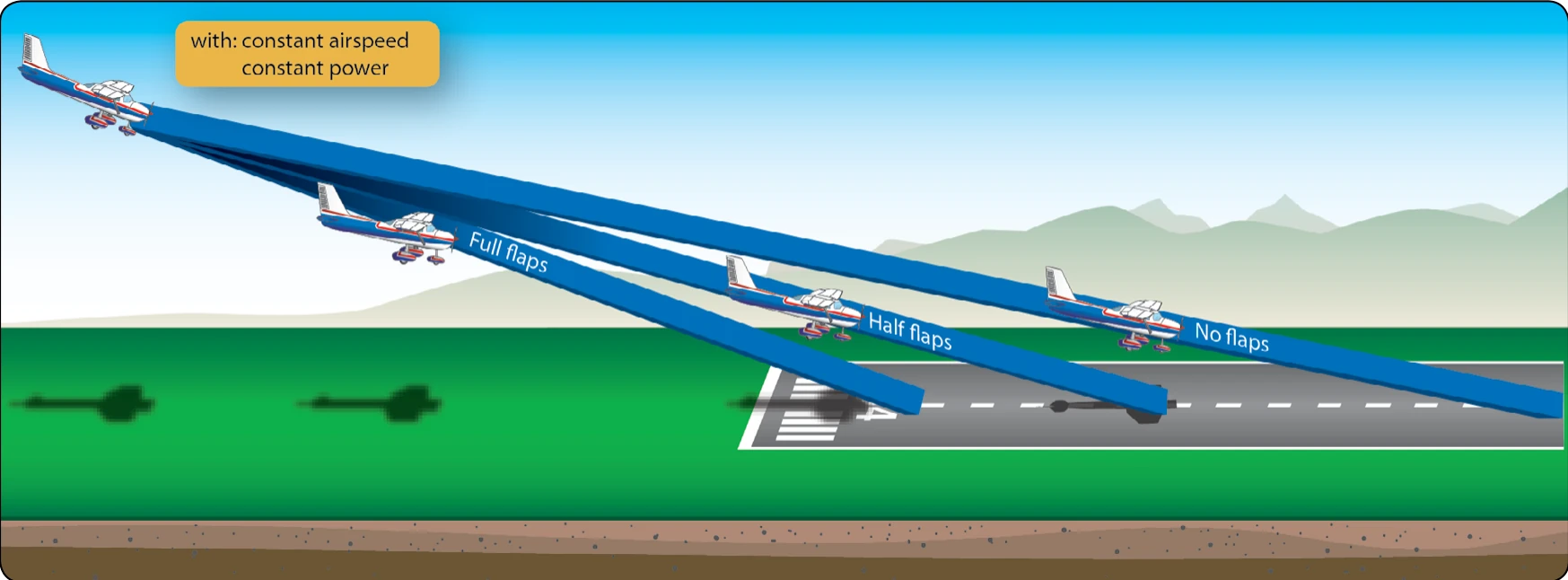
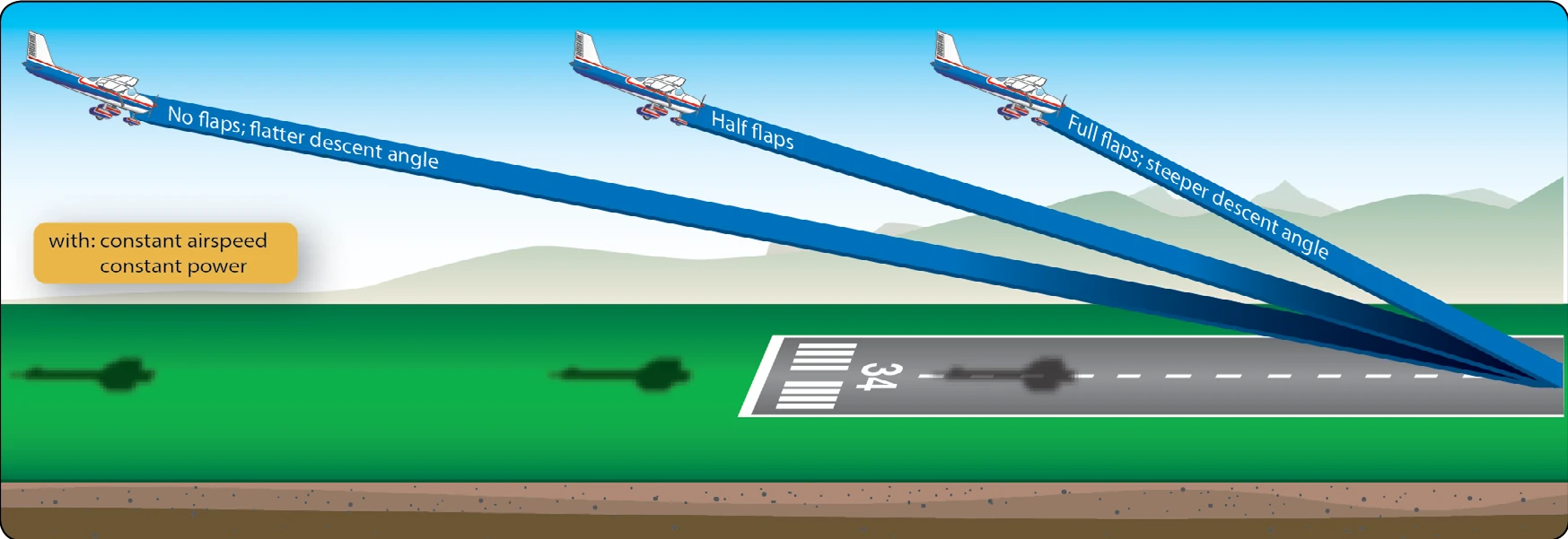
The following general discussion applies to airplanes equipped with flaps. The pilot may use landing flaps during the descent to adjust lift and drag. Flap settings help determine the landing spot and the descent angle to that spot. [Figure 9-1 and Figure 9-2] Flap extension during approaches and landings provides several advantages by:
- Producing greater lift and permitting lower approach and landing speeds,
- Producing greater drag and permitting a steeper descent angle,
- Increasing forward visibility by allowing a lower pitch, and
- Reducing the length of the landing roll.
The increased camber from flap deflection increases lift, primarily on the rear portion of the wing. This produces a nose-down pitching moment which may cause the airplane to pitch down. Flap deployment may also affect wing downwash on the horizontal tail and alter the tail-down force. Consequently, pitch behavior from flap extension depends on the design of the particular airplane.
Flap deflection of up to 15° primarily produces lift with minimal drag. The airplane has a tendency to balloon up with initial flap deflection because of the lift increase. The nose-down pitching moment, however, tends to offset the balloon. Flap deflection beyond 15° produces a large increase in drag. Deflection beyond 15° also produces a significant nose-up pitching moment in certain high-wing airplanes because the resulting downwash changes the airflow over the horizontal tail.
The time of flap extension and the degree of deflection are related. Large changes in flap deflection at one single point in the landing pattern can produce large lift changes that require significant pitch and power changes in order to maintain airspeed and descent angle. Consequently, there is an advantage to extending flaps in increments while in the landing pattern. Incremental deflection of flaps on downwind, base leg, and final approach allow smaller adjustments of pitch and power and support a stabilized approach.
Whenever the flap setting is changed, the pilot should be prepared to re-trim the airplane as needed to compensate for the change in aerodynamic forces. Throughout this chapter, more detail is provided on the use of flaps during specific approach and landing situations, as appropriate.
Normal Approach and Landing
Normal approach and landing procedures are used when the engine power is available, the wind is light or the final approach is made directly into the wind, the final approach path has no obstacles, and the landing surface is firm and of ample length to gradually bring the airplane to a stop. The selected landing point is normally beyond the runway approach threshold but within the first 1⁄3 of the runway.
The factors involved and the procedures described for the normal approach and landing also have applications to the other-than-normal approaches and landings discussed later in this chapter. The principles of normal operations are explained first and need to be understood before proceeding to the more complex operations. To better understand the factors that influence judgment and procedures, the last part of the approach pattern and the actual landing are divided into five phases:
- the base leg
- the final approach
- the round out (flare)
- the touchdown
- the after-landing roll
Base Leg
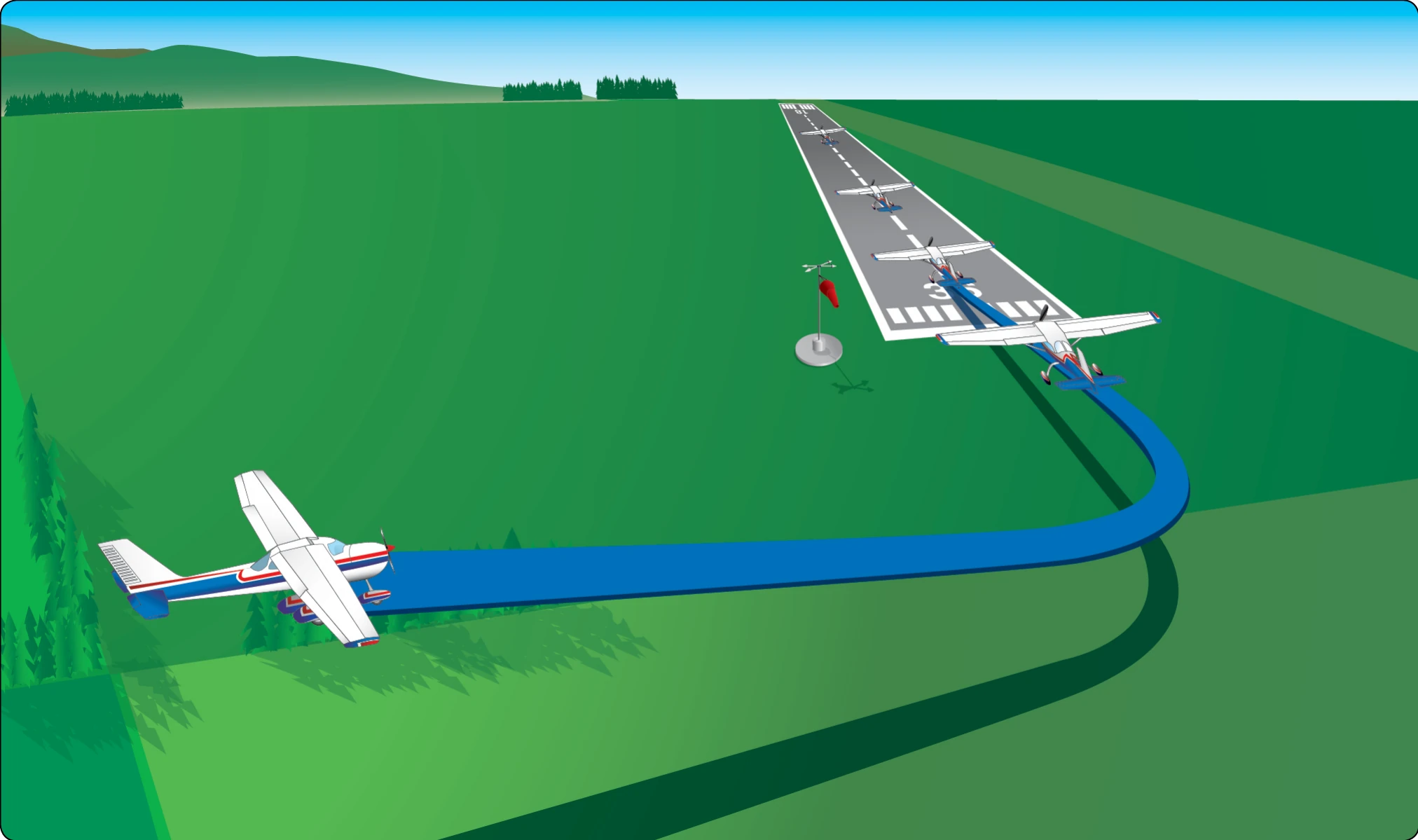
The placement of the base leg is one of the important judgments made by the pilot to set up for a good landing. [Figure 9-3] The pilot accurately judges the height, distance from the approach end of the runway, and rate of descent to allow a stabilized approach, round out, and touchdown at the desired spot. The distance depends on the altitude of the base leg, the current winds, and the amount of wing flaps used. When there is a strong wind on final approach or the flaps are used to produce a steep angle of descent, the base leg should be positioned closer to the approach end of the runway than would be required with normal winds or flap settings. Normally, the landing gear is extended and the before-landing check completed prior to reaching the base leg.
After turning onto the base leg, the pilot starts or continues the descent with reduced power and a target airspeed of approximately 1.4 VSO —the stalling speed in the landing configuration. For example, if VSO is 60 knots, 1.4 VSO is 84 knots (84 = 1.4 x 60). Landing flaps should be deployed as recommended. Full flaps are not recommended until the final approach is established. Since the final approach and landing are normally made into the wind, there is usually a crosswind during the base leg. A drift correction is established and maintained to follow a ground track perpendicular to the extension of the landing runway centerline. This requires that the airplane be angled sufficiently into the wind to prevent drifting farther away from the intended landing spot.