
Chapter 9
Approaches and Landings
If the approach becomes shallow, the runway appears to shorten and become wider. Conversely, if the approach is steepened, the runway appears to become longer and narrower. [Figure 9-7]
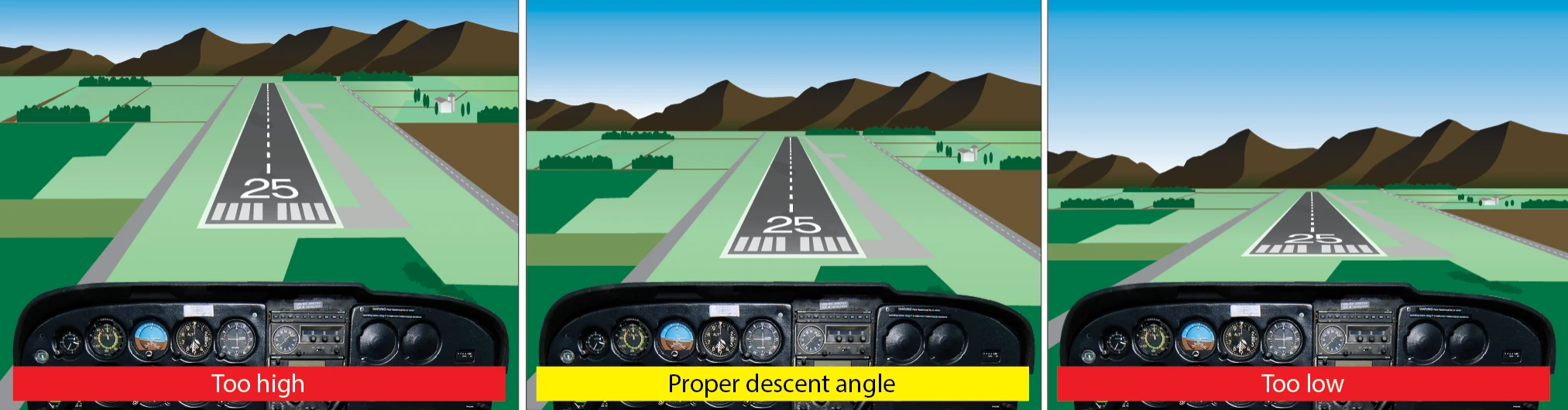
Immediately after rolling out on final approach, the pilot adjusts the pitch attitude, power, and trim so that the airplane is descending directly toward the aiming point at the appropriate airspeed in the landing configuration. If it appears that the airplane is going to overshoot the desired landing spot, a steeper approach results by reducing power and lowering the pitch attitude to maintain airspeed. If available and not fully extended, the pilot may further extend the flaps. If the desired landing spot is being undershot and a shallower approach is needed, the pilot increases both power and pitch attitude to reduce the descent angle. Once the approach is set up and control pressures removed with trim, the pilot is free to devote significant attention toward outside references and use the available visual cues to fine tune the approach. The pilot should not stare at any one place, but rather scan from one point to another, such as from the aiming point to the horizon, to any objects along the runway, to an area well short of the runway, and back to the aiming point. This makes it easier to perceive any deviation from the desired glide path and determine if the airplane is proceeding directly toward the aiming point. The pilot should also glance at the airspeed indicator periodically and correct for any airspeed deviation.
Pilots normally establish a stabilized approach before short final. The round out, touchdown, and landing roll are much easier to accomplish when preceded by a stabilized final approach, which reduces the chance of a landing mishap. Therefore, deviations from the desired glide path should be detected and corrected early so that the magnitude of corrections during the later portion of the approach is small. If the approach is very high or very low, it may not be possible to establish a stabilized approach, and the pilot normally executes a go-around. If the airplane is initially low and undershooting the aiming point, the pilot may intercept the desired glide path by increasing pitch attitude and adding power to level off while maintaining the correct airspeed. This may necessitate a substantial increase in power if the aircraft is operating on the backside of the power curve. As the airplane intercepts the desired glide path, the pilot reduces power and pitches down to remain on the glide path. Retracting the flaps to correct for an undershoot creates an unnecessary risk. It may cause a sudden decrease in lift, an excessive sink rate, and an aggravated unstable condition.
If the approach is too high or too low, it may not be possible to establish a stabilized approach, and the pilot should execute a go-around. Typically, pilots go-around if unable to establish a stabilized approach by 500 ft above airport elevation in visual meteorological conditions (VMC) or 1,000 ft above airport elevation in instrument conditions (IMC). For a typical GA piston aircraft in a traffic pattern, an immediate go-around should be initiated if the approach becomes unstabilized below 300 ft AGL.
Pilots may consider the following elements when attempting to set up and fly a stabilized approach to landing. The pilot should focus on the elements that lead to a stabilized approach rather than the order of the elements or the insistence on meeting all of the approach criteria. For a typical piston aircraft, an approach is stabilized when the following criteria are met:
- Glide path. Typically a constant 3 degrees to the touchdown zone on the runway (obstructions permitting).
- Heading. The aircraft tracks the centerline to the runway with only minor heading/pitch changes necessary to correct for wind or turbulence to maintain alignment. Bank angle normally limited to 15 degrees once established on final.
- Airspeed. The aircraft speed is within +10 /-5 KIAS of the recommended landing speed specified in the AFM, 1.3VSO, or on approved placards/markings. If the pilot applies a gust factor, indicated airspeed should not decay below the recommended landing speed.
- Configuration. The aircraft is in the correct landing configuration with flaps as required; landing gear extended, and is in trim.
- Descent rate. A descent rate (generally 500-1000 fpm for light general aviation aircraft) makes for a safe approach. Minimal adjustments to the descent rate as the airplane approaches the runway provide an additional indication of a stabilized and safe approach. If using a descent rate in excess of 500 fpm due to approach considerations, the pilot should reduce the descent rate prior to 300 ft AGL.
- Power setting. The pilot should use a power setting appropriate for the aircraft configuration and not below the minimum power for approach as defined by the AFM.
- Briefings and checklists. Completing all briefings and checklists prior to initiating the approach (except the landing checklist), ensures the pilot can focus on the elements listed above.
Estimating Airplane Movement and Height
During short final, round out, and touchdown, vision is of prime importance. To provide a wide scope of vision and to foster good judgment of height and movement, the pilot’s head should assume a natural, straight-ahead position. Visual focus is not fixed on any one side or any one spot ahead of the airplane. Instead, it is changed slowly from a point just over the airplane’s nose to the desired touchdown zone and back again. This is done while maintaining a deliberate awareness of distance from either side of the runway using peripheral vision.
Accurate estimation of distance, besides being a matter of practice, depends upon how clearly objects are seen. It requires that vision be focused properly so that the important objects stand out as clearly as possible.
Speed blurs objects at close range. For example, most everyone has noted this in an automobile moving at high speed. Nearby objects seem to merge together in a blur, while objects farther away stand out clearly. The driver subconsciously focuses the eyes sufficiently far ahead of the automobile to see objects distinctly.
The distance at which the pilot’s vision is focused should be proportional to the speed at which the airplane is traveling over the ground. Thus, as speed is reduced during the round out, the distance ahead of the airplane at which it is possible to focus is brought closer accordingly.
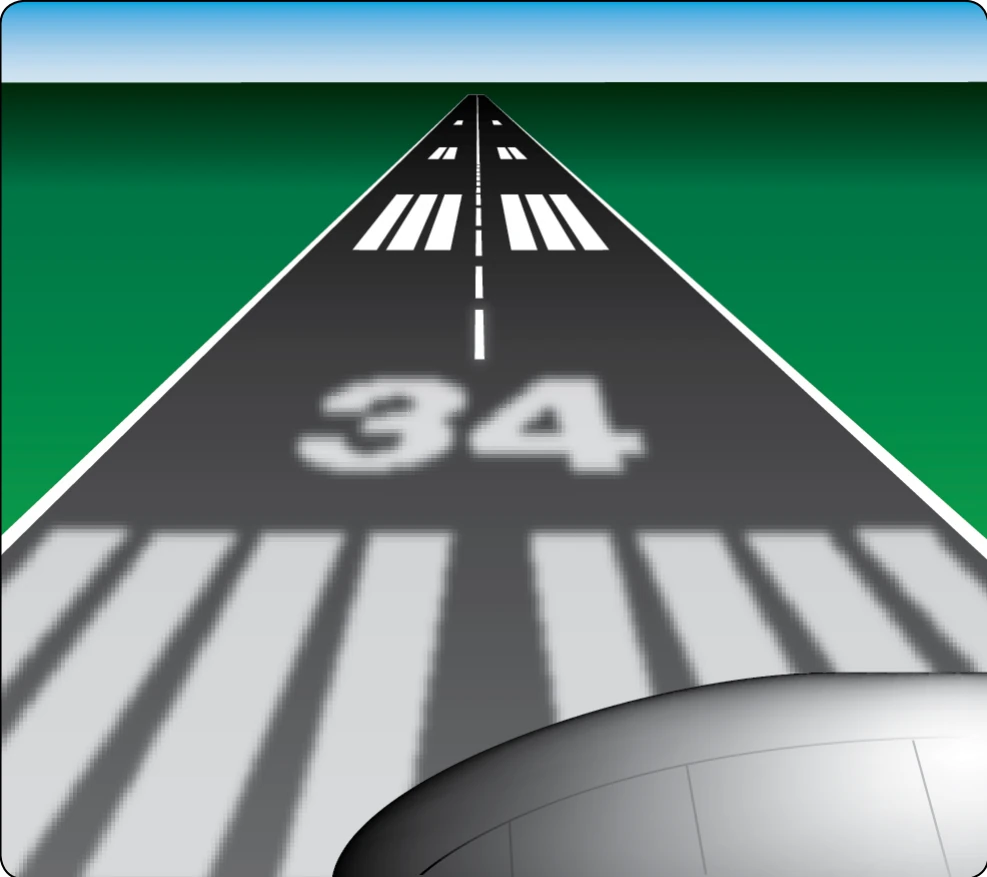
If the pilot attempts to focus on a reference that is too close or looks directly down, the reference becomes blurred, [Figure 9-8] and the reaction is either too abrupt or too late. In this case, the pilot’s tendency is to over-control, round out high, and make full-stall, drop-in landings. If the pilot focuses too far ahead, accuracy in judging the closeness of the ground is lost and the consequent reaction is too slow, since there does not appear to be a necessity for action. This sometimes results in the airplane flying into the ground nose first. The change of visual focus from a long distance to a short distance requires a definite time interval, and even though the time is brief, the airplane’s speed during this interval is such that the airplane travels an appreciable distance, both forward and downward toward the ground.
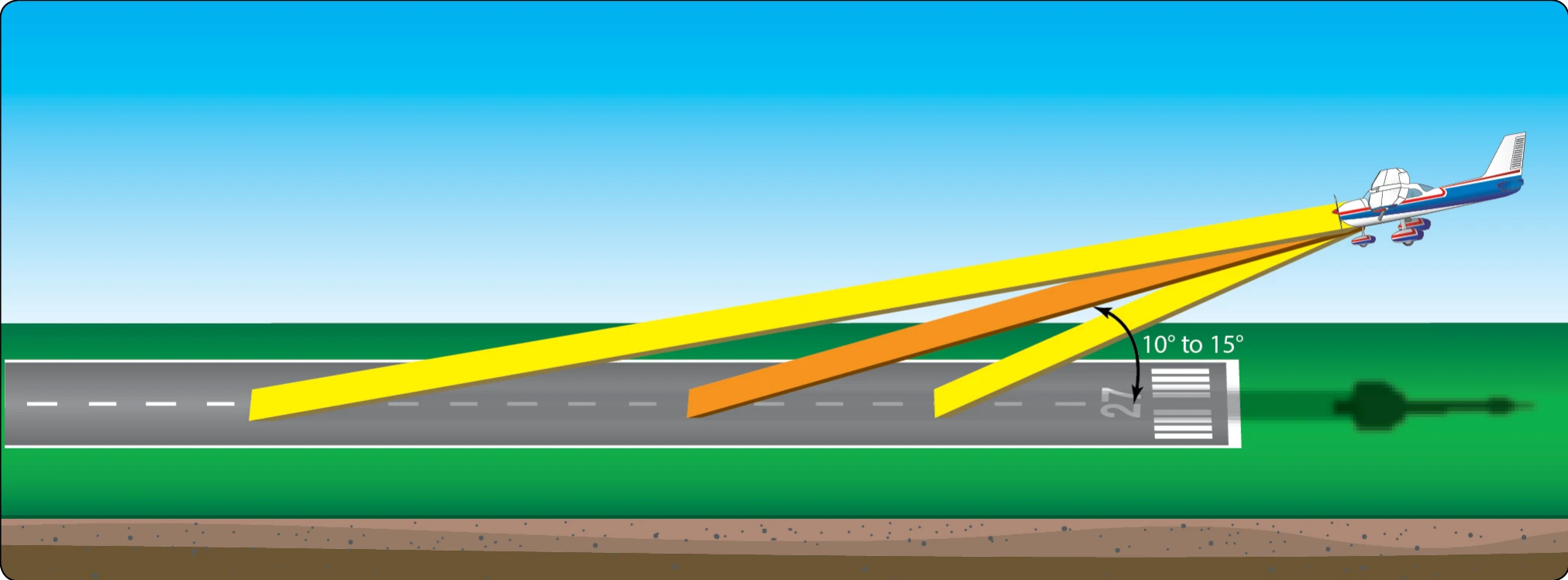
Visual cues are important in flaring at the proper height and maintaining the wheels a few inches above the runway until eventual touchdown. Flare cues are primarily dependent on the angle at which the pilot’s central vision intersects the ground (or runway) ahead and slightly to the side. Proper depth perception is a factor in a successful flare, but the visual cues used most are those related to changes in runway or terrain perspective and to changes in the size and texture of familiar objects near the landing area. The pilot should focus direct central vision at a shallow downward angle from 10° to 15° relative to the runway as the round out/flare is initiated. [Figure 9-9] When using this steady viewing angle, the point of visual interception with the runway appears progressively closer as the airplane loses altitude. This rate of closure is an important visual cue in assessing the rate of altitude loss. Conversely, movement of the visual interception point further down the runway indicates an increase in altitude and means that the pitch angle was increased too rapidly during the flare. Location of the visual interception point in conjunction with assessment of flow velocity of nearby off-runway terrain, as well as the similarity of appearance of height above the runway ahead of the airplane (in comparison to the way it looked when the airplane was taxied prior to takeoff), is also used to judge when the wheels are just a few inches above the runway.
Round Out (Flare)
The round out is a slow, smooth transition from a normal approach attitude to a landing attitude, gradually rounding out the flightpath to one that is parallel to and a few inches above the runway. When the airplane approaches 10 to 20 feet above the ground in a normal descent, the round out or flare is started. Back-elevator pressure is gradually applied to slowly increase the pitch attitude and AOA. [Figure 9-10] The AOA is increased at a rate that allows the airplane to continue settling slowly as forward speed decreases. This is a continuous process until the airplane touches down on the ground.
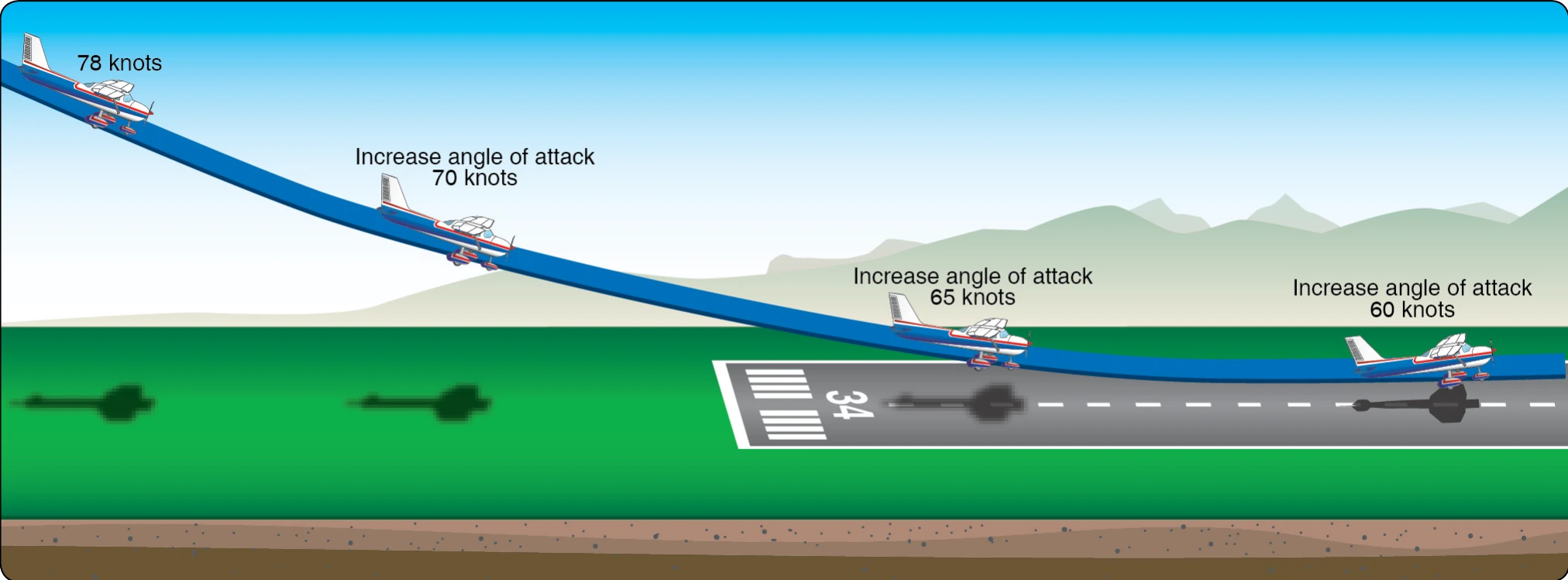
When the AOA is increased, the lift is momentarily increased and this decreases the rate of descent. Since power normally is reduced to idle during the round out, the airspeed also gradually decreases. This causes lift to decrease again and necessitates raising the nose and further increasing the AOA. During the round out, the airspeed is decreased to touchdown speed while the lift is controlled so the airplane settles gently onto the landing surface. The round out is executed at a rate such that the proper landing attitude and the proper touchdown airspeed are attained simultaneously just as the wheels contact the landing surface.