Chapter 9
Approaches and Landings
Final Approach
After the base-to-final approach turn is completed, the pilot aligns the longitudinal axis of the airplane with the centerline of the runway or landing surface. On a final approach, with no crosswind, the longitudinal axis is kept aligned with the runway centerline throughout the final approach and landing. (Methods to correct for a crosswind are explained in the “Crosswind Approach and Landing” section of this chapter. For now, only approaches and landings where the wind is straight down the runway are discussed.)
After aligning the airplane with the runway centerline, the final flap setting is completed and the pitch attitude adjusted as required. Some adjustment of pitch and power may be necessary to maintain the desired rate of descent and approach airspeed. The pilot should use the manufacturer's recommended airspeed or 1.3 VSO if there is no manufacturer's recommendation. As the pitch attitude and airspeed stabilize, the airplane is re-trimmed to relieve any control pressure.
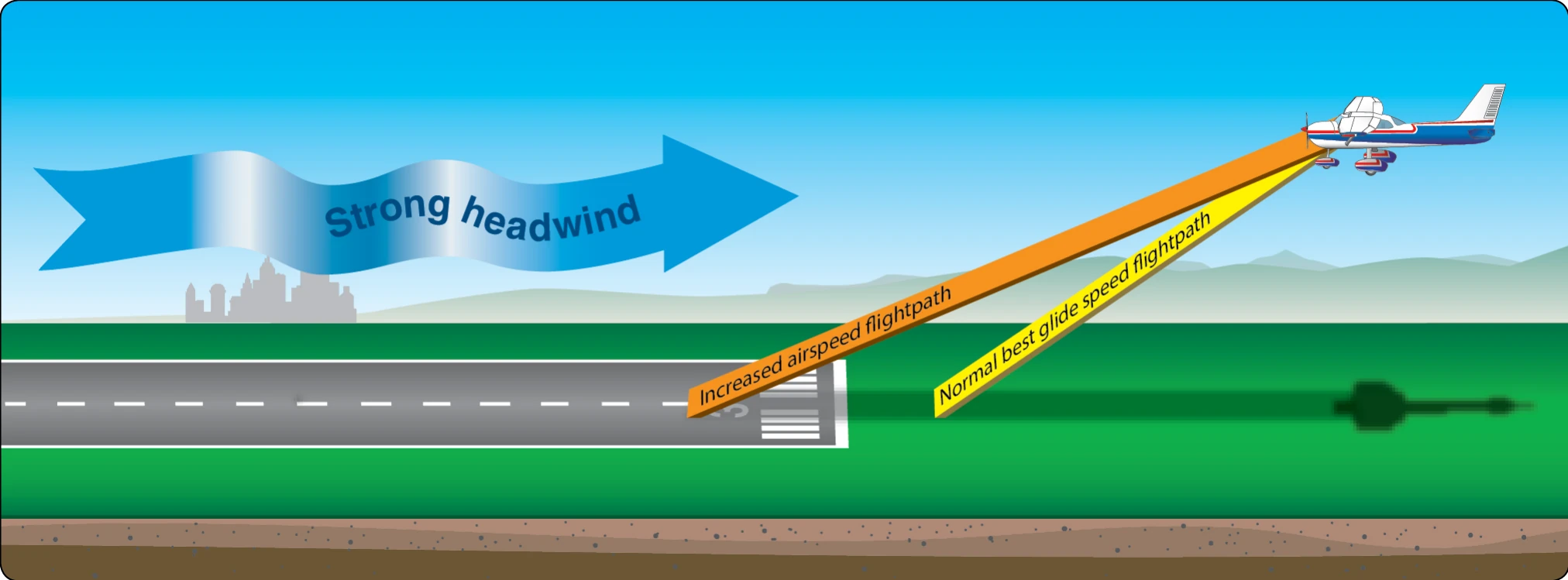
The descent angle is controlled throughout the approach so that the airplane lands in the center of the first third of the runway. The descent angle is affected by all four fundamental forces that act on an airplane (lift, drag, thrust, and weight). If all the forces are balanced out such that the net force on the airplane is zero, the descent angle remains constant in a steady state wind condition. The pilot controls these forces by adjusting the airspeed, attitude, power, and drag (flaps or forward slip). However, wind may affect the gliding distance over the ground [Figure 9-4]; the pilot does not have control over the wind, but corrects for its effect on the airplane’s descent by adjusting pitch and power appropriately.
A well-executed final approach includes reaching the desired touchdown point at an airspeed that results in minimum floating just before touchdown. To accomplish this, both the descent angle and the airspeed need to be controlled. This is one reason for performing approaches with partial power; if the approach is too high, the pilot can lower the nose and reduce the power to maintain the correct airspeed. When the approach is too low, the pilot can add power and raise the nose.
While the proper angle of descent and airspeed are maintained by integrating pitch and power changes, an untrained or inexperienced pilot may try to reach a landing spot by applying back-elevator pressure without adding power. However, attempting to stretch the final approach by raising the pitch attitude alone is almost always a bad idea. Using pitch alone causes a significant increase in AOA and decay in airspeed that leads to an excessive rate of descent or a low altitude stall. It is possible for either or both to occur.
Wrong Surface Landing Avoidance
A wrong surface landing occurs when an aircraft lands or tries to land on the wrong runway, on a taxiway in error, or at the wrong airport. The pilot should take a moment on every final approach to verify the correctness of the landing zone ahead.
Lack of familiarity with a particular airport, complacency, or fatigue may lead to pilot confusion, and occasionally a pilot will line up with the wrong surface while perceiving the situation as normal. A pilot may compensate for any lack of destination airport familiarity by studying an airport diagram and lighting ahead of time and noting key features and geometry. On final approach, the pilot should verify correct runway alignment and runway number. Pilots often refer to moving map displays driven by GPS, and these devices should increase situational awareness and safety. If there is a doubt over the landing surface, the pilot should go around and consider the situation further.
Stabilized Approach Concept
A stabilized approach is one in which the pilot establishes and maintains a constant-angle glide path towards a predetermined point on the landing runway. It is based on the pilot’s judgment of certain visual clues and depends on maintaining a constant final descent airspeed and configuration.
An airplane descending on final approach at a constant rate and airspeed travels in a straight line towards a spot on the ground ahead, commonly called the aiming point. If the airplane maintains a constant glide path without a round out for landing, it will strike the ground at the aiming point. [Figure 9-5]
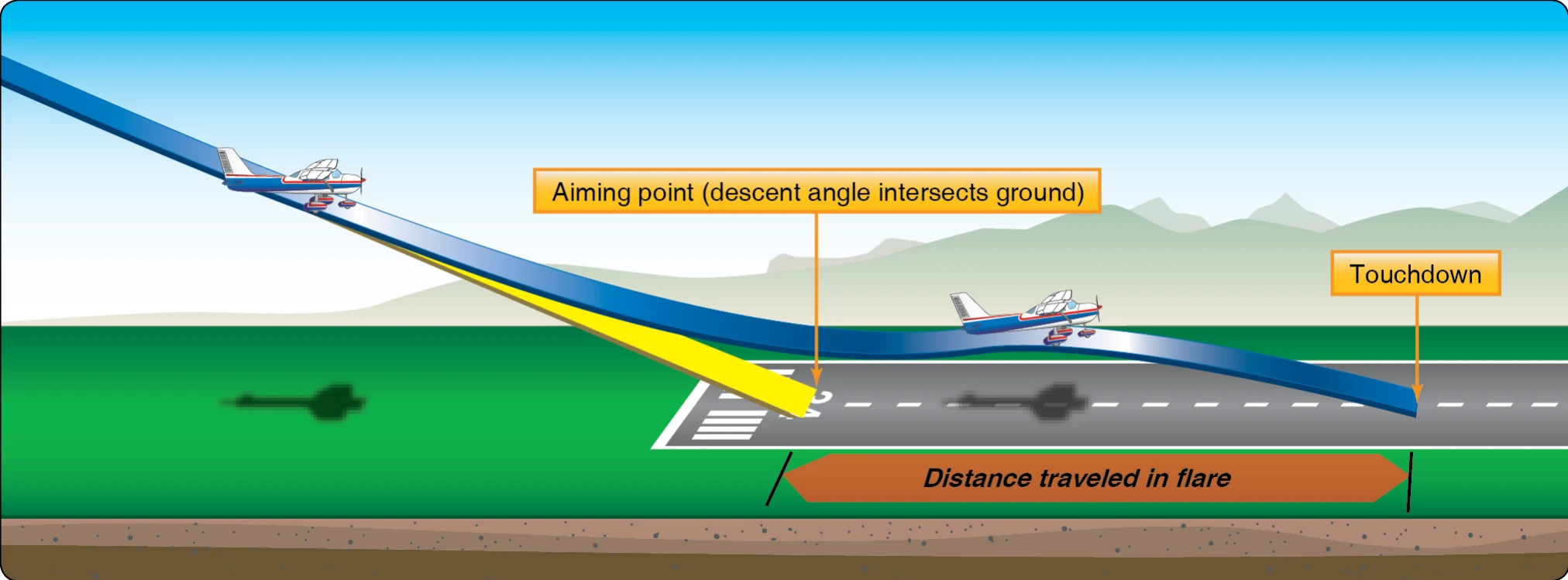
To the pilot, the aiming point appears to be stationary. It does not appear to move under the nose of the aircraft and does not appear to move forward away from the aircraft. This feature identifies the aiming point—it does not move. However, objects in front of and beyond the aiming point do appear to move as the distance is closed, and they appear to move in opposite directions! For a constant angle glide path, the distance between the horizon and the aiming point remains constant. If descending at a constant angle and the distance between the perceived aiming point and the horizon appears to increase (aiming point moving down away from the horizon), then the true aiming point is farther down the runway. If the distance between the perceived aiming point and the horizon decreases, meaning that the aiming point is moving up toward the horizon, the true aiming point is closer than perceived.
During instruction in landings, one of the important skills a pilot acquires is how to use visual cues to discern the true aiming point from any distance out on final approach. From this, the pilot determines if the current glide path will result in either an under or overshoot. Note that the aiming point is not where the airplane actually touches down. Since the pilot reduces the rate of descent during the round out (flare), the actual touchdown occurs farther down the runway. Considering float during round out, the pilot is also able to predict the point of touchdown with some accuracy.
When the airplane is established on final approach, the shape of the runway image also presents clues as to what should be done to maintain a stabilized approach to a safe landing.
Obviously, a runway is normally shaped in the form of an elongated rectangle. When viewed from the air during the approach, the phenomenon, known as perspective, causes the runway to assume the shape of a trapezoid with the far end looking narrower than the approach end and the edge lines converging ahead.
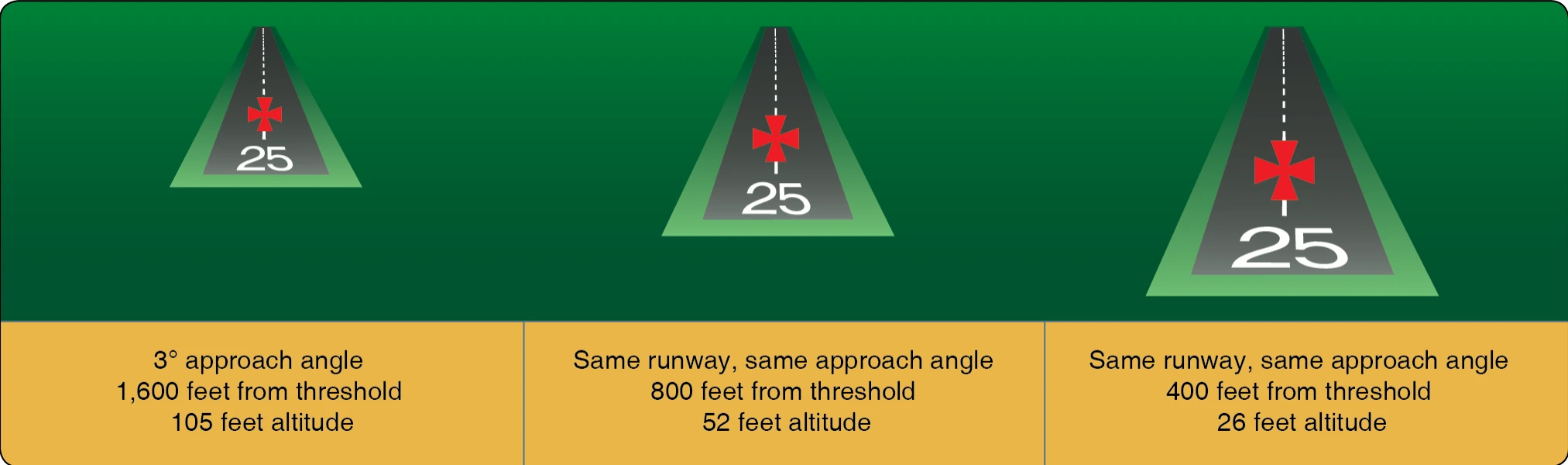
As an airplane continues down the glide path at a constant angle (stabilized), the image the pilot sees is still trapezoidal, but of proportionately larger dimensions. In other words, during a stabilized approach, the runway shape does not change. [Figure 9-6]