
Chapter 9
Approaches and Landings
The purpose of pneumatic tires, shock absorbing landing gear, and other devices is to cushion the impact and to increase the time in which the airplane’s vertical descent is stopped. The importance of this cushion may be understood from the computation that a 6-inch free fall on landing is roughly equal to a 340 fpm descent. Within a fraction of a second, the airplane gets slowed from this rate of vertical descent to zero without damage.
During this time, the landing gear, together with some aid from the lift of the wings, supplies whatever force is needed to counteract the force of the airplane’s inertia and weight. However, the lift decreases rapidly as the airplane’s forward speed is decreased, and the force on the landing gear increases by the impact of touchdown. When the descent stops, the lift is practically zero, leaving the landing gear alone to carry both the airplane’s weight and inertia force. The load imposed at the instant of touchdown may easily be three or four times the actual weight of the airplane depending on the severity of contact.
Touchdown in a Drift or Crab
At times, it is necessary to correct for wind drift by crabbing on the final approach. If the round out and touchdown are made while the airplane is drifting or in a crab, it contacts the ground while moving sideways. This imposes extreme side loads on the landing gear and, if severe enough, may cause structural failure.
The most effective method to prevent drift is the wing-low method. This technique keeps the longitudinal axis of the airplane aligned with both the runway and the direction of motion throughout the approach and touchdown. There are three factors that cause the longitudinal axis and the direction of motion to be misaligned during touchdown: drifting, crabbing, or a combination of both.
If the pilot does not take adequate corrective action to avoid drift during a crosswind landing, the main wheels’ tire tread offers resistance to the airplane’s sideward movement with respect to the ground. Consequently, any sideward velocity of the airplane is abruptly decelerated, as shown in Figure 9-37. This creates a moment around the main wheel when it contacts the ground, tending to overturn or tip the airplane. If the upwind wingtip is raised by the action of this moment, all the weight and shock of landing is borne by one main wheel. This concentration of forces may cause tire failure or structural damage.
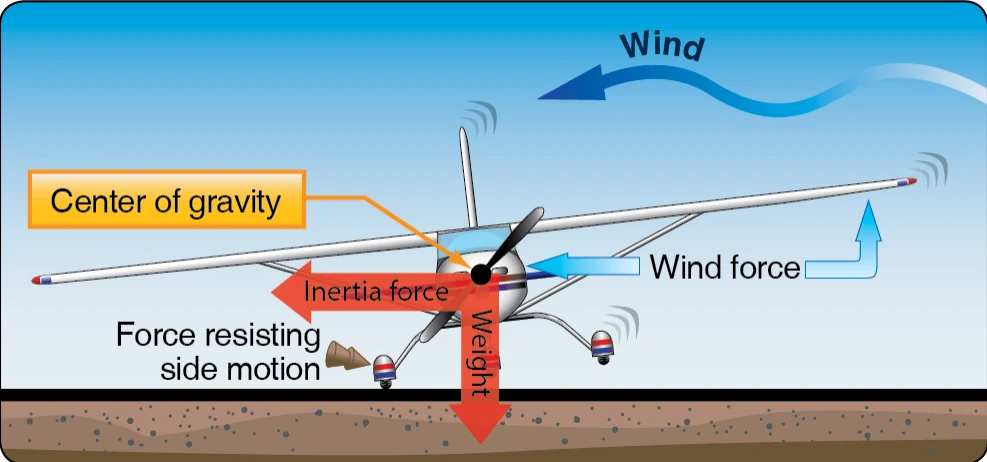
Not only are the same factors present that are attempting to raise a wing, but the crosswind is also acting on the fuselage surface behind the main wheels, tending to yaw (weathervane) the airplane into the wind. This often results in a ground loop.
Ground Loop
A ground loop is an uncontrolled turn during ground operation that may occur while taxiing or taking off. However, an airplane is especially vulnerable to this occurrence during the after-landing roll. A ground loop may result if the pilot fails to control an initial swerve. Drift or weathervaning may cause the initial swerve. Careless use of the rudder, an uneven ground surface, or a soft spot that retards one main wheel of the airplane may also cause a swerve. In any case, the initial swerve tends to make the airplane ground loop, whether it is a tailwheel-type or nose-wheel type. [Figure 9-38]
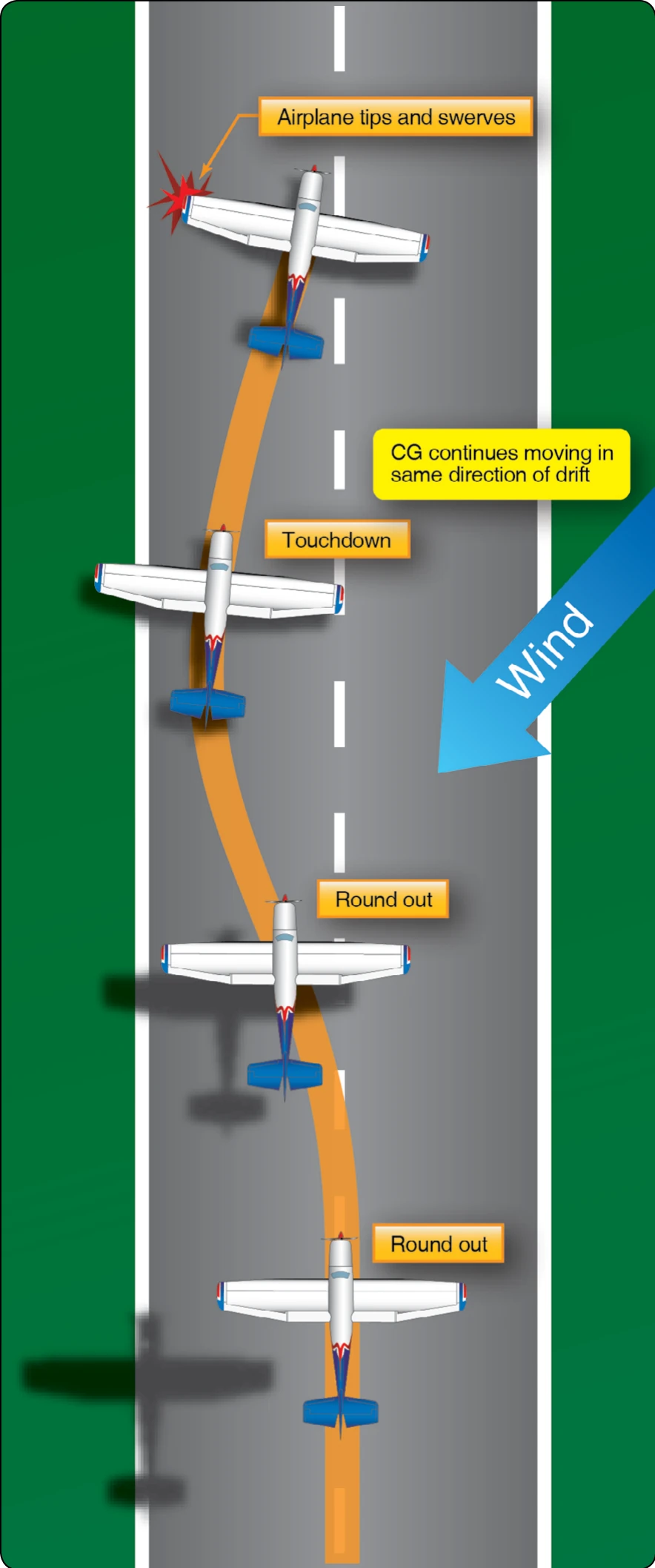
Nose-wheel type airplanes are somewhat less prone to ground loop than tailwheel-type airplanes. Since the center of gravity (CG) is located forward of the main landing gear on these airplanes, any time a swerve develops, centrifugal force acting on the CG tends to stop the swerving action.
If the airplane touches down while drifting or in a crab, apply aileron toward the high wing and stop the swerve with the rudder. Brakes are used to correct for turns or swerves only when the rudder is inadequate. Exercise caution when applying corrective brake action because it is very easy to over control and aggravate the situation.
If brakes are used, sufficient brake is applied on the low-wing wheel (outside of the turn) to stop the swerve. When the wings are approximately level, the new direction should be maintained until the airplane has slowed to taxi speed or has stopped.
In nose-wheel airplanes, a ground loop is almost always a result of wheelbarrowing. A pilot should be aware that even though the nose-wheel type airplane is less prone than the tailwheel-type airplane, virtually every type of airplane, including large multiengine airplanes, can be made to ground loop when sufficiently mishandled.
Wing Rising After Touchdown
When landing in a crosswind, there may be instances when a wing rises during the after-landing roll. This may occur whether or not there is a loss of directional control, depending on the amount of crosswind and the degree of corrective action.
Any time an airplane is rolling on the ground in a crosswind condition, the upwind wing is receiving a greater force from the wind than the downwind wing. This causes a lift differential. Also, as the upwind wing rises, there is an increase in the AOA, which increases lift on the upwind wing, rolling the airplane downwind.
When the effects of these two factors are great enough, the upwind wing may rise even though directional control is maintained. If no correction is applied, it is possible that the upwind wing rises sufficiently to cause the downwind wing to strike the ground.
In the event a wing starts to rise during the landing roll, the pilot should immediately apply more aileron pressure toward the high wing and continue to maintain direction. The sooner the aileron control is applied, the more effective it is. The further a wing is allowed to rise before taking corrective action, the more airplane surface is exposed to the force of the crosswind. This diminishes the effectiveness of the aileron.