
Chapter 9
Approaches and Landings
When the airplane contacts the ground with a sharp impact as the result of an improper attitude or an excessive rate of sink, it tends to bounce back into the air. Though the airplane’s tires and shock struts provide some springing action, the airplane does not bounce like a rubber ball. Instead, it rebounds into the air because the wing’s AOA was abruptly increased, producing a sudden addition of lift. [Figure 9-35]
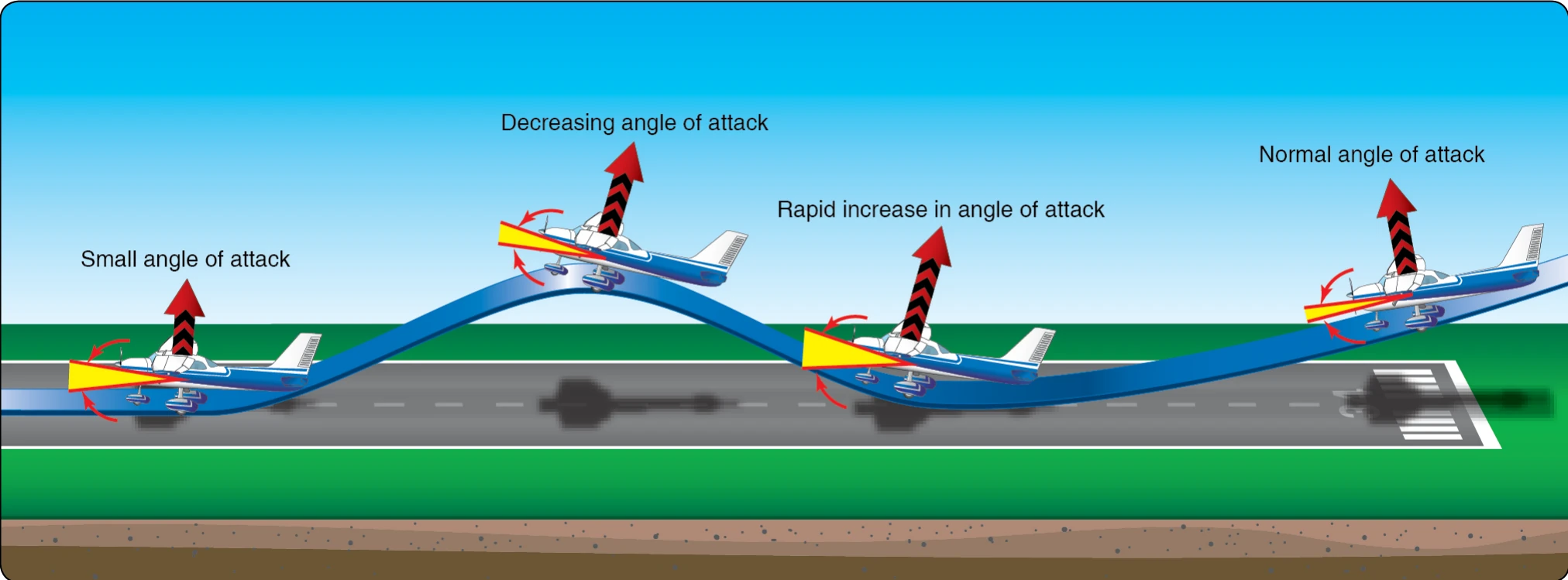
The abrupt change in AOA is the result of inertia instantly forcing the airplane’s tail downward when the main wheels contact the ground sharply. The severity of the bounce depends on the airspeed at the moment of contact and the degree to which the AOA or pitch attitude was increased.
Since a bounce occurs when the airplane makes contact with the ground before the proper touchdown attitude is attained, it is almost invariably accompanied by the application of excessive back-elevator pressure. This is usually the result of the pilot realizing too late that the airplane is not in the proper attitude and attempting to establish it just as the second touchdown occurs.
The corrective action for a bounce is the same as for ballooning and similarly depends on its severity. When it is very slight and there is no extreme change in the airplane’s pitch attitude, a follow-up landing may be executed by applying sufficient power to cushion the subsequent touchdown and smoothly adjusting the pitch to the proper touchdown attitude.
In the event a very slight bounce is encountered while landing with a crosswind, crosswind correction needs to be maintained while the next touchdown is made. Since the subsequent touchdown is made at a slower airspeed, the upwind wing has to be lowered even further to compensate for drift.
Extreme caution and alertness should be exercised any time a bounce occurs, but particularly when there is a crosswind. Pilots should not release the crosswind correction. When one main wheel of the airplane strikes the runway, the other wheel touches down immediately afterwards, and the wings become level. Then, with no crosswind correction as the airplane bounces, the wind causes the airplane to roll with the wind, thus exposing even more surface to the crosswind and increasing any drift.
When a bounce is severe, the safest procedure is to execute a go-around immediately. The pilot should not attempt to salvage the landing. Apply full power while simultaneously maintaining directional control and lowering the nose to a safe climb attitude. The go-around procedure should be continued even though the airplane may descend and another bounce may be encountered. Landing from a bad bounce should not be attempted, since airspeed diminishes very rapidly in the nose-high attitude, and a stall may occur before a subsequent touchdown can be made.
Porpoising
In a bounced landing that is improperly recovered, the airplane comes in nose first, initiating a series of motions imitating the jumps and dives of a porpoise. [Figure 9-36] The improper airplane attitude at touchdown may be caused by inattention, not knowing where the ground is, miss-trimming, or forcing the airplane onto the runway.
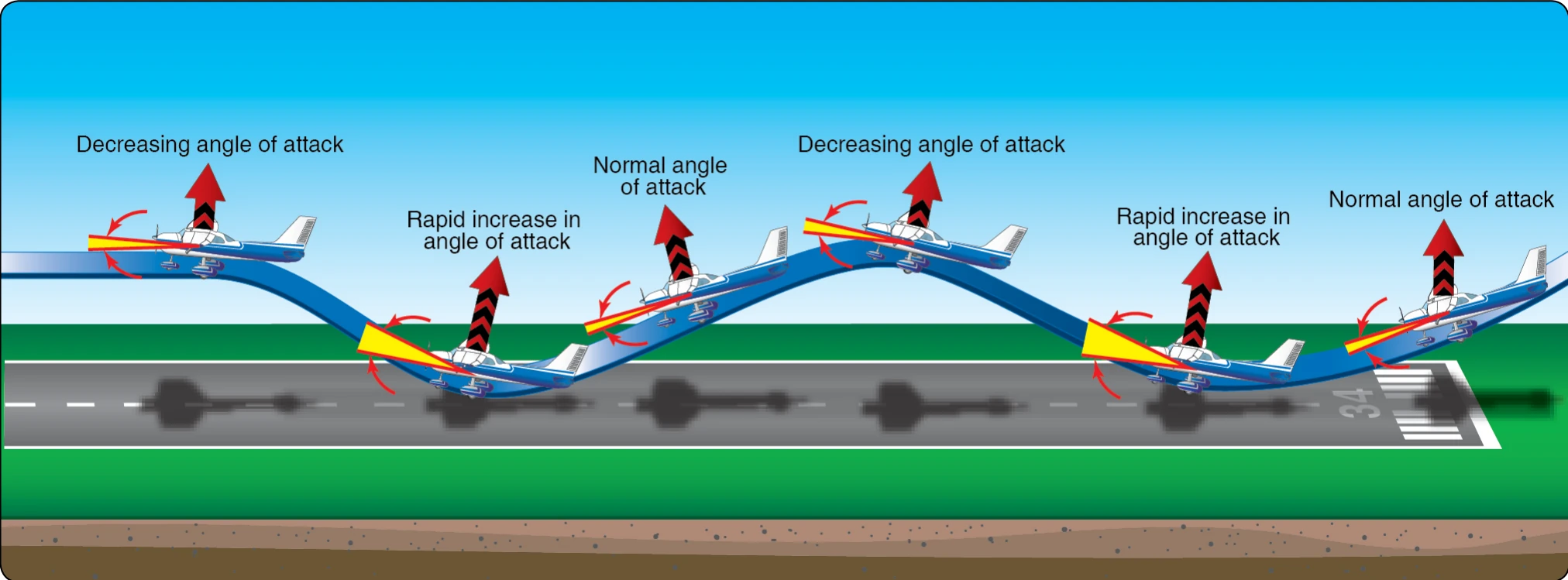
Ground effect decreases elevator control effectiveness and increases the effort required to raise the nose. Not enough elevator or stabilator trim can result in a nose low contact with the runway and a porpoise develops.
Porpoising can also be caused by improper airspeed control. Usually, if an approach is too fast, the airplane floats and the pilot tries to force it on the runway when the airplane still wants to fly. A gust of wind, a bump in the runway, or even a slight tug on the control wheel sends the airplane aloft again.
The corrective action for a porpoise is the same as for a bounce and similarly depends on its severity. When it is very slight and there is no extreme change in the airplane’s pitch attitude, a follow-up landing may be executed by applying sufficient power to cushion the subsequent touchdown and smoothly adjusting the pitch to the proper touchdown attitude.
When pilots attempt to correct a severe porpoise with flight control and power inputs, the inputs are often untimely may increase the severity of each successive contact with the surface. These unintentional and increasing pilot-induced oscillations may lead to damage or collapse of the nose gear. When porpoising is severe or seems to be getting worse, the safest procedure is to execute a go-around immediately by applying full power while simultaneously maintaining directional control and lowering the nose to a safe climb attitude.
Wheelbarrowing
When a pilot permits the airplane weight to become concentrated about the nose-wheel during the takeoff or landing roll, a condition known as wheelbarrowing occurs. Wheelbarrowing may cause loss of directional control during the landing roll because braking action is ineffective, and the airplane tends to swerve or pivot on the nose-wheel, particularly in crosswind conditions. One of the most common causes of wheelbarrowing during the landing roll is a simultaneous touchdown of the main and nose-wheel with excessive speed, followed by application of forward pressure on the elevator control. Usually, the situation can be corrected by smoothly applying back-elevator pressure.
Wheelbarrowing does not occur if the pilot achieves and maintains the correct landing attitude, touches down at the proper speed, and gently lowers the nose-wheel while losing speed on rollout. However, if wheelbarrowing is encountered and runway and other conditions permit, it is advisable to promptly initiate a go-around. If the pilot decides it's safer to stay on the ground rather than attempt a go-around when directional control is lost, close the throttle and adjust the pitch attitude smoothly but firmly to the proper landing attitude.
Hard Landing
When the airplane contacts the ground during landings, its vertical speed is instantly reduced to zero. Unless provisions are made to slow this vertical speed and cushion the impact of touchdown, the force of contact with the ground could cause structural damage to the airplane.