
Chapter 9
Approaches and Landings
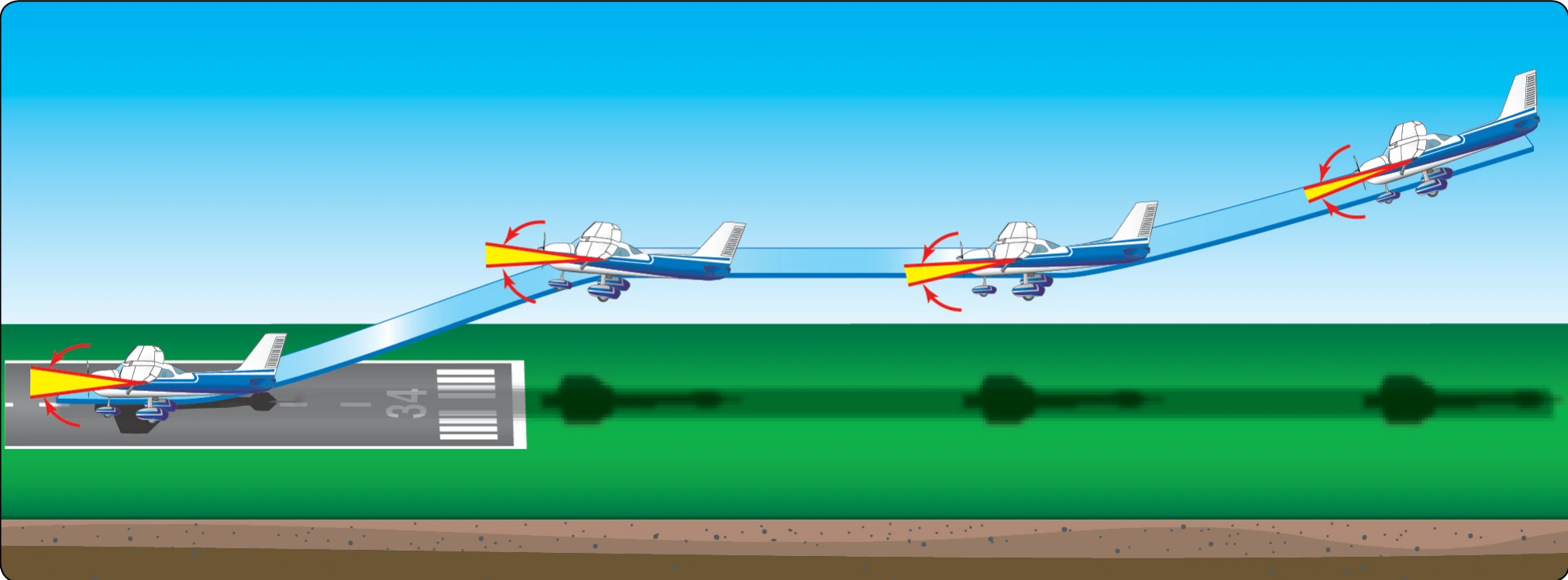
Although back-elevator pressure may be relaxed slightly, the nose should not be lowered to make the airplane descend when fairly close to the runway unless some power is added momentarily. The momentary decrease in lift that results from lowering the nose and decreasing the AOA might cause the airplane to contact the ground with the nose-wheel first and may result in nose gear damage or collapse.
It is recommended that a go-around be executed any time it appears the nose needs to be lowered significantly or that the landing is in any other way uncertain.
Late or Rapid Round Out
Starting the round out too late or pulling the elevator control back too rapidly to prevent the airplane from touching down prematurely can impose a significant load on the wings and cause an accelerated stall.
Suddenly increasing the AOA and stalling the airplane during a round out is a dangerous situation since it may cause the airplane to land extremely hard on the main landing gear and then bounce back into the air. As the airplane contacts the ground, the tail is forced down very rapidly by the back-elevator pressure and by inertia acting downward on the tail.
Recovery from this situation requires prompt and positive application of power prior to occurrence of the stall. This may be followed by a normal landing if sufficient runway is available—otherwise the pilot should execute a go-around immediately.
If the round out is late and uncorrected, the nose-wheel may strike the runway first, causing the nose to bounce upward. Do not attempt to force the airplane back onto the ground; execute a go-around immediately.
Floating During Round Out
If the airspeed on final approach is excessive, it usually results in the airplane floating. [Figure 9-33] Before touchdown can be made, the airplane may be well past the desired landing point and the available runway may be insufficient. When diving the airplane on final approach to land at the proper point, there is an appreciable increase in airspeed. The proper touchdown attitude cannot be established without producing an excessive AOA and lift. This causes the airplane to gain altitude or balloon.
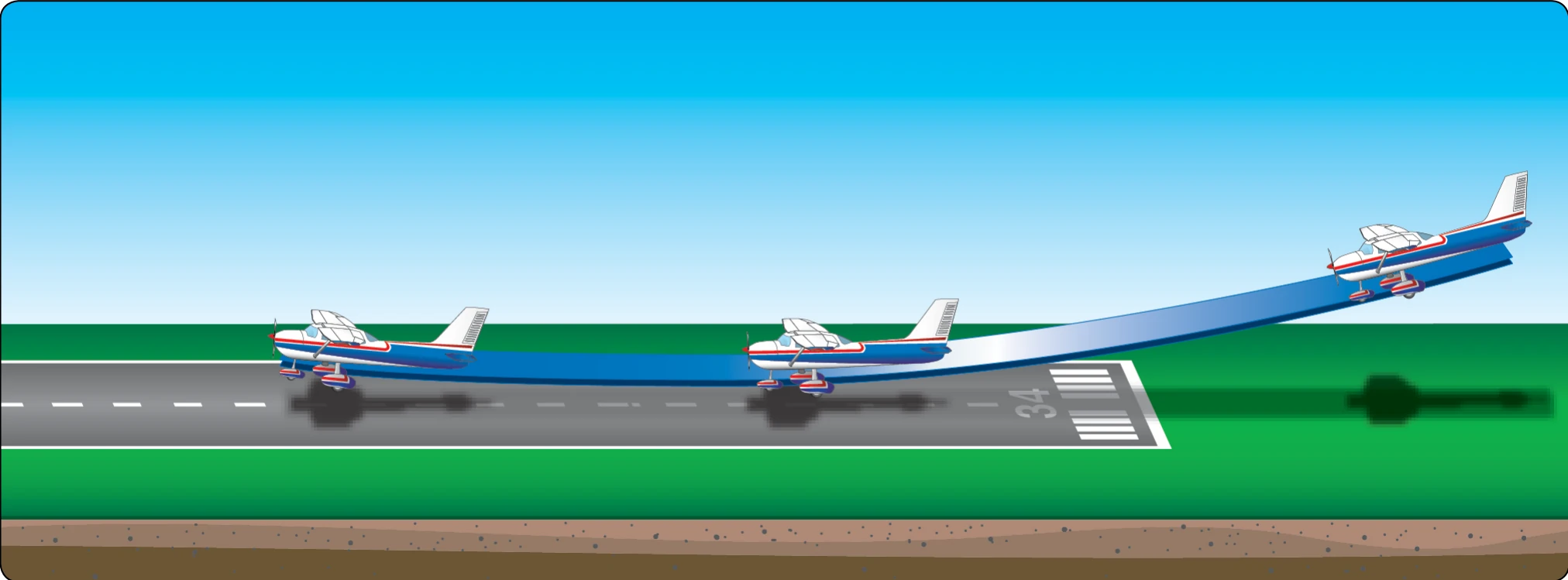
Any time the airplane floats, judgment of speed, height, and rate of sink needs to be especially acute. The pilot should smoothly and gradually adjust the pitch attitude as the airplane decelerates to touchdown speed and starts to settle, so the proper landing attitude is attained at the moment of touchdown. The slightest error in judgment and timing results in either ballooning or bouncing.
The recovery from floating is dependent upon the amount of floating and the effect of any crosswind, as well as the amount of runway remaining. Since prolonged floating utilizes considerable runway length, it should be avoided especially on short runways or in strong crosswinds. If a landing cannot be made on the first third of the runway, or the airplane drifts sideways, execute a go-around.
Ballooning During Round Out
If the pilot misjudges the rate of sink during a landing and thinks the airplane is descending faster than it should, there is a tendency to increase the pitch attitude and AOA too rapidly. This not only stops the descent, but actually starts the airplane climbing. This climbing during the round out is known as ballooning. [Figure 9-34] Ballooning is dangerous because the height above the ground is increasing and the airplane is rapidly approaching a stalled condition. The altitude gained in each instance depends on the airspeed or the speed with which the pitch attitude is increased.
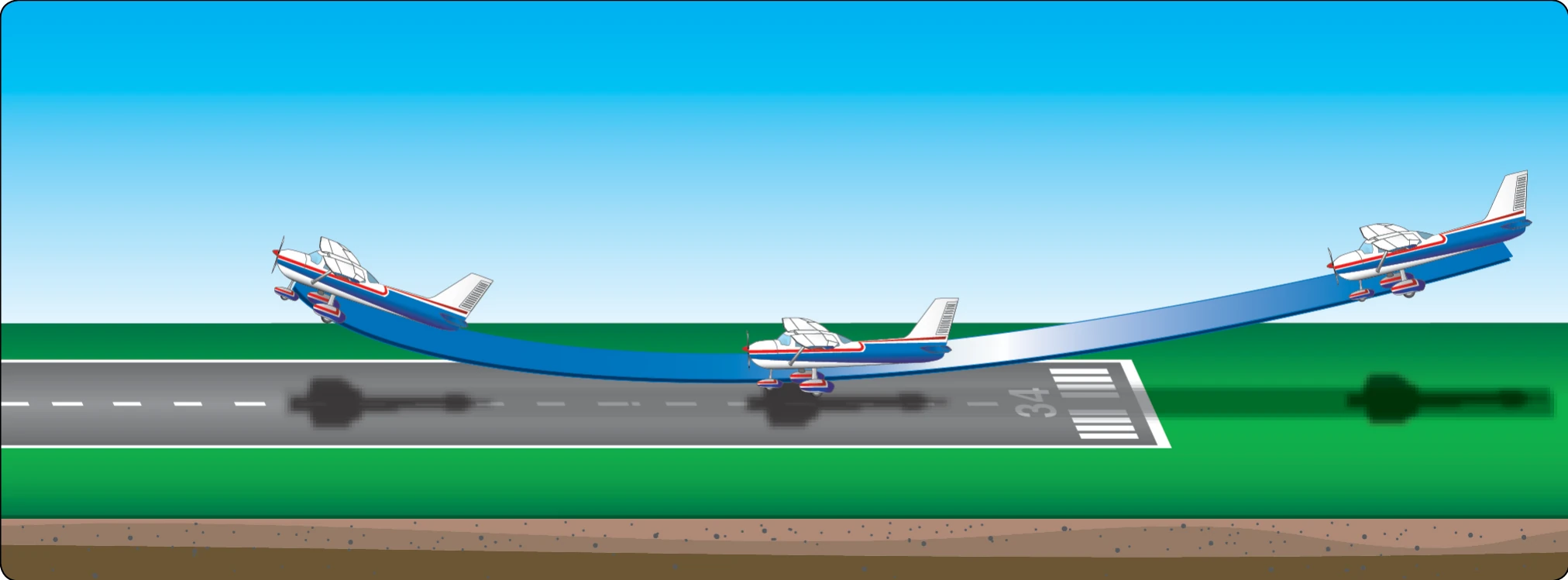
Depending on the severity of ballooning, the use of throttle is helpful in cushioning the landing. By adding power, thrust is increased to keep the airspeed from decelerating too rapidly and the wings from suddenly losing lift, but throttle should be closed immediately after touchdown. Torque effects vary as power is changed, and it is necessary to use rudder pressure to keep the airplane straight as it settles onto the runway.
The pilot needs to be extremely cautious of ballooning when there is a crosswind present because the crosswind correction may be inadvertently released or it may become inadequate. Because of the lower airspeed after ballooning, the crosswind affects the airplane more. Consequently, the wing has to be lowered even further to compensate for the increased drift. It is imperative that the pilot makes certain that the appropriate wing is down and that directional control is maintained with opposite rudder. If there is any doubt, or the airplane starts to drift, the pilot should execute a go-around.
When ballooning is excessive, it is best to execute a go-around immediately and not attempt to salvage the landing. Power should be applied before the airplane enters a stalled condition.